


Unitree A2 vs B2: Industrial Inspection, Payload and Mobility Comparison
Compare two industrial quadruped platforms across payload, endurance, weather protection, stairs, slopes, LiDAR, computing, interfaces and deployment cost—then select the right robot for utilities, inspection, logistics or emergency-response programs.
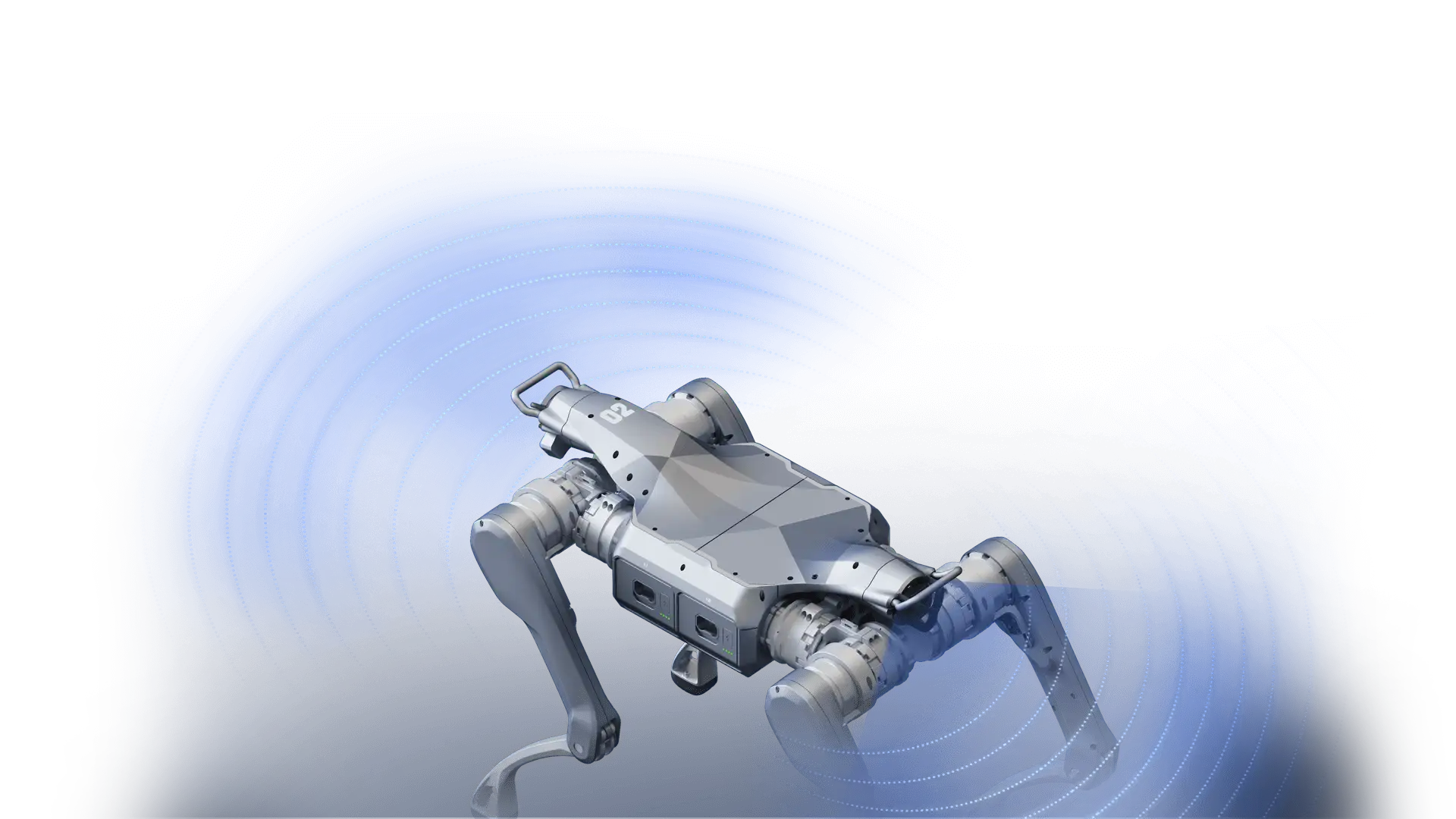 A2 · 42 KG
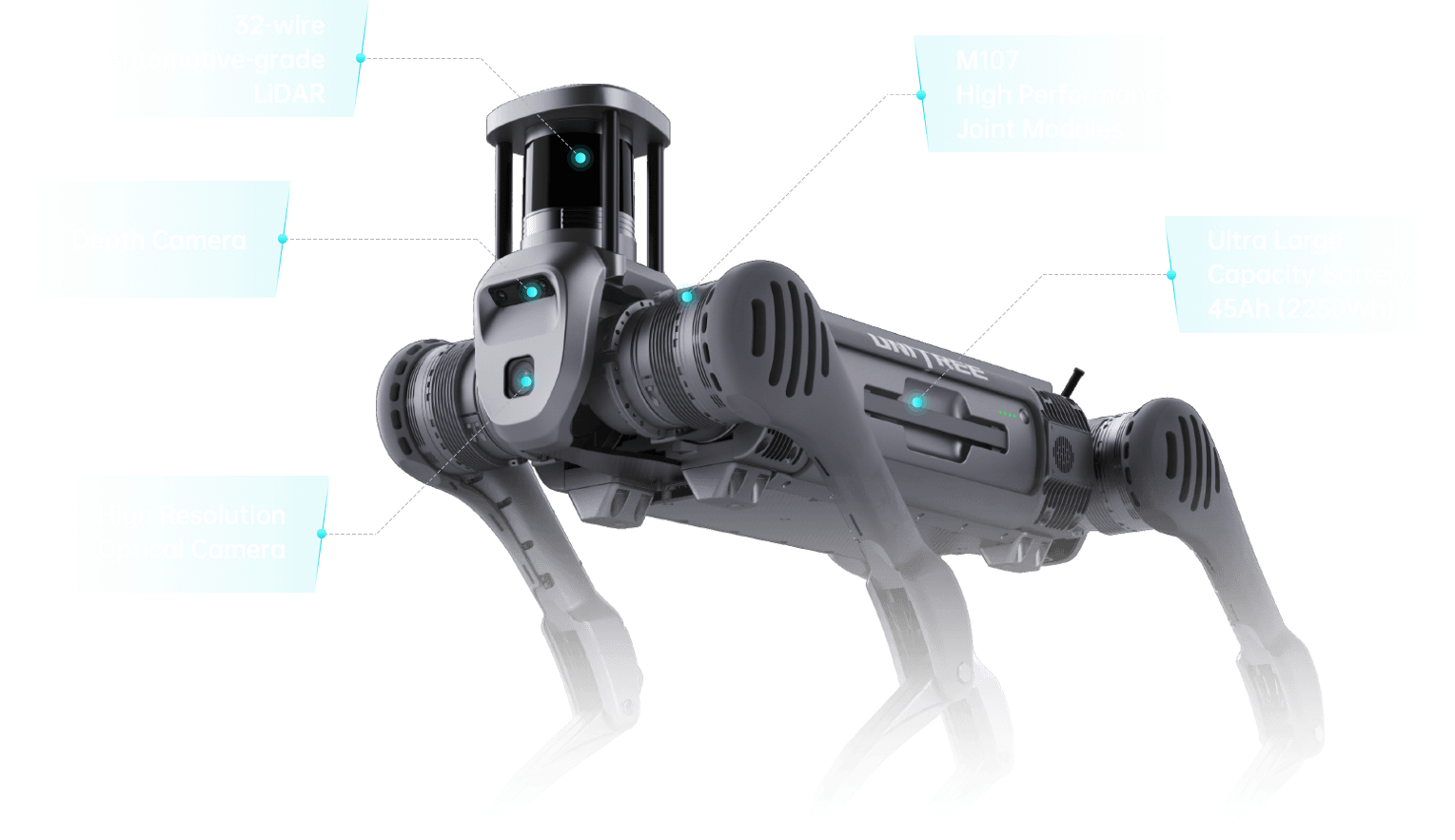 B2 · 60 KG
Choose A2 when portability, dual hot-swappable batteries, approximately 25 kg continuous payload and easier site integration matter most. Choose B2 when the mission requires more than 40 kg continuous payload, IP67 protection, 40 cm obstacles, larger interfaces or severe terrain.
A2 is the efficient field platform; B2 is the heavy-duty mission carrier
A2 and B2 share an industrial quadruped form, secondary-development support and operation across difficult terrain. The strategic difference is not merely “B2 has larger numbers.” A2 is designed to deliver industrial capability with lower mass and simpler logistics, while B2 creates more payload, protection, interface and obstacle margin for high-consequence missions.
Lower deployment mass
A2 is approximately 18 kg lighter than B2, which can simplify transport, carts, vehicles, elevators, operator handling and recovery planning.
Hot-swappable continuity
A2 uses two parallel battery slots so one battery can be replaced while the platform remains powered, supporting long inspection programs.
Continuous walking payload
B2 provides substantially more operating payload for large thermal, gas, communications, robotic-arm or emergency-response systems.
Higher published protection
B2’s IP67 rating provides stronger published ingress-protection margin than standard A2’s IP56 rating.
A larger platform is not automatically the better investment. B2 increases payload and environmental margin, but it also increases capital cost, transport burden, fall consequence, operator training, site controls and integration effort. Select B2 only when the mission consumes its extra capability.
Unitree A2, A2 Pro and B2 comparison table
A2 and A2 Pro share the same published mechanical platform but differ in sensing, communications and protection. B2 is a larger architecture with a single high-capacity battery, more interfaces and heavier payload capability.
On smaller screens, swipe the table left to compare A2, A2 Pro and B2.
| Specification | Unitree A2 | Unitree A2 Pro | Unitree B2 |
|---|---|---|---|
| Primary position | Medium industrial platform | Enhanced inspection and communications platform | Heavy-duty industrial platform |
| Standing dimensions | 820 × 440 × 570 mm | 820 × 440 × 570 mm | Approx. 1098 × 450 × 645 mm |
| Weight with battery | About 42 kg | About 42 kg | About 60 kg |
| Degrees of freedom | 12 | 12 | 12 |
| Maximum joint torque | About 180 N·m | About 180 N·m | About 360 N·m |
| Published speed | 0–3.7 m/s; up to about 5 m/s | 0–3.7 m/s; up to about 5 m/s | More than 6 m/s in special configuration* |
| Continuous walking load | About 25 kg; ideally around 35 kg | About 25 kg; ideally around 35 kg | More than 40 kg |
| Maximum standing load | About 100 kg | About 100 kg | At least 120 kg |
| Unloaded endurance | More than 5 hours / about 20 km | More than 5 hours / about 20 km | More than 5 hours / more than 20 km |
| Loaded endurance example | More than 3 hours / about 12.5 km with 25 kg | More than 3 hours / about 12.5 km with 25 kg | More than 4 hours / more than 15 km with 20 kg |
| Battery architecture | Dual slots, dual 9000mAh batteries | Dual slots, dual 9000mAh batteries | 45Ah / 2250Wh plug-in battery |
| Hot-swap continuity | Dual-battery hot-swap design | Dual-battery hot-swap design | Quick change; autonomous charging optional |
| Operating temperature | -20°C to 55°C | -20°C to 55°C | -20°C to 55°C |
| Ingress protection | IP56 | IP56–IP67; core components IP67 | IP67 |
| Slope capability | About 45° | About 45° | More than 45° |
| Published step or stair height | Maximum step height about 30 cm | Maximum step height about 30 cm | Continuous 20–25 cm stairs; forward stairs up to 40 cm |
| Additional climb figure | About 0.5–1 m | About 0.5–1 m | Obstacle crossing up to 40 cm; jump distance above 1.6 m |
| Standard sensing | One LiDAR + one HD camera | Two LiDARs + one HD camera | One 3D LiDAR + two depth cameras + two optical cameras, configuration-dependent |
| Platform and user compute | 8-core platform CPU + Intel Core i7 user-development computer | 8-core platform CPU + Intel Core i7 user-development computer | Intel Core i5 platform + Intel Core i7 user development |
| Optional compute | High-computing expansion dock | High-computing expansion dock | Multiple Intel Core i7 or Orin NX devices, up to three |
| Communications | GPS and 4G optional | GPS, 4G and tracking expanded | Configuration-dependent enterprise communications |
| External data interfaces | 2× RS485, 2× CAN, 2× Gigabit Ethernet, 4× USB-C | 2× RS485, 2× CAN, 2× Gigabit Ethernet, 4× USB-C | 4× Gigabit Ethernet + 4× USB 3.0 |
| Payload power outputs | 12V / 24V / battery voltage | 12V / 24V / battery voltage | 4× 12V, 1× 5V, 4× 24V, 1× battery output |
| Secondary development | Supported | Supported | Supported; functions vary by configuration |
| Wheeled form | A2-W separate platform / wheel option ecosystem | A2-W separate platform / wheel option ecosystem | B2 wheeled feet optional; B2-W also available |
| Best deployment fit | Logistics, research and medium-duty inspection | Professional inspection and patrol | Heavy inspection, severe terrain, rescue and large payloads |
| Published warranty | 12 months | 12 months | Confirm final quotation and applicable terms |
*Unitree states that B2’s more-than-6 m/s result is achieved in special configurations and that practical operation has a speed limit for safety. All figures vary with configuration, payload, centre of gravity, terrain, temperature, battery condition, firmware and operating method.
Industrial inspection requires a complete system architecture
A2 or B2 does not become an inspection program simply because it carries a camera. A deployable system connects mobility, navigation, mission payloads, edge computing, communications, command software, reporting and human oversight.
Mobility
A2 or B2 carries the system through stairs, slopes, rubble, corridors or outdoor routes.
Perception
LiDAR, depth and optical cameras localize the robot and detect the route.
Payload
Thermal, gas, acoustic, zoom, radiation or manipulation tools collect mission data.
Edge compute
Onboard computers run autonomy, inference, compression and sensor fusion.
Network
Wi-Fi, private cellular, radio or mesh systems connect the robot to operators.
Command
Operators supervise routes, live video, alarms, state and remote intervention.
Enterprise data
Reports, trends, work orders and asset history convert observations into decisions.
Unitree’s published inspection architecture follows the same logic: visible-light and thermal cameras, acoustic sensors, LiDAR, AI vision, cloud-connected management, automated reporting, trend comparison and optional robotic arms or suppression equipment are integrated around the quadruped platform.
A2 vs B2 payload: operating load matters more than standing load
A2 lists approximately 25 kg of continuous walking load, with an ideal-condition figure near 35 kg. B2 lists more than 40 kg of continuous walking load. Those values are more useful than standing-load figures when sizing a real inspection system.
- A2 supports about 100 kg standing load
- B2 supports at least 120 kg standing load
- A2 continuous walking load is about 25 kg
- B2 continuous walking load is above 40 kg
- B2 provides more data and power interfaces for complex payload stacks
- A2’s lower base weight may improve overall transport efficiency
A 20 kg payload is not one universal engineering condition. A compact centred enclosure behaves differently from a tall thermal mast, offset robotic arm, long antenna, moving hose or water cannon.
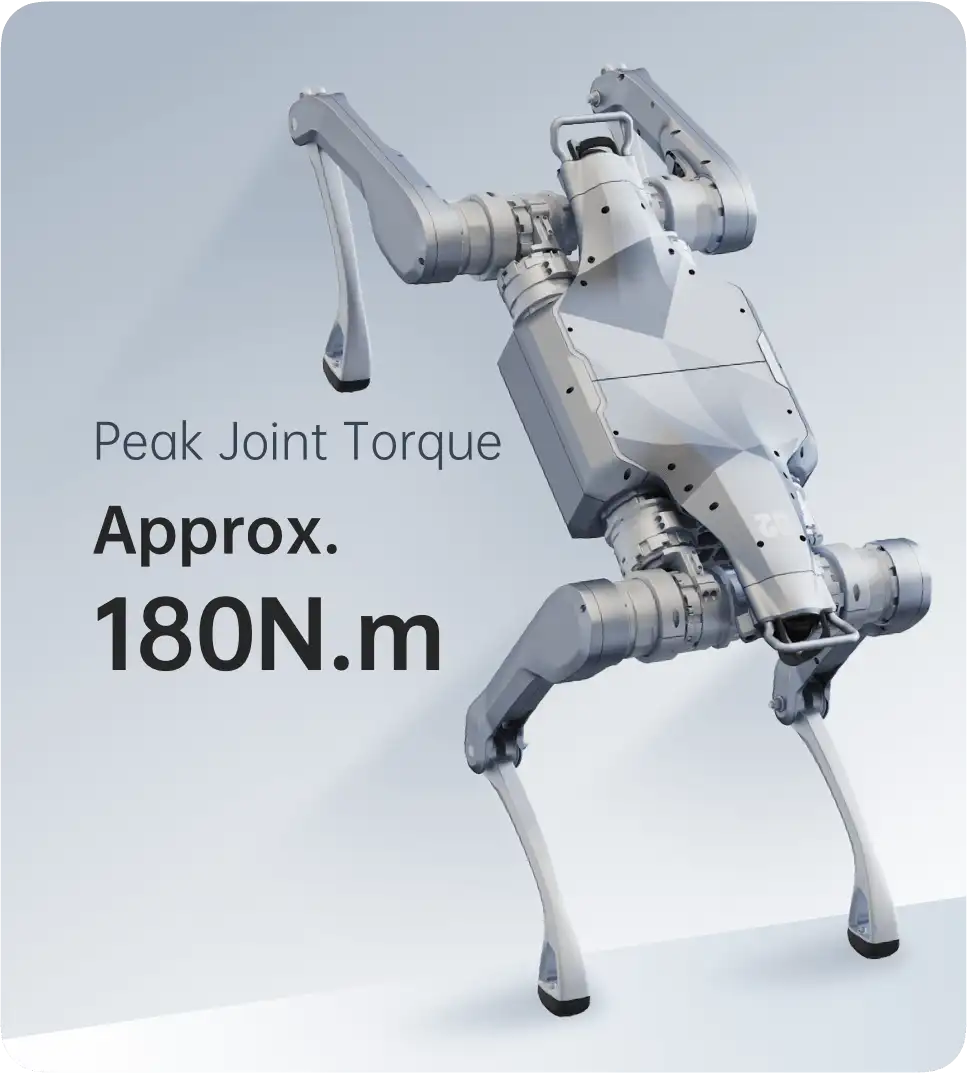
Use continuous-load figures
Size the platform against the complete installed system, including mounts, enclosures, cables, antennas, computers and environmental protection.
Keep payload low and centred
Elevated or offset payloads can reduce stability on stairs, side slopes, sudden stops and rapid turns even when total weight is below the rating.
Account for movement
Robotic arms, liquid, hoses and suspended tools create changing forces that require more margin than a rigid sensor enclosure.
Budget power and heat
Payload power draw reduces mission endurance and may require fusing, conversion, thermal management and startup-surge testing.
Match the payload bus
Confirm Ethernet, USB, CAN, RS485, synchronization, bandwidth, timestamps and software drivers before selecting the robot.
Protect every component
The base robot’s IP rating does not automatically protect a custom sensor, cable gland, connector, computer or mounting plate.
Decision rule: when the complete payload approaches A2’s continuous walking limit, or when it creates a high centre of gravity, B2 may be the safer engineering choice even if A2 can support the payload while stationary.
A2 is faster to deploy; B2 carries more terrain margin
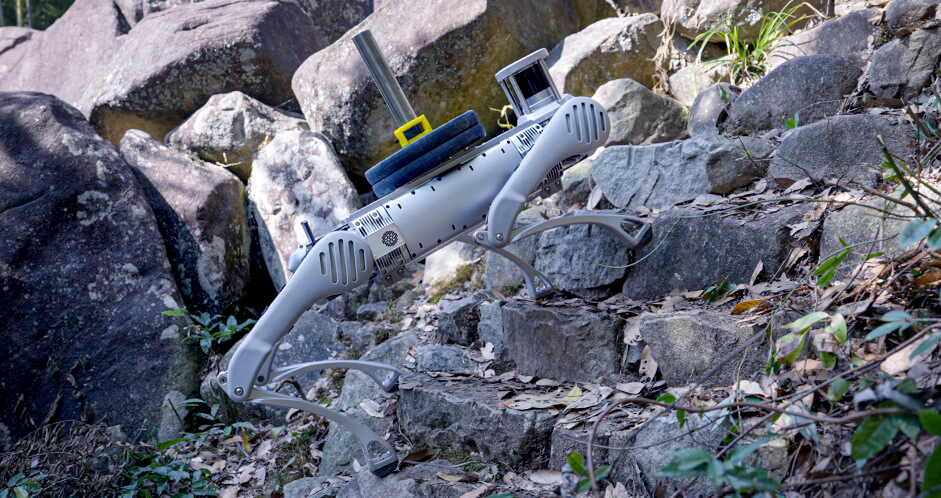
A2 lists a 30 cm maximum step height and approximately 45° slope capability. B2 lists continuous 20–25 cm stair climbing, forward stair capability up to 40 cm and a climbing angle above 45°.
- A2 published speed: 0–3.7 m/s, maximum near 5 m/s
- B2 special-configuration speed: above 6 m/s, practically limited
- A2 maximum step height: about 30 cm
- B2 obstacle and forward stair figure: up to 40 cm
- A2 and B2 both publish operation from -20°C to 55°C
- Both families offer wheeled mobility pathways
The most important route metric is rarely maximum speed. Inspection programs usually care more about safe stair repeatability, turning space, slippery surfaces, clearance, blind corners, network continuity and reliable return to charge.
Routes are mixed but manageable
A2 is well suited to industrial floors, utility corridors, standard stairs, outdoor patrol routes and facilities where a 42 kg robot is easier to handle.
Terrain is a mission constraint
B2 provides more obstacle, torque and load margin for rubble, large stairs, rock piles, steep approaches and emergency-response equipment.
Distance dominates obstacle height
A2-W or B2-W can improve rolling efficiency on long roads, campuses and industrial parks, but wheel-leg geometry changes traction and obstacle strategy.
Dual hot-swap A2 batteries vs B2’s 2250Wh pack
Mission continuity through two battery slots
- Two 9000mAh / 453.6Wh batteries
- 907.2Wh total published energy
- Parallel dual-battery architecture
- Hot-swap design supports uninterrupted power
- More than five hours unloaded
- More than three hours with 25 kg load
Higher energy and autonomous-charging pathway
- 45Ah / 2250Wh published battery
- Quick-change plug-in architecture
- Optional autonomous charging solution
- Four-to-six-hour general endurance range
- More than five hours unloaded
- More than four hours with 20 kg load
A2 may be better for staffed operations: crews can rotate batteries while preserving robot power. B2 may be better for autonomous patrol concepts: Unitree publishes an optional autonomous-charging pathway, but the complete docking, navigation and recovery workflow must be engineered and validated.
Measure loaded runtime
Test the actual route with the actual payload, network, speed, temperature and stopping frequency.
Keep recovery margin
Do not plan missions to consume the published maximum. Maintain energy for rerouting, communications failure and return to base.
Log every pack
Track cycles, condition, temperature, incidents, storage state and replacement dates through an institutional battery-management process.
IP56 A2 vs IP67 B2: what the rating changes—and what it does not
Standard A2 lists IP56. A2 Pro lists IP56–IP67 with core components rated IP67. B2 lists IP67 for the platform. That difference matters for water and dust exposure, but the integrated mission system must still be evaluated as a complete assembly.
General industrial outdoor use
IP56 can support many outdoor and dusty workflows, but the site should define rain intensity, washdown, spray direction, duration and connector exposure.
Protected core with enhanced sensing
A2 Pro’s core-component IP67 description strengthens its inspection positioning, but the complete assembled system is not automatically one uniform IP67 enclosure.
Higher published exposure margin
B2’s IP67 rating is the stronger default for high-consequence outdoor, wet, dusty or emergency-response missions.
The weakest component controls
Thermal cameras, microphones, gas sensors, computers, antennas and mounting interfaces need their own environmental specifications.
Published range is not mission proof
Both platforms list -20°C to 55°C, but battery, traction, snow, ice, wind, condensation and payload behaviour must be tested locally.
Do not infer explosion certification
An IP rating does not prove intrinsic safety or hazardous-location certification. Verify the exact integrated system and site requirements.
Important: equipment ownership, IP protection or a manufacturer demonstration does not authorize operation in every industrial or hazardous environment. The site owner and qualified safety professionals must approve the complete deployment.
A2 Pro improves patrol sensing; B2 provides more integration headroom
Standard A2 lists one LiDAR and one HD camera. A2 Pro lists two LiDARs—front and rear—plus an HD camera, expanded GPS, 4G and tracking capabilities. B2 lists one 3D LiDAR, two depth cameras and two optical cameras, depending on configuration.
- A2 and A2 Pro include separate platform and user-development computing
- B2 includes Intel platform and user-development computers
- B2 can accept up to three optional Intel Core i7 or Orin NX devices
- A2 provides CAN, RS485, Ethernet, USB-C and power outputs
- B2 doubles key Ethernet and USB counts
- Both platforms support secondary development
More onboard compute does not automatically create autonomy. The deployment still needs mapping, route logic, localization, alarm thresholds, failure handling, remote intervention and a validated return or safe-stop policy.
Network test before purchase: a robot can have excellent mobility and still fail the business case if the inspection route contains cellular dead zones, congested Wi-Fi, reflective tunnels, high latency or security restrictions that prevent reliable video, control or data upload.
A2 vs A2 Pro—and when wheeled models change the answer
Best base industrial platform
Choose A2 for payload development, logistics, controlled industrial routes and projects that will add their own perception or communications stack.
Best ready inspection foundation
Choose A2 Pro when dual LiDAR, expanded GPS/4G/tracking and protected core components align with the patrol workflow.
Best heavy mission foundation
Choose B2 for large payloads, severe exposure, difficult terrain, more external interfaces or emergency-response integration.
Efficient medium-duty rolling
A2-W targets inspection, park logistics and rescue workflows where long rolling routes matter more than pure legged obstacle clearance.
Convertible heavy mobility
B2 publishes optional wheeled feet, allowing one platform to shift between legged and rolling operation with configuration-specific trade-offs.
Long-range heavy wheel-leg platform
B2-W is a separate wheel-leg product for high payload and long-distance industrial routes. It should be compared separately from standard B2.
Wheel decision: choose wheels for long, relatively smooth routes where energy efficiency and speed dominate. Choose standard feet when the mission depends on rubble, irregular stairs, foothold placement and low-speed terrain adaptation.
Which robot fits the inspection workflow?
Lower mass, dual batteries and A2 Pro dual LiDAR suit repeatable patrol routes.
Justified by large sensors, severe terrain or IP67 requirement.
Strong for medium payload and managed routes.
Better for heavier gas, thermal and communications payloads.
Smaller body may help where access is constrained.
More obstacle and payload capacity, subject to communications.
A2 Pro or A2-W can reduce operating burden.
Often more platform than the route needs.
Check centre of gravity and continuous payload.
More payload, power and interface headroom.
Use only with a fully approved system.
Unitree reports B2 deployments with cameras, networking and gas sensing.
Payload dynamics and hose forces can exceed practical margin.
Higher payload and joint torque better suit specialized systems.
Lower weight and smaller length improve logistics.
Confirm elevator limits, turning radius and recovery route.
Efficient rolling with medium payload.
Choose only when payload or endurance justifies scale.
Where B2 has been deployed in emergency-response workflows
Unitree publishes several B2 emergency-response examples. These are useful as configuration references, but they are not proof that a base B2 automatically performs the same mission without the listed payloads, communications, software and trained teams.
Two configured B2 units
Unitree reports two B2 systems equipped with 360-degree cameras, a dual-light cloud platform, self-networking, gas sensors and industrial remote controllers.
Reconnaissance and monitoring
Unitree reports quadrupeds used for fire inspection, source location, extinguishing support and post-disaster monitoring to check for reignition.
Multi-level reconnaissance
Unitree reports a B2 with cameras, gas sensing and point-to-point communications conducting reconnaissance through an underground commercial environment.
Evidence boundary: these examples are published by the manufacturer. Canadian public-safety teams should treat them as deployment references—not independent performance guarantees—and run their own procurement, safety, communications and acceptance process.
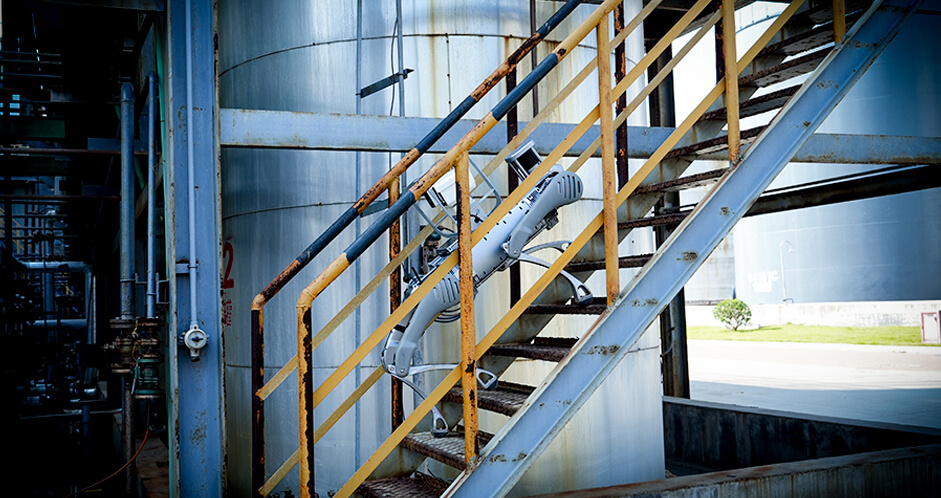
A practical Canadian A2 or B2 deployment roadmap
Define one mission
Document route, payload, hazards, data output, network, runtime, weather, operator roles and measurable success criteria.
Build the complete system
Select A2, A2 Pro or B2 plus sensors, compute, communications, battery workflow, mounts and environmental protection.
Validate the actual route
Test unloaded, then loaded, then connected to the production network. Record failures, interventions, energy and data quality.
Scale only after acceptance
Approve repeatability, safety, cybersecurity, maintenance, reporting and operator training before expanding routes or fleet size.
Use a formal hazard assessment
CCOHS notes that collaborative robots are not inherently safe; configuration, programming, payloads and interaction with other equipment create hazards.
Control video collection
Define purpose, camera range, notices, access, storage and deletion whenever the robot may capture identifiable people.
Segment the robot network
Restrict privileges, log changes, protect remote access, verify updates and preserve a tested human shutdown and recovery process.
Keep an operator in authority
Autonomous patrol must include observable state, communications-loss behaviour, safe-stop logic and an approved intervention process.
Procure the full operational package
Camera, gas, radio, controller, charging, command software, transport and training are part of the system—not optional afterthoughts.
Test pass and fail criteria
Validate route completion, payload data, endurance, network recovery, alarm accuracy, safe stop and maintenance procedures.
This article is not legal, engineering or safety certification advice. Canadian organizations should involve the site owner, occupational health and safety, privacy, IT security, insurer, engineering and legal teams appropriate to the deployment.
Total ownership cost: robot price is only one line item
A2 and B2 are best purchased as configured enterprise systems. Final Canadian cost depends on sensors, computing, communications, charging, integration, software, transport, training, spares and support.
Configured hardware
- Robot and model variant
- Sensors and payload mounts
- Compute and storage
- Battery, charger or dock
- Controller and communications
Make the mission work
- Route survey and mapping
- Software and autonomy
- Network and cybersecurity
- Commissioning and acceptance
- Operator and maintenance training
Keep the program operational
- Battery replacement
- Feet, wheels and wear components
- Diagnostics and freight
- Software updates and data storage
- Insurance and governance
A2 often wins on operational efficiency. B2 wins when its extra payload, protection and mobility prevent mission failure or enable a task A2 cannot reliably perform. Do not pay for unused capacity, but do not under-size a high-consequence system.
A2 and B2 enterprise buying checklist
Measure the environment
Record stairs, slopes, floor materials, clearances, doors, elevators, rubble, weather, lighting and network coverage.
Define installed mass and geometry
Include every sensor, mount, cable, antenna, enclosure, computer, battery and moving tool.
Specify the inspection output
Define thermal resolution, gas type, acoustic data, meter reading, video quality, alarms and report format.
Plan the complete shift
State route duration, battery reserve, swaps, charging, docking, intervention and recovery requirements.
Test the real site
Validate bandwidth, latency, dead zones, roaming, tunnels, remote access and communications-loss behaviour.
Put interfaces in writing
Confirm SDK, sensor streams, CAN, RS485, Ethernet, USB, power outputs and software documentation.
Define human and robot zones
Create speed limits, barriers, operator roles, safe-stop, manual recovery and payload-specific controls.
Confirm the Canadian pathway
Clarify warranty, diagnostics, parts, freight, technical escalation, training and response expectations.
Write the test before ordering
Tie payment and operational approval to route, payload, endurance, data, alarm and safety performance.
Request an industrial quadruped deployment assessment
SpeedyDrone Canada supports Canadian organizations evaluating Unitree A2, A2 Pro and B2 for utilities, inspection, logistics, public safety, research and industrial automation. Send your route, environment, payload, runtime, communications, development, budget and timeline requirements for a platform review.
A2 and B2 are configuration-sensitive enterprise products. Confirm robot variant, sensors, compute, payload, battery, charger or dock, communications, software, warranty, training, freight and lead time before purchase.
Unitree A2 and B2 FAQ
What is the main difference between Unitree A2 and B2?
A2 is the lighter medium-duty platform at approximately 42 kg with about 25 kg continuous walking payload and dual hot-swappable batteries. B2 is approximately 60 kg, carries more than 40 kg while walking and provides IP67 protection, larger obstacles, higher joint torque and more integration interfaces.
Which robot is better for industrial inspection?
A2 Pro is the practical default for many inspection routes because it adds dual LiDAR, expanded communications, lower mass and dual-battery continuity. B2 is better when inspection requires heavier payloads, IP67 protection, severe terrain or larger compute and interface capacity.
What is the difference between A2 and A2 Pro?
Both use the same published 42 kg mechanical platform. A2 lists one LiDAR and optional GPS and 4G, while A2 Pro lists two LiDARs and expanded tracking, GPS and 4G. A2 Pro also lists core components rated IP67.
How much payload can Unitree A2 carry?
Unitree lists approximately 25 kg continuous walking payload, with an ideal-condition figure near 35 kg, and approximately 100 kg standing load. Actual performance depends on payload geometry, route and operating conditions.
How much payload can Unitree B2 carry?
Unitree lists more than 40 kg continuous walking payload and at least 120 kg standing load. The complete payload must still be validated for centre of gravity, movement, power, terrain and safety.
Which robot has better battery endurance?
Both publish more than five hours unloaded. A2 lists more than three hours with a 25 kg load and uses dual hot-swappable batteries. B2 lists more than four hours with a 20 kg load and supports an optional autonomous-charging solution.
Is B2 faster than A2?
Unitree lists A2 at 0–3.7 m/s with a maximum near 5 m/s. B2 lists more than 6 m/s in a special configuration, but Unitree states that practical operation is speed-limited for safety.
Which robot is better on stairs and rubble?
B2 provides more published obstacle margin, including continuous 20–25 cm stairs and forward stair capability up to 40 cm. A2 lists a maximum step height of approximately 30 cm and may be easier to handle in tighter indoor environments.
What are the IP ratings of Unitree A2 and B2?
Standard A2 lists IP56. A2 Pro lists IP56–IP67 with core components rated IP67. B2 lists IP67. Custom payloads, connectors and mounts require their own protection assessment.
Do A2 and B2 support secondary development?
Yes. Unitree lists secondary-development support for A2 and A2 Pro. B2 also supports configuration-dependent secondary development and provides platform and user-development computing with extensive external interfaces.
Should I choose A2-W or B2-W instead?
Choose a wheel-leg platform when long rolling distance and energy efficiency matter more than maximum foothold flexibility. A2-W suits medium payload and inspection routes; B2-W suits heavier payload and longer heavy-duty routes.
Can A2 or B2 patrol autonomously?
Both provide sensing, computing and development capability. A complete autonomous patrol requires mapping, route planning, localization, communications, alarm logic, docking or battery operations, safe-stop behaviour and site-specific validation.
Has Unitree B2 been used by firefighters?
Unitree reports B2 systems deployed with the Qingdao Firefighting and Rescue Support Team and used in several drills with cameras, communications, gas sensing and specialized fire-response equipment. These are manufacturer-reported cases.
How much do Unitree A2 and B2 cost in Canada?
Canadian pricing is configuration-based because sensors, compute, batteries, charging, communications, payload integration, software and support vary. Contact SpeedyDrone Canada for a mission-specific quotation.
Where can a Canadian organization request an A2 or B2 assessment?
Contact SpeedyDrone Canada for configuration guidance, Canadian quote planning, financing questions, Toronto consultation and support for enterprise or public-sector robotics projects.
- Unitree A2 official product page and A2 / A2 Pro specifications
- Unitree B2 official product page and specifications
- Unitree A2-W official wheel-leg platform page
- Unitree B2-W official wheel-leg platform page
- Unitree advanced quadruped industrial inspection solution
- Unitree fire-rescue quadruped solution and manufacturer-reported B2 cases
- Unitree A2 official SDK development guide
- Unitree B2 official developer documentation
- SpeedyDrone Canada enterprise and robotics contact page
- SpeedyDrone Canada financing information
- Canadian Centre for Occupational Health and Safety robot and cobot guidance
- Office of the Privacy Commissioner of Canada video-surveillance guidance
Information was checked on July 21, 2026. Specifications, software, firmware, sensors, computing, communications, battery and charging systems, wheel options, payloads, protection ratings, package contents, pricing, warranty procedures and lead times can change. Manufacturer maximum figures and application claims are configuration- and test-dependent, not guarantees. Some features require human operation or secondary development. Verify the exact Canadian configuration, site requirements, institutional approvals and acceptance criteria before purchase.


