Unitree Dexterous Hands & Grippers

Unitree five-finger robotic hand performing a grasp demonstration

Unitree Robotic Hands and Grippers

Choose the Right Hand for the Task

Compare Unitree's parallel gripper, lightweight tendon-driven hand, force-controlled tactile hand, and high-articulation five-finger platform for embodied AI, manipulation research, robotics education, and system integration.

  • Dex1-1 Parallel two-finger gripper
  • Dex2/5 Coordinated five-finger hand
  • Dex3-1 Force-controlled three-finger hand
  • Dex5-1 / 5-1P High-DOF five-finger hand

Unitree Dex5-1

Contact for price

Unitree Dex2/5

Contact for price

Unitree Dex3-1

Contact for price

Unitree Dex1-1

Contact for price

Product Family

Four Architectures, Different Integration Priorities

Start with the required grasp, finger independence, sensing, mass, and interface—not simply the number of fingers.

Unitree Dex1-1 parallel two-finger gripper component overview
Dex1-1
Unitree Dex1-1

Wide-Stroke Parallel Gripper

Two fingers · one Unitree M4010 motor

90 mm Stroke
5–120 N Adjustable force
550 g Weight
Selection profile

Consider when adjustable parallel grasping, a 90 mm stroke, speed control, or an optional integrated-camera configuration is more important than independent multi-finger articulation.

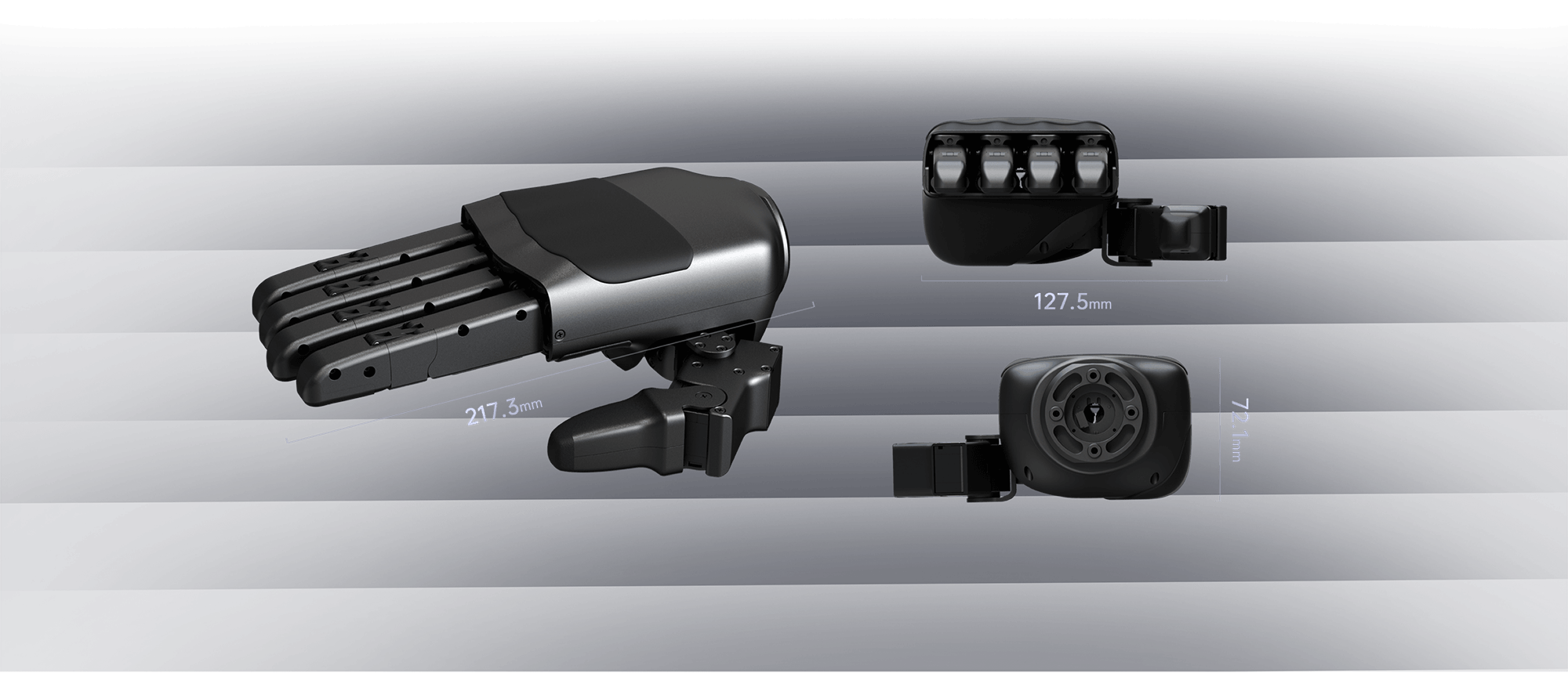
Unitree Dex2/5 five-finger robotic hand with published dimensions
Dex2/5
Unitree Dex2/5

Lightweight Tendon-Driven Hand

Five fingers · coordinated actuation

10 / 2 Total / actuated DOF
365 g Weight
8 mm Minimum grip diameter
Selection profile

Consider when a lightweight, compact five-finger form and coordinated grasping are suitable. The thumb has one actuated DOF; the other four fingers share the second.

Unitree Dex3-1 three-finger robotic hand and tactile pressure-sensor locations
Dex3-1
Unitree Dex3-1

Force-Controlled Tactile Hand

Three fingers · seven motor-driven DOF

7 DOF Motor-driven motion
33 Pressure sensors
710 g Weight
Selection profile

Consider when three-finger dexterity, force-and-position hybrid control, tactile feedback, and data-collection capability are central to a compatible G1 research project.

Selection profiles are practical guidance derived from Unitree's published specifications, not performance guarantees or official customer case studies. Validate the complete task, robot, wrist, power, software, and safety architecture.

Comparison

Unitree Hand Family at a Glance

Compare architecture and integration data before reviewing the detailed specifications and test conditions on each product listing.

Comparison of Unitree Dex1-1, Dex2/5, Dex3-1 and Dex5-1 robotic hand families
Product Hand Architecture Published Motion Published Sensing Weight Main Interface Platform Compatibility Listed by Unitree
Dex1-1 Parallel two-finger gripper Single M4010 motor; 90 mm stroke 15-bit absolute encoder; angle, velocity, torque and temperature feedback 550 g High-speed 485; 6 Mbps; up to 1000 Hz Standalone, G1, H2 and R1
Dex2/5 Five-finger gear-and-tendon drive 10 total DOF; 2 actuated DOF Joint mode, position, velocity, torque and temperature; voltage/current 365 g RS485; 1000 Hz G1 and R1
Dex3-1 Three-finger force-controlled hand 7 DOF; 6 direct-drive joints + 1 geared joint 33 pressure sensors; sensor temperature; IMU and joint feedback 710 g USB 2.0; 1000 Hz G1
Dex5-1 Five-finger composite-transmission hand 20 total DOF; 16 active + 4 coupled Joint feedback and IMU; no pressure-sensor array listed for Dex5-1 1100 g USB 2.0; 1000 Hz Not stated on the official Dex5-1 product page
Dex5-1P Five-finger composite-transmission hand 20 total DOF; 16 active + 4 coupled 12 arrays with 94 pressure sensors; 10–2500 g perception range 1100 g USB 2.0; 1000 Hz Not stated on the official Dex5-1 product page

DOF, force, load, repeatability, sensing, and speed values are not directly interchangeable across products. Manufacturer tests use different objects, orientations, voltages, and conditions. Refer to each product page for full definitions and footnotes.

Selection Path

Start with the Manipulation Requirement

The simplest architecture that satisfies the task is often easier to integrate, control, validate, and support.

01

Parallel Grasping

Wide stroke, adjustable closing force and speed, and straightforward two-finger object handling.

Begin with Dex1-1 →
02

Lightweight Five-Finger Form

A compact human-inspired hand where coordinated, rather than independent, four-finger motion is acceptable.

Review Dex2/5 →
03

Force and Tactile Research

Three independently structured fingers, pressure sensing, hybrid force/position control, and G1 integration.

Review Dex3-1 →
04

Maximum Articulation

High-DOF five-finger motion, lateral finger swing, RL-oriented backdrivability, and optional pressure sensing.

Compare Dex5-1 / 5-1P →

Integration Planning

Confirm the Complete System Before Ordering

A hand model alone does not define a working manipulation system. Capture configuration and interface requirements in the quotation.

Project Checklist

  • Task and objects: Define geometry, mass, surface, orientation, motion and acceptable failure modes.
  • Hand configuration: Confirm exact model, version, left/right side and quantity.
  • Robot and wrist: Verify platform version, mounting geometry, wrist and mechanical adapters.
  • Power and communication: Validate voltage, current capacity, connector, serial/USB interface and host controller.
  • Software and sensing: Confirm control documentation, feedback fields, calibration, SDK/resources and camera or pressure-sensor requirements.
  • Quoted contents: Treat only components explicitly listed in the SpeedyDrone quotation as included.

Published Platform Statements

  • Dex1-1 Unitree lists standalone use and use with G1, H2 and R1.
  • Dex2/5 Unitree lists compatibility with G1 and R1 models.
  • Dex3-1 Unitree states that Dex3-1 can be used with the G1 humanoid robot.
  • Dex5-1 / Dex5-1P The official Dex5-1 product page does not publish a platform-compatibility list.

Listed compatibility does not mean every robot version, wrist, cable, controller, or software configuration is plug-and-play.

Frequently Asked Questions

Choosing a Unitree Robotic Hand

What is the difference between a parallel gripper and a dexterous hand?
A parallel gripper such as Dex1-1 moves two opposing fingers for controlled opening and closing. A dexterous hand uses multiple fingers and joint structures for more varied grasp shapes, but generally requires more complex mechanical, electrical and software integration.
Which model has an integrated camera option?
Unitree presents Dex1-1 in a Standard Version and an Advanced Version with Camera. Published camera data for the Advanced Version is 1080p at 30/60 fps with H 118°, V 87° and D 140° field of view. Confirm camera interface, cabling and software requirements before integration.
Which models publish pressure-sensor arrays?
Dex3-1 lists 33 pressure sensors. Dex5-1P lists 12 arrays with 94 pressure sensors in total. The standard Dex5-1 column does not list a pressure-sensor array, and the public Dex1-1 and Dex2/5 product pages do not publish pressure-array specifications.
Can grasp-load figures be compared directly across all four products?
No. The official figures use different objects, orientations, force definitions and test conditions. Review the detailed footnotes on each product listing and validate the intended object, contact surface, movement and installation.
Which hand is the lightest?
Dex2/5 has the lowest published hand weight in this collection at 365 g. Its lightweight design uses 10 total mechanical DOF with only two actuated DOF, so confirm that coordinated finger motion suits the task.
Does listed robot compatibility mean plug-and-play installation?
No. Confirm the exact robot and wrist version, mechanical mounting, hand side, power system, cabling, communication interface, software and included components for the quoted configuration.
Are power supplies, cables, mounting parts and adapters included?
This collection description does not define package contents. Required components vary by model and integration. Treat only items explicitly listed in the SpeedyDrone quotation as included.

Need Help Selecting the Right Unitree Hand?

Send SpeedyDrone Canada the robot model, wrist configuration, intended objects, sensing requirements, control environment, hand side and quantity for a configuration review.

Request a Configuration Review

Browse the Collection Below

Use the Shopify product cards below to review individual descriptions, current pricing and ordering options. Confirm configuration-sensitive details with SpeedyDrone Canada before purchase.