


Before the first T50 spray, clear both rulebooks.
A DJI Agras T50 operation is regulated as an aircraft operation and, when pesticides are applied, as an aerial pesticide application. This 2026 guide explains the pilot certificate, aircraft registration, Safety Assurance, SFOC triggers, Health Canada label policy, Ontario Aerial licence, commercial operator requirements, PPE, permits and records.
Owning a T50 does not create permission to spray.
A legal operation depends on the exact aircraft, payload, site, people-distance, airspace, product label, provincial licence, business model and crew procedure. For a typical Ontario pesticide mission, the operator must solve four separate questions: can the pilot fly this medium RPAS, can this exact T50 configuration perform the intended operation, can this pesticide be applied by RPAS, and is the Ontario applicator or business licensed for aerial extermination?
Eight approvals, documents and decisions can sit behind one field mission.
Not every operation needs every item, but no operator should assume that one certificate replaces the rest.
Advanced Pilot Certificate
The normal VLOS pilot path for a T50 because its maximum takeoff weight places it in the medium RPAS category.
Aircraft Registration
Register the exact aircraft, mark it with the registration number and keep proof accessible during operations.
Safety Assurance
Verify the exact model, configuration and intended operation against Transport Canada's current declared-drone list.
Airspace Authorization
Controlled airspace requires permission from air traffic control, normally through the applicable NAV CANADA process.
SFOC-RPAS, if triggered
Special operations can include dangerous or hazardous payloads, certain BVLOS missions, poor visibility and flights above 400 ft.
Ontario Aerial Licence
A land pesticide extermination by aerial application requires a licensed land exterminator of the Aerial class.
Operator Licence and Insurance
A commercial pesticide extermination business generally requires an Ontario operator licence and appropriate insurance.
Label, Permit and Records
The product, crop, rate, buffer, PPE, permit, notice and recordkeeping requirements remain mission-specific.
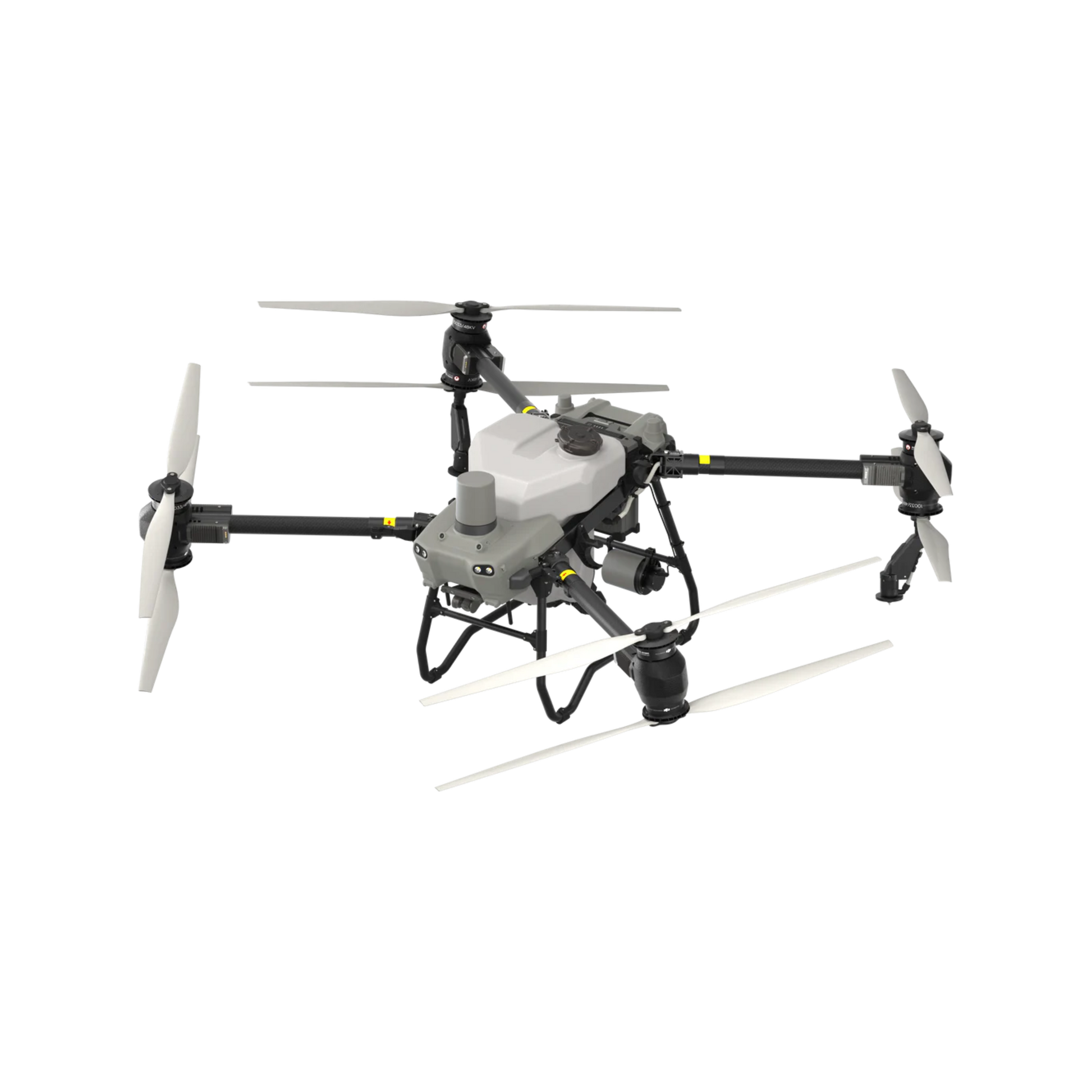
The T50 is a medium RPAS in Canada.
DJI lists a maximum takeoff weight of 92 kg in spraying configuration and 103 kg in spreading configuration. Transport Canada defines a medium drone as more than 25 kg and not more than 150 kg. Medium-drone operations are Advanced operations or beyond, and ordinary Advanced privileges are limited to visual line-of-sight.
- Hold and carry a Pilot Certificate - Advanced Operations.
- Pass the Advanced online examination and flight review before applying for the certificate.
- Maintain 24-month recency and carry proof of recurrent activity.
- Register and mark the T50, and keep the certificate of registration accessible.
- Stay within visual line-of-sight unless a separate BVLOS pathway is fully satisfied.
- Conduct the required site survey, including airspace, NOTAMs, aerodromes, wires, people, weather and emergency areas.
- Remain at or below 400 ft or 122 m AGL unless an SFOC authorizes otherwise.
The required declaration changes with the operating environment.
A pilot certificate is not a technical approval for every mission. The aircraft model must have the applicable Safety Assurance Declaration or Pre-Validated Declaration for the environment in which it will be used.
More than 152.4 m or 500 ft
A medium VLOS operation away from uninvolved people requires the applicable declaration for Standard 922.08 containment. Verify the current T50 listing and exact configuration before flight.
30 m to 152.4 m
Medium VLOS operations near uninvolved people require a Pre-Validated Declaration under Standard 922.07. Do not reduce the separation based only on obstacle sensing.
Higher technical assurance
A Pre-Validated Declaration is required. If the aircraft and operation do not have the exact rating, keep people outside the required operating area.
Do not assume an Advanced certificate covers every chemical payload.
Transport Canada identifies operations with dangerous or hazardous payloads, including some chemicals, as high-complexity special operations. Canadian Aviation Regulation 901.43 also restricts payloads that could create a hazard to aviation safety or cause injury unless the mission is conducted under an SFOC-RPAS.
- Review the product label and Safety Data Sheet before classifying the payload.
- Ask whether the mixture could create a hazard or cause injury if released after a malfunction.
- Confirm the current Transport Canada interpretation for the exact product and operation.
- Do not rely on the Ontario pesticide licence as aviation authorization.
- Build lead time into the project: high-complexity SFOC service standards are measured in working days after a complete application and fee.

Dangerous or hazardous payload
Obtain a mission-specific determination and the required SFOC before carrying a payload captured by CAR 901.43.
Above 400 ft or special conditions
Flights above 122 m AGL, certain poor-visibility operations and other missions outside normal categories require special approval.
BVLOS
Lower-risk BVLOS can require a Level 1 Complex pilot, RPOC and declaration; other BVLOS operations require an SFOC.
The June 2026 policy expanded eligibility, but the label still controls the application.
Health Canada's SPN2026-02 allows RPAS use when the registered end-use product already permits conventional aerial application. The operator must follow the aerial directions without inventing a lower volume, different buffer, different rate or different crop use.
If the label does not include aerial application, or says "DO NOT apply by air," RPAS use is prohibited.
A registrant can add "DO NOT apply by Remotely Piloted Aircraft Systems (RPAS)." Always use the current label.
Crop, pest, rate, number of applications, retreatment interval, spray volume and all other directions remain mandatory.
Health Canada currently requires the labelled conventional rotary-aircraft spray buffer zones for RPAS applications.
Can I reduce spray volume because the T50 flies lower and slower?
Not below the minimum aerial spray volume on the label. SPN2026-02 requires the aerial label directions to be followed without changing application rate, spray volume, droplet size, spray buffer zones or other conditions of use.
Does every aerial-labelled pesticide automatically become a good T50 application?
No. Legal eligibility is only the first gate. The aircraft must be calibrated, the actual swath must be measured, the required droplet category and coverage must be achieved, and the product must fit the crop, rate, weather, field, PPE and crew workflow.
What happens if a product requires closed-cab protection?
Health Canada's policy says the product must not be applied by RPAS unless equivalent closed-cab protection designed for the RPAS pilot is available. If no equivalent protection exists, choose another aerial-labelled product that does not require it.
Ontario treats drone spraying as aerial extermination.
The federal policy determines whether the pesticide may be applied by RPAS. Ontario determines who may perform the application, whether a business licence or permit is required, and what provincial records, notices, storage and spill duties apply.
Land Exterminator Licence - Aerial class
Ontario Regulation 63/09 states that no person may perform a land extermination by aerial application unless the person is a licensed land exterminator of the Aerial class. The ordinary farmer exemptions specifically exclude aerial application.
Pesticide Operator Licence
A business performing pesticide exterminations for fee or payment generally requires an operator licence, appropriate insurance, licensed exterminators in charge, employee qualification controls and vehicle information or identification.
Provincial Permit Review
Some aerial applications require permits, including certain Class B uses, specified active ingredients, Crown-forest applications and water exterminations. Confirm with the appropriate Ontario regional office before scheduling.
Records for at least two years
The aerial applicator must prepare and retain the approved record for each aerial extermination. If the work is performed for an operator, a copy must be provided and retained by that operator.
The pilot, mixer and loader cannot be treated as one interchangeable job.
Health Canada's 2026 policy separates key roles to reduce pesticide exposure. It also treats anyone who handles the drone, battery or contaminated surface as a potential pesticide handler.
Fly and protect clean controls
The pilot must understand the label, hold the correct Transport Canada certificate, stay out of the downwind area and avoid transferring residue to the controller.
Separate from the pilot
The person who mixes and loads the pesticide must not be the RPA pilot. This separation is a federal risk-management requirement.
Premixed loading only when allowed
If the label permits the pilot to load premixed chemical using a closed system, the pilot may load after another person has completed mixing.
PPE applies beyond mixing
Required PPE applies to lifting the aircraft, changing batteries, cleaning, repair and any task involving surfaces that may carry pesticide residue.
- Do not place the pilot, visual observer or crew downwind of the spraying drone.
- Follow the minimum label PPE, including long sleeves, long pants, chemical-resistant gloves, socks and shoes, plus any additional label requirement.
- Use groundboom or airblast PPE and mitigation measures for the applicable crop or use site when required by the policy.
- Keep contaminated gloves away from the controller, phones, vehicles and other clean surfaces.
- Consider assigning battery changes to the mixer or loader to reduce transfer of residue to the pilot's controls.
Spraying, spreading and demos do not use the same compliance path.
Define the payload and purpose before deciding which licences or permits apply.
| Operation | Aviation path | Pesticide path | Key caution |
|---|---|---|---|
|
Aviation only Water-only demo |
Advanced certificate, registration, Safety Assurance, people-distance, site survey and airspace rules. | No pesticide licence for water alone. | Do not represent the water demo as proof that a chemical application is legally approved. |
|
Verify material Seed or fertilizer spreading |
Medium-RPAS rules still apply. | Ontario pesticide licensing normally does not apply unless the payload is a pesticide or regulated treated product. | Check material classification, TDG, seed, fertilizer, environmental, property and manufacturer requirements. |
|
Full stack Own-farm pesticide spraying |
Advanced or higher, registration, Safety Assurance and SFOC review for the payload and mission. | Aerial label eligibility, Ontario Aerial exterminator licence, permit review, PPE, role separation and records. | Farmer exemptions in O. Reg. 63/09 exclude aerial pesticide application. |
|
Full commercial stack Custom application for payment |
All applicable aviation requirements plus business SOPs and insurance. | Aerial exterminator licence, operator licence, insurance, vehicles, permits, label, records and customer documentation. | Do not quote or schedule until crop, product, rate, acreage, label, airspace, pilot and insurance are confirmed. |
|
Special review BVLOS or chemical high-complexity mission |
Level 1 Complex plus RPOC and declarations for qualifying lower-risk BVLOS, or SFOC for operations outside that category. | All pesticide requirements still apply if pesticide is dispersed. | Do not treat a visual observer or long control link as automatic BVLOS authorization. |
A compliant crew should be able to produce the file, not just describe it.
Build one mission folder containing the aviation, pesticide, site, crew and emergency documents relevant to the job.
Certificate and recency
Advanced or Level 1 Complex certificate, government ID when appropriate, and proof of recurrent training completed within the required period.
Registration and declaration
Registration certificate, aircraft marking, exact model and configuration, live Safety Assurance verification and maintenance status.
Site survey and authorizations
Airspace classification, NOTAM review, aerodrome check, controlled-airspace authorization, SFOC when required and emergency landing areas.
Current label and SDS
Aerial-use directions, RPAS opt-out check, crop and pest, rate, volume, droplets, buffer zones, PPE, re-entry and pre-harvest intervals.
Licence, permit and insurance
Aerial exterminator licence, operator licence when applicable, permit, proof of insurance, vehicle details and any notice or signage plan.
Mission and emergency records
Field map, route, swath validation, weather limits, crew roles, spill response, decontamination, customer authorization and completed aerial record.
How long should records be retained?
Ontario requires aerial extermination records to be kept for at least two years. Transport Canada also requires 24-month proof of pilot recency activity, and CAR 901.49 requires records of certain incident analyses to be kept for 12 months. Business, insurance, label and customer requirements may require longer retention.
What should happen after a pesticide spill or abnormal discharge?
Stop the operation, protect people and the environment, follow the label, SDS and emergency plan, contain the release when safe, and make all required reports. Ontario directs immediate reporting to the Spills Action Centre at 1-800-268-6060 when a discharge causes or is likely to cause an adverse effect.
Do pesticide storage and transport rules apply to the support vehicle?
Yes. Ontario regulates pesticide storage, transportation and disposal. Operators may also have annual fire-department notification duties for stored Class B, C or D pesticides, and Transportation of Dangerous Goods requirements apply when the product is classified as dangerous goods.
Build the legal pathway before the spray window opens.
A farm or service company should not wait until the day before application to discover that the aircraft declaration, pesticide licence, permit, airspace or SFOC path is incomplete.
Crop, acreage, location, payload, product, rate, people-distance, VLOS or BVLOS, own farm or paid service.
Advanced certificate, flight review, recurrent training, Agras-specific training and crew competence.
Registration, marking, Safety Assurance, exact configuration, firmware, maintenance and payload system.
Current label, aerial authorization, no RPAS opt-out, Ontario Aerial licence, operator licence and permit review.
Site survey, airspace, SFOC decision, weather, buffers, people controls, crew roles, PPE, spill and emergency plan.
What drone licence do I need to fly a DJI Agras T50 in Canada?
For ordinary visual-line-of-sight operation, the T50 falls in the medium RPAS category and requires a Pilot Certificate - Advanced Operations or higher. The pilot must also satisfy recency requirements, register the aircraft and use a model with the applicable Safety Assurance for the intended environment.
Why is the DJI Agras T50 considered a medium drone?
DJI lists maximum takeoff weights of 92 kg for spraying and 103 kg for spreading. Transport Canada defines a medium drone as more than 25 kg and not more than 150 kg.
Do I need an SFOC to spray pesticides with a T50?
It depends on the product and operation. Transport Canada treats dangerous or hazardous payload operations as high-complexity special operations, and CAR 901.43 restricts payloads that could create a hazard or cause injury. Confirm the exact chemical, SDS and mission with Transport Canada rather than assuming an Advanced certificate is enough.
Can any aerial-labelled pesticide now be applied by drone in Canada?
As of June 30, 2026, Health Canada allows RPAS application of products registered for conventional aerial application, provided all aerial label directions are followed. The product cannot be used if the label prohibits aerial application, lacks aerial directions or includes an RPAS opt-out statement.
Can a farmer spray the farmer's own field without an Ontario Aerial licence?
Ontario Regulation 63/09 requires a licensed land exterminator of the Aerial class for land extermination by aerial application. The farmer exemptions described in the regulation exclude aerial application.
Do I need an Ontario operator licence for custom drone spraying?
A person or business operating a pesticide extermination business for fee or payment generally requires an Ontario operator licence, appropriate insurance and properly licensed exterminators. Confirm any exemption or corporate structure with Ontario.
Can the T50 pilot also mix and load the pesticide?
Health Canada's 2026 policy separates the roles: the person who mixes and loads must not be the RPA pilot. The pilot may load premixed chemical only when the label allows it and a closed transfer system is used after another person has mixed the pesticide.
What PPE is required for T50 pesticide application?
Follow the current product label and SPN2026-02. All people handling the pesticide, aircraft, batteries or potentially contaminated surfaces must follow the applicable PPE and mitigation measures, including any additional coveralls, goggles, respirators, closed systems or handling limits stated on the label.
Can I fly the T50 near farm workers or neighbours?
Medium-RPAS separation depends on the aircraft's Safety Assurance rating. More than 152.4 m from uninvolved people uses the away-from-people declaration path; closer operations require a Pre-Validated Declaration. Pesticide drift, label buffers, property access and worker protection may require even larger practical separation.
Does seed or fertilizer spreading require an Ontario pesticide licence?
Ordinary non-pesticide seed or fertilizer spreading does not normally trigger the pesticide licensing system, but all aviation rules still apply. Confirm whether the material is pesticide-treated, dangerous goods or subject to other federal, provincial, environmental, seed or fertilizer requirements.
Does SpeedyDrone issue government licences or approve pesticide use?
No. SpeedyDrone can provide equipment, setup, training, workflow support and documentation guidance, but Transport Canada, Health Canada, Ontario authorities, NAV CANADA, the product label, insurer and other responsible bodies determine the final legal requirements.
This guide was updated on July 21, 2026 and uses current official federal, Ontario and DJI sources. Always re-check these pages before a mission because declarations, labels, policies and regulations can change.

Start with the mission, then build the licence path.
Send us the crop, acreage, Ontario location, material, application rate, own-farm or commercial-service model, pilot status and intended timeline. We will organize the T50 fit-check, equipment package, training scope and the compliance questions that must be resolved before deployment.
Planning a farm open house, dealer day or association event? Ask about combining a T50 compliance and workflow session with robot demonstrations or a STEMAX youth robotics activation.


