


Everything You Need to Know About DJI Agras T50
Specifications are only the beginning. A successful T50 program also needs a legal application, trained crew, batteries and power, field logistics, calibration, records, maintenance, insurance and a realistic economic model. This complete guide explains the aircraft and the operating system around it.
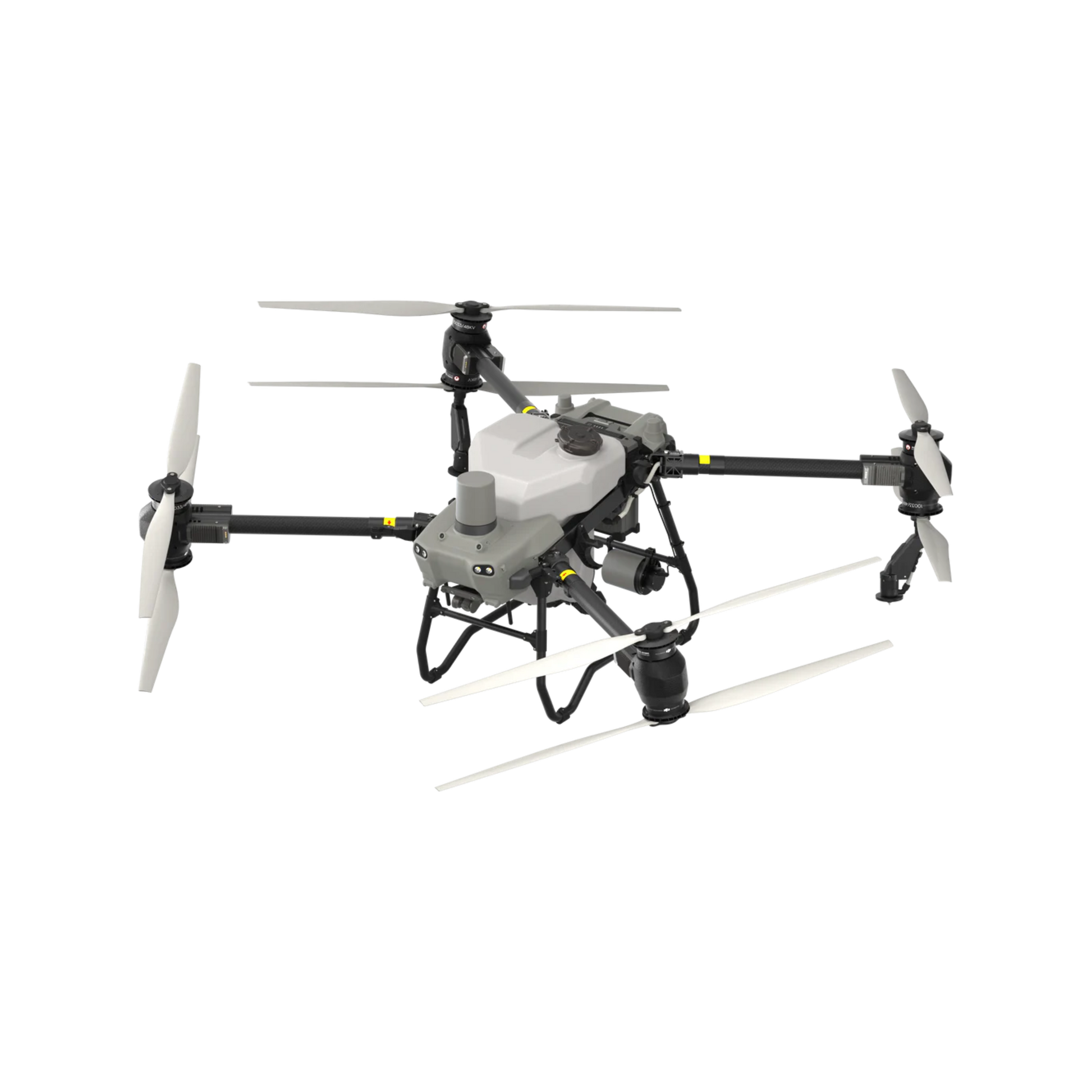
T50 is a field platform, not a flying appliance.
T50 is designed for farms and service providers that need flexible access, spraying and spreading without sending a ground machine into every block. It is strongest when wet fields, tall crops, edges, small blocks, orchards, spot work or timing create a recurring operational problem.
fit
Buy it to solve a repeated workflow problem.
Strong candidates include established farms, vegetable and specialty-crop operations, orchards and vineyards, co-ops, custom applicators and agricultural service companies with enough seasonal work to support a complete operating system.
Weak candidates are buyers with no legal use case, no trained crew, no power or refill plan, no recurring demand, or an expectation that the drone will automatically replace every existing sprayer.
The numbers that shape the field workflow.
T50 weighs 39.9 kg without a battery and 52 kg with its DB1560 battery. DJI publishes maximum takeoff weights of 92 kg for spraying and 103 kg for spreading at sea level.
HDPE spray tank, dual atomizing system, two magnetic-drive pumps and adjustable droplets from 50 to 500 micrometres.
Designed for compatible dry granules from 0.5 to 5 mm, with an 8 m nominal spread width and real-time weighing.
Up to 16 L/min with two sprinklers or 24 L/min with the optional four-sprinkler arrangement.
About 50 acres per hour in DJI's test at 15 L/ha, 11 m swath, 7 m/s speed and 3 m height.
Flow, droplet and coverage must be calibrated together.
A larger flow number does not prove coverage or efficacy. The correct setup depends on the product label, crop, target, application volume, droplet class, swath, speed, height, wind, temperature, humidity and acceptable drift risk.

Droplet control begins at the sprinkler.
The centrifugal sprinklers support 50-500 micrometre droplets. The operator still validates the selected droplet class, flow, speed and swath against the label, crop and weather.

Coverage is a field result, not a menu setting.
Application volume, overlap, canopy, height, wind and turning determine whether the programmed route produces acceptable coverage.
| Spray variable | Official capability | What the operator must determine |
|---|---|---|
| Droplet size | 50-500 micrometres; six preset classes plus custom adjustment | Target coverage, drift risk, label directions and weather suitability |
| Effective swath | 4-11 m at 3 m above crops | Actual overlap and uniformity under the selected crop, height, speed and wind |
| Maximum flow | 16 L/min with two sprinklers; 24 L/min with four | Whether required application volume can be delivered without sacrificing coverage |
| Operating speed | Maximum operating flight speed published at 10 m/s | Safe speed that still meets swath, coverage, obstacle and label requirements |
| Wind resistance | DJI aircraft specification: 6 m/s | Legal and agronomic spray limit, which may be lower than the aircraft limit |
Material behaviour matters more than the hopper label.
T50 is designed for compatible dry granules. Material diameter, density, moisture, surface smoothness, bridging, dust, breakage and gate selection all affect calibration and uniformity.

The spinning disc is only one part of uniform application.
Gate selection, material condition, disk speed, flight speed, height, overlap and wind must be calibrated for the actual seed or granular fertilizer. DJI's 108 kg/min maximum was measured with 4 mm urea.
75 L tank and 50 kg internal load.
DJI Agras intelligently recommends a payload limit based on aircraft and environmental status.
Do not exceed app limit0.5-5 mm dry granules.
Seed and granular fertilizer may be suitable; wet, sticky, clumped or excessively dusty material requires caution.
Test before field useUp to 108 kg per minute.
DJI measured the maximum using 4 mm urea; other materials can behave very differently.
Material-specific resultNominally 8 m.
Uniformity depends on material, disk speed, flight speed, height, wind and overlap.
Calibrate trays or catch testsSmall hopper gates improve control.
Use the correct gate and calibration method for low-rate materials instead of relying on the maximum-flow setup.
Match gate to rateFast disassembly supports maintenance.
Remove residue after use and prevent moisture, corrosion, caking and contamination between materials.
Clean after every materialT50 can map the job before it executes it.
The FPV gimbal camera, RC Plus and RTK workflow support field and orchard surveying, map creation, obstacle identification, route generation and automated spraying or spreading. Mavic 3M and SmartFarm can expand the workflow into scouting and prescription mapping.

Maps turn site information into repeatable routes.
Point-cloud and obstacle information help define terrain, tree distribution and route geometry. The operator still verifies the map against current field conditions before execution.

Terrain-following begins with a clean survey.
Row shape, slope, canopy, boundaries and visible obstacles should be reviewed before generating an automatic orchard route.
Automation assists the crew. It does not replace the crew.
T50 combines RTK positioning, forward and rear active phased-array radar, binocular vision and terrain-following functions. Performance depends on light, rain, fog, speed and obstacle properties.

Front and rear radar expand awareness around the aircraft.
The radar and vision systems support terrain and obstacle functions, but their effective range changes with light, rain, fog, speed and the size, shape and material of the obstacle.

Technology supports the site plan; it does not replace it.
Mark wires, roads, buildings, workers, livestock, sensitive areas, refill points and emergency landing locations before the aircraft begins the mission.
Route consistency and terrain awareness.
- Multidirectional radar sensing under stated conditions.
- Terrain following and altitude assistance.
- Obstacle depiction and bypass planning.
- Repeatable RTK routes and field boundaries.
Automatic avoidance of every hazard.
- Fine wires, dead branches or low-contrast objects.
- Reliable sensing in poor light, rain or fog.
- Safe flight without a site survey and trained supervision.
- Legal permission to fly in a location or near uninvolved people.
The field system is designed around battery rotation.
The DB1560 battery is rated at 30,000 mAh, weighs approximately 12.1 kg and is designed for rapid charging with the matching cooling and power system. Charging claims require the correct cable, power, altitude and cell temperature.

Fast charging depends on battery temperature and power.
The matching cooling and charging workflow is part of the system. A headline charge time is not achievable with weak electrical service, the wrong cable or a battery outside the specified temperature range.

Capacity, condition and cycle count belong in the quote.
DB1560 is rated at 30 Ah and approximately 12.1 kg. For pre-owned batteries, confirm cycle count, condition, performance, warranty and replacement planning before purchase.
| Component | Official reference | Planning question |
|---|---|---|
| DB1560 battery | 30 Ah, 52.22 V, approximately 12.1 kg | How many batteries cover charging, cooling, inspection and downtime? |
| D12000iE generator | Up to 9,000 W DC charging output and 30 L fuel tank | Where will fuel, exhaust, heat, fire separation and weather protection be managed? |
| C10000 power supply | Up to 9,000 W with suitable 220-240 V input; lower output on 100-120 V | Does the site actually have the electrical service required for full-speed charging? |
| Cooling | Air-cooled heat-sink workflow | Can hot batteries reach the specified temperature range before the next charge? |
The aircraft, pilot, pesticide and business must all be legal.
T50's spraying and spreading takeoff weights place it in Canada's medium-drone category. Pesticide application adds a separate federal label and Ontario licensing system. Meeting one layer does not satisfy the others.
Transport Canada
Medium-drone VLOS operations require Advanced privileges or higher.
- Register and mark the aircraft.
- Use the correct pilot certificate and operating category.
- Verify the exact model and intended operation in the current Safety Assurance list.
- Obtain controlled-airspace authorization where required.
- Use an SFOC when the operation falls outside permitted categories.
Health Canada pesticide policy
SPN2026-02 permits RPAS use only for products that already allow conventional aerial application.
- Check the current registered product label.
- Do not use a product that prohibits aerial application.
- Follow aerial rate, minimum volume, buffer zone, PPE and interval directions.
- Check whether the registrant has opted out of RPAS application.
Ontario aerial pesticide licensing
Ontario requires an Aerial-class land exterminator licence for aerial land extermination.
- Do not assume a normal farm exemption covers aerial application.
- Commercial businesses may also require an Operator licence.
- Keep required aerial-application records for at least two years.
- Confirm any applicable permit or notification requirements.
Crew, insurance and site control
Separate piloting, pesticide preparation and contaminated work.
- The pilot should not mix pesticide.
- Follow all label PPE and closed-transfer conditions.
- Keep uninvolved people and animals outside the operating area.
- Confirm aviation liability, pollution, equipment and vehicle coverage.
- Use contracts that define weather, cancellation, damage and customer obligations.
A repeatable job starts before the drone arrives.
The safest and most efficient operators turn every application into the same sequence: qualify, survey, calibrate, stage, operate, inspect, clean and document.
Qualify the legal application.
Crop, product label, aerial directions, licences, aircraft assurance, airspace, insurance, crew and weather.
Survey the site.
Boundaries, wires, roads, buildings, livestock, workers, sensitive areas, refill zone and emergency landing sites.
Inspect the aircraft.
Arms, propellers, motors, tank, pumps, hoses, sprinklers, radar, vision sensors, battery and landing gear.
Map and calibrate.
RTK status, route, home point, return altitude, swath, flow, droplet, rate, height, speed and overlap.
Stage crew and power.
Clean controller area, contaminated handling area, batteries, cooling, charger, generator, water, PPE and communications.
Run and monitor.
People, wind, route, flow, pressure, remaining payload, battery, signal, obstacles and abort criteria.
Clean and inspect.
Flush and clean according to label and manual, inspect damage, remove residue and isolate contaminated PPE and tools.
Close the record.
Date, field, product, rate, area, weather, crew, route, incidents, cleaning, maintenance, battery and customer sign-off.
Review before the next job.
Coverage, missed areas, drift concerns, refill time, battery cycle, customer feedback and corrective actions.
Downtime usually begins as a small neglected detail.
Follow the current DJI manual, product label and service guidance. The checklist below is a planning framework, not a substitute for model-specific maintenance instructions.

High-load structures deserve consistent inspection.
Watch for impact damage, looseness, deformation, cracking, abnormal vibration and contamination around arms, motor bases, fasteners and landing components.

Leaks and blockage become downtime when they are ignored.
Inspect the tank, seals, hoses, filters, pumps, sprinklers, valves, spreader and electrical connections before and after demanding work.
Inspect the airframe and application system.
- Propellers, arms, motors and fasteners.
- Tank, hoses, pumps, filters and sprinklers.
- Radar and vision-sensor cleanliness.
- Battery housing, terminals and locking.
- Firmware, maps, RTK and controller status.
Remove residue before it hardens or contaminates.
- Follow product-label cleaning directions.
- Flush spray lines and clean filters.
- Disassemble and clean spreading components.
- Dry components before storage.
- Record damage, leaks, blockage and abnormal vibration.
Store for battery health and fire safety.
- Use DJI-recommended temperature and charge conditions.
- Keep terminals clean and protected.
- Separate damaged or abnormal batteries.
- Track cycle count, swelling, heat and performance changes.
- Schedule inspection before the next season.
The cheapest aircraft is not always the lowest-cost deployment.
Compare aircraft condition, battery cycles, charger type, power availability, included accessories, warranty, training and support. Public prices below were reviewed July 21, 2026 and can change.
Build your own field system.
Current SpeedyDrone public listing reference.
- Brand-new T50 with RC Plus controller.
- Battery cooler fan adapter cable.
- Atomized sprinkler package.
- Batteries, charger and field deployment services quoted separately.
Lowest public three-battery entry.
Demonstration-used package reference; exact condition must be confirmed.
- Pre-owned T50 with RC Plus.
- Three DB1560 batteries listed around 110-160 cycles.
- C10000 battery station and field accessories.
- Brand-new 40 L spray tank listed.
Brand-new aircraft with three-battery workflow.
Current public package reference.
- Brand-new T50 with RC Plus.
- Pre-owned Grade AAA+ C10000 charger.
- Three pre-owned Grade AAA+ batteries listed around 100-150 cycles.
- DJI Relay and listed field accessories.
Count the acres that need a drone, not every acre you own.
T50 economics improve when the drone solves a recurring access or timing problem, supports a profitable custom service, or avoids measurable operational loss. No seller can guarantee savings, yield or payback.
Low, expected and high utilization.
Include weather cancellations, training time, regulatory delays, transport, water, labour, batteries, generator fuel, insurance, maintenance, travel and replacement reserves.
Answer these questions before requesting the final quote.
A complete answer lets SpeedyDrone quote the aircraft, power, training, logistics and compliance support together.
What is the recurring job?
- Crop and annual treated acres or block size.
- Current sprayer, spreader or contractor.
- Application volume and typical material.
- Wet field, tall crop, slope, edge, spot-work or timing problem.
- Need for spraying, spreading, surveying or all three.
Can the operation legally proceed?
- Pilot certificate and flight experience.
- Aircraft registration and Safety Assurance path.
- Pesticide aerial label and Ontario Aerial-class licensing.
- Controlled-airspace or SFOC requirements.
- Insurance, customer contracts and recordkeeping.
Can the crew keep the drone working?
- Water and product at the staging area.
- Number and condition of batteries.
- Generator or suitable electrical service.
- Truck, trailer, secure storage and fuel.
- Mixing, loading, observation and battery roles.
Which ownership path fits?
- Brand-new, pre-owned or mixed-condition package.
- Purchase, leasing or service-first trial.
- Training and deployment support.
- Seasonal maintenance and spare parts.
- Target delivery date and budget.
Choose the support level with the equipment.
Final scope and price depend on location, crew, aircraft package, battery condition, training and regulatory requirements.
Equipment handover.
- Serial-number and exterior inspection.
- Activation and firmware check.
- Controller and core-system review.
- Official warranty-path explanation.
Field-ready orientation.
- Everything in Basic.
- Battery, cooling and charging workflow.
- Mapping, RTK and route orientation.
- Dry-run and crew-role walkthrough.
Deployment program.
- Everything in Plus.
- Farm fit-check and SOP framework.
- Calibration and recordkeeping workflow.
- SmartFarm and Mavic 3M integration.
- Seasonal support planning.
The questions buyers and operators ask most.
What is DJI Agras T50 used for?
T50 is designed for agricultural surveying, spraying and spreading. It is often used for wet fields, tall crops, field edges, small blocks, orchards, vineyards, spot work, granular spreading and time-sensitive applications.
How much can T50 spray and spread?
DJI specifies a 40 L spray tank with a 40 kg operating payload and a 75 L spread tank with a 50 kg internal load. The DJI Agras app may recommend a lower payload based on altitude and conditions.
Can T50 really spray 50 acres per hour?
DJI measured approximately 50 acres or 21 hectares per hour at 15 L/ha, 11 m swath, 7 m/s and 3 m height. Real field productivity is lower when turning, refilling, travelling, calibrating or operating under different rates, weather and legal limits.
Can T50 legally spray pesticides in Ontario?
Potentially, but only when the product permits aerial application and the operator meets the current Health Canada policy, registered label, Transport Canada, Ontario Aerial-class licence, PPE, crew, insurance and recordkeeping requirements.
What pilot certificate is required for T50?
T50 is a medium drone at its spraying and spreading takeoff weights. Medium-drone VLOS operations require Advanced privileges or higher, and the exact aircraft and operation must meet current Safety Assurance requirements.
Does T50 require an SFOC?
Not automatically for every permitted VLOS medium-drone operation. An SFOC is required when the mission falls outside Basic, Advanced or Level 1 Complex permissions, including certain special, dangerous-payload, event, adverse-weather or higher-complexity operations.
How many batteries are needed?
DJI promotes continuous operation with a pair of batteries under qualifying rapid-charge conditions. Commercial operators may choose three or more batteries for cooling delays, travel, inspections, weak power and redundancy.
How long does it take to charge a DB1560 battery?
DJI specifies approximately 9-12 minutes for a full charge under qualifying conditions and cites about 9 minutes from 30 to 95 per cent using the generator and cooling workflow.
Can T50 replace a ground sprayer?
Not automatically. It is often most valuable as a complementary tool for access, timing, localized work, tall crops, wet fields and difficult blocks. Ground equipment may remain more suitable for other acres and application volumes.
Can T50 spread seed and fertilizer?
It can spread compatible dry granules from 0.5 to 5 mm. Material moisture, density, surface condition and flow behaviour must be tested and calibrated before field use.
How much does DJI Agras T50 cost in Canada?
When reviewed on July 21, 2026, SpeedyDrone publicly listed a brand-new aircraft-only package at CA$17,999, a pre-owned Pro Package at CA$22,999, and a new-airframe three-battery Pro Package at CA$29,999. Prices and package details can change.
Can T50 be financed or leased?
Agriculture leasing may be available to qualified buyers through a consultation process. Approval, down payment, term, rate and eligible equipment are determined by the financing partner.
What should be included in a complete T50 quote?
The quote should identify aircraft condition, controller, spray and spread equipment, battery number and cycles, charger, generator or site power, cooling, relay, accessories, transport, training, warranty, delivery, support and any compliance or demo work.
Can SpeedyDrone support farm open houses or school visits?
SpeedyDrone can separately discuss a static agricultural-drone display, Unitree robot activation or STEMAX farm-technology workshop. Any live flight or pesticide activity requires its own site, aviation, insurance, consent and safety plan.
Check the official material before every season.
Send the farm problem before choosing the package.
Share the crop, acreage, current equipment, recurring access problem, application rate, material, crew, licences, transport, power, budget and target season. SpeedyDrone can recommend equipment, training, a demo, leasing review or a service-first path.


