


DJI Agras T50 vs Ground Rig Spraying for 5 Eastern Canadian Crops
Corn, soybeans, winter wheat, potatoes and apples create five very different spray jobs. This guide compares where the T50 can improve access and timing, where a ground rig remains more efficient, and how to calculate savings without relying on a universal per-acre claim.
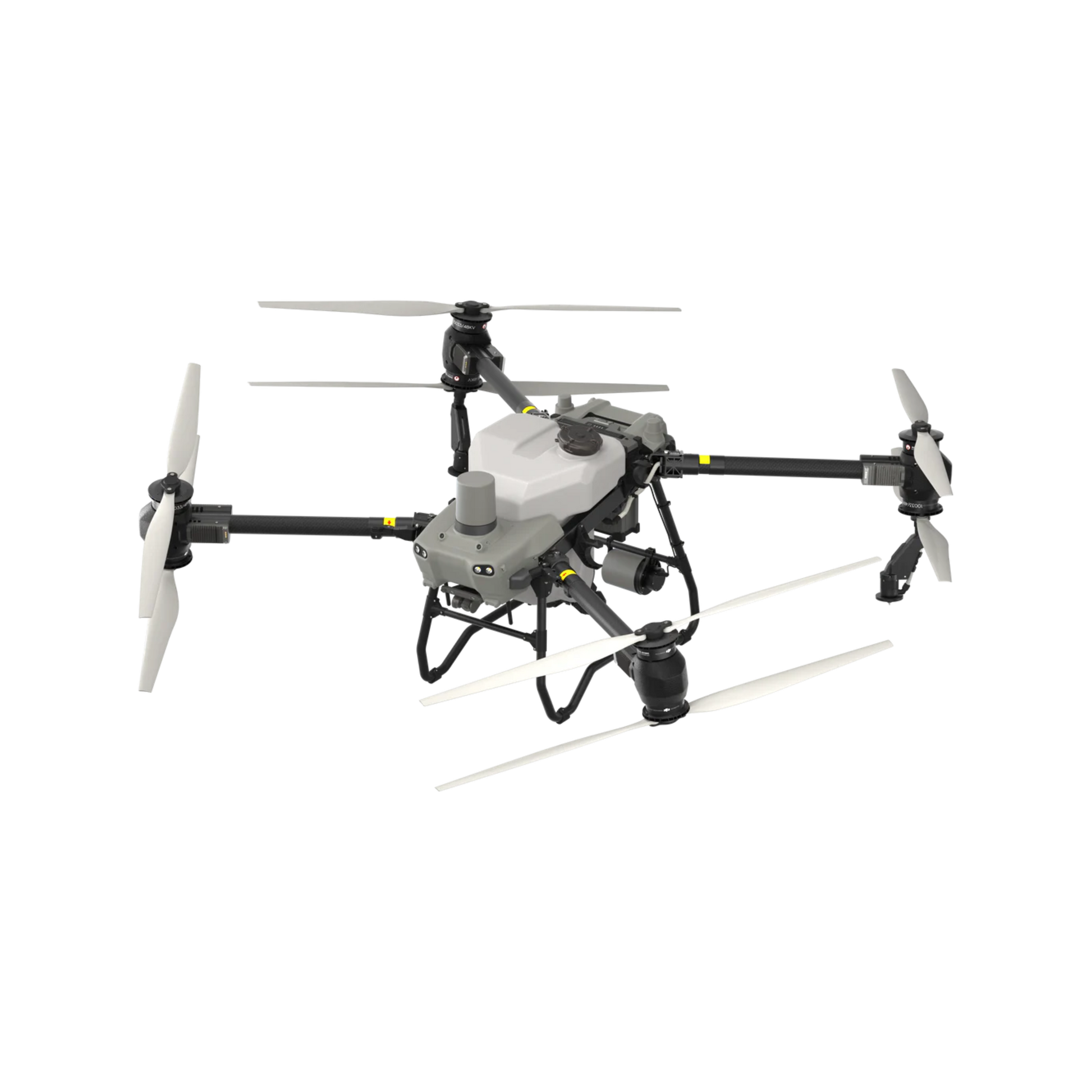
DJI Agras T50: 40 L spray tank, 40 kg spray payload, 50 kg spreading payload, dual atomizing sprinklers, RTK, radar and binocular vision.
T50 wins specific windows. Ground rigs win continuous volume.
T50 is strongest when field access, crop height, irregular blocks, localized treatment or timing is the bottleneck. Ground rigs remain strongest where large fields, high carrier volumes, mature refill infrastructure and continuous operation dominate the economics. The most profitable farm may use both.
Access and timing create the value.
- Soil is too soft for the ground rig.
- The crop is tall or the canopy is closed.
- The treatment area is irregular, isolated or relatively small.
- Only part of the field requires treatment.
- A missed application window is more costly than the refill burden.
Continuous capacity creates the value.
- Fields are large, open and trafficable.
- The crop program requires higher carrier volumes.
- The farm already owns an efficient self-propelled or pull-type system.
- Canopy penetration depends on boom or airblast configuration.
- Frequent refilling would erase the drone's access advantage.
The farm has two different jobs.
- Ground rig for normal whole-field programs.
- T50 for wet conditions, edges, spot work and late-season access.
- Ground rig for high-volume coverage.
- T50 for blocks where mobilizing a large machine is inefficient.
- Service provider during peak demand before committing to ownership.
Wet seasons and diverse crops create more than one spraying problem.
Ontario and Quebec contain large corn and soybean acreages, winter wheat is concentrated in Eastern Canada, potatoes remain important in Quebec and Atlantic Canada, and orchard spraying demands a different canopy-based approach.
Ontario growers reported approximately 2.3 million seeded acres of grain corn in 2026.
Ontario remained Canada's largest soybean-producing province by seeded area in 2026.
Quebec reported about 900,500 corn acres and 1.0 million soybean acres in 2026.
Quebec and Atlantic provinces remain important potato regions with weather-sensitive crop protection.
T50 and ground rigs solve different operating constraints.
Compare the complete workflow: aircraft or machine, refill and power, labour, transport, coverage, field conditions, compliance and the economic cost of delay.
| Factor | DJI Agras T50 | Ground rig | Decision signal |
|---|---|---|---|
| Spray capacity | 40 L tank; up to 16 L/min standard or 24 L/min with four sprinklers | Much larger tank and continuous boom or airblast output | Ground rig usually wins high-volume whole-field work |
| Field contact | No wheel traffic through the treated crop | Tyres may create rutting, crop contact or compaction | T50 value rises when traffic creates measurable loss |
| Wet-field access | Can operate without driving on soft soil when aviation and weather conditions allow | May be delayed until field conditions support traffic | T50 may protect a narrow timing window |
| Refilling | Frequent liquid refills; strong staging is essential | Longer runs between refills | Carrier volume can decide the economics |
| Irregular blocks | Flexible launch and route planning | Headlands, turning and transport can be less efficient | T50 can fit small, remote or irregular areas |
| Canopy penetration | Must be validated through crop-specific calibration and coverage testing | Boom and airblast systems have mature crop-specific setups | Ground rig remains the benchmark for many dense canopies |
| Power | Batteries, cooling, charger and generator or suitable electrical service | Diesel, tractor or self-propelled chassis and service network | Compare full power and maintenance systems |
| Compliance | Aviation plus pesticide label plus provincial aerial licensing | Pesticide, worker, equipment and provincial ground-application rules | Drone ownership does not authorize pesticide application |
Crop structure and spray volume determine the winner.
These recommendations are workflow guidance, not pesticide directions. The current registered label and provincial rules control every application.
T50 becomes more attractive as the crop gets taller.
Corn creates a strong drone use case when late-season access, soft ground or crop contact makes ground application difficult. It is less compelling for early-season whole-field work where a wide boom can cover large acreage quickly.
- T50 advantage: late-season access, edges, spot work and wet conditions.
- Ground-rig advantage: early timing, large fields and higher-volume application.
- Coverage question: can the aerial label, droplet and carrier volume meet the target?
- Savings signal: avoided delay or measurable crop contact.
Closed canopy makes access easier to value and coverage harder to assume.
T50 can reach soybeans when the canopy is closed and soil is soft, but dense foliage requires real coverage testing. Ground rigs remain highly efficient for large, continuous fields when trafficability and crop stage permit.
- T50 advantage: late-season access, localized pressure and irregular fields.
- Ground-rig advantage: continuous acreage and mature boom calibration.
- Coverage question: does spray reach the biological target within the canopy?
- Savings signal: timely treatment without wheel traffic.
A narrow application window can outweigh refill frequency.
Winter wheat can create a strong timing case during soft spring conditions. However, head-stage fungicide applications can be highly coverage-sensitive, and ground rigs may use crop-specific nozzle angles and carrier volumes.
- T50 advantage: traffic-free access and rapid mobilization.
- Ground-rig advantage: established head-coverage techniques and longer runs.
- Coverage question: can the selected aerial setup produce acceptable head coverage?
- Savings signal: avoiding a missed crop-stage window.
Frequent, coverage-sensitive programs favour ground rigs unless access fails.
Potato programs can involve repeated applications and dense canopy coverage. Higher carrier volumes can create a significant T50 refill burden. The drone becomes more attractive when wet soil, urgent timing, smaller blocks or localized work prevents efficient ground access.
- T50 advantage: wet-field access, urgent blocks, edges and spot treatment.
- Ground-rig advantage: repeated whole-field coverage and high carrier volume.
- Coverage question: can the aerial label and volume reach the target consistently?
- Savings signal: avoiding delay without sacrificing coverage.
Airblast remains the benchmark until the orchard proves otherwise.
Apple canopies require careful distribution, air direction, output and seasonal adjustment. T50 can be valuable on slopes, remote blocks or targeted work, but a clean-water demonstration and water-sensitive paper should verify the hardest-to-reach canopy zones.
- T50 advantage: difficult terrain, smaller blocks and reduced ground traffic.
- Airblast advantage: canopy-directed air and mature orchard calibration.
- Coverage question: does the setup cover the upper, inner and lower canopy?
- Savings signal: access and labour value after coverage is proven.
The label and target decide before the equipment does.
A crop may appear suitable for drone spraying, but the product must permit aerial application and the operation must follow the aerial rate, minimum volume, buffer zones, PPE and every other label condition.
- Do not convert a ground-only label into a drone use.
- Do not reduce carrier volume below the aerial-label minimum.
- Determine actual swath and coverage for the selected settings.
- Stop when wind, visibility, people or equipment conditions are unsuitable.
The field system matters more than the brochure rate.
Atomizer settings, charging, canopy shape and route planning all change the real cost per completed acre.


Calculate savings from the farm problem that disappears.
Do not compare only diesel with electricity. Compare the full T50 system with the full ground-rig system and assign value only to outcomes the farm can document.
T50 needs enough high-value work, not simply enough acres.
Ten difficult acres can create more value than one hundred easy acres. The correct metric is how often T50 solves a costly problem.
| Farm condition | Economic signal | Likely next step |
|---|---|---|
| Recurring wet-field delays | Strong timing and access value | T50 ownership or service pilot Strong fit |
| Large, dry, continuous fields with an efficient owned sprayer | Low incremental value from replacing the ground rig | Keep ground rig; use T50 for exceptions Ground rig |
| High-value specialty crop with irregular blocks | Access and mobilization savings may be meaningful | Crop-specific demo and coverage test Test first |
| High carrier-volume program | Frequent T50 refills may dominate cost | Ground rig or limited T50 contingency role Ground rig |
| Custom-applicator customer pipeline | Commercial utilization may support the full system | Build licence, insurance, crew and revenue model Business fit |
| Uncertain demand or unverified label fit | High risk of underutilization | Demo or service-first season Delay ownership |
Drone spraying adds aviation rules to pesticide rules.
Health Canada's 2026 policy allows RPAS application only when the registered product already permits conventional aerial application. Provincial aerial-application requirements still apply.
T50 is a medium drone.
- Advanced Pilot Certificate or higher privileges.
- Aircraft registration and marking.
- Applicable Safety Assurance declaration for the exact operation.
- Visual line of sight unless another approved category applies.
- Controlled-airspace permission when required.
The aerial label controls the application.
- The product must permit aerial application.
- Follow aerial rate, minimum spray volume and buffer zones.
- Do not use a product whose label says not to apply by air.
- Determine actual swath and uniformity for the selected settings.
- Follow PPE and crew-separation requirements.
Aerial-class licensing is separate.
- Aerial land extermination requires the appropriate Aerial-class licence.
- Commercial extermination businesses may require an Operator licence.
- Records and any permit or notification duties must be maintained.
- Normal ground-application exemptions should not be assumed to cover aerial work.
Check the province before quoting the job.
- Quebec requires an aerial-application company permit and CD1 certification or supervision.
- Quebec also requires mapped permitted and prohibited zones around the application area.
- New Brunswick, Nova Scotia, PEI and Newfoundland and Labrador have their own pesticide rules.
- Municipal and sensitive-site restrictions may also apply.
Prove the crop fit before building the business case.
A disciplined evaluation prevents the farm from buying capacity before validating the label, coverage and logistics.
Define the recurring problem.
Wet access, late crop stage, irregular blocks, crop contact, labour or custom-service demand.
Check the exact label and province.
Confirm aerial use, volume, rate, buffer zones, PPE, licence, airspace and aircraft assurance.
Run a clean-water demo.
Measure actual swath, overlap, canopy coverage, refill time and battery turnaround.
Compare whole-system economics.
Use farm records and low, expected and high utilization scenarios.
Choose ownership or service.
Buy only when recurring work supports the aircraft, crew, power, transport and compliance system.
Document and improve.
Record settings, route, weather, coverage, refill time, cost, incidents and corrective actions.
T50 versus ground-rig questions for Eastern Canadian crops.
Is DJI Agras T50 cheaper than ground-rig spraying?
Sometimes, but not universally. T50 economics improve when a farm assigns measurable value to wet-field access, narrow application windows, reduced crop contact, localized work, smaller irregular blocks or custom-application revenue. A ground rig may remain cheaper on large, accessible fields with high application volumes.
Which five Eastern Canadian crops are compared in this guide?
This guide compares grain corn, soybeans, winter wheat, potatoes and apples because they represent major field-crop, specialty-crop and orchard workflows across Ontario, Quebec and Atlantic Canada.
Is T50 a good fit for corn?
T50 can be useful for late-season access, wet soil, field edges and targeted work. Ground rigs often remain more efficient for early-season, high-acreage work. Any pesticide must permit aerial application and the intended rate, volume, droplet and coverage must be validated.
Is T50 a good fit for soybeans?
T50 can help where closed canopy, soft soil, late-season timing or irregular fields make ground access difficult. Ground rigs remain strong for continuous acreage and higher carrier volumes. Coverage should be tested on the actual canopy.
Is T50 a good fit for winter wheat?
T50 may help when soft spring soils or tight fungicide timing limit ground access. Ground rigs may still be preferred when nozzle angle, carrier volume and head coverage are critical. The product label and a crop-specific coverage test control the decision.
Is T50 a good fit for potatoes?
Potatoes often require repeated, coverage-sensitive applications and may use higher carrier volumes. Ground rigs usually remain the core platform. T50 may add value for wet access, urgent timing, smaller blocks, edges or localized work when the aerial label and coverage requirements can be met.
Is T50 a good fit for apples?
Airblast sprayers remain the benchmark for many orchard programs because canopy penetration and spray distribution are highly crop- and canopy-specific. T50 may be useful on slopes, difficult blocks or targeted work, but the orchard must be mapped and coverage verified with clean-water tests and water-sensitive paper.
Can T50 spray pesticides in Eastern Canada?
Potentially. The product must permit aerial application under the registered label and Health Canada policy. Transport Canada requirements and the pesticide licensing rules of the relevant province also apply. Ontario and Quebec have specific aerial-application licensing requirements.
What pilot certificate is required for T50 in Canada?
T50 is a medium drone at its agricultural operating weights. Medium-drone visual-line-of-sight operations require Advanced privileges or higher, and the exact aircraft and intended operation must satisfy the applicable Transport Canada Safety Assurance requirements.
How much does T50 cost in Canada?
When checked on July 21, 2026, SpeedyDrone listed a brand-new T50 aircraft-only package at CAD 17,999 and a three-battery Pro Package at CAD 29,999. Prices, stock, condition, tax, freight, training and support can change.
How should a farm calculate T50 savings?
Calculate annual system cost, variable cost per treated acre, avoided ground-equipment cost, timing value, access value, measurable crop-contact value and any custom-application contribution. Test low, expected and high utilization rather than assuming every farm acre will be treated by drone.
Should a farm buy T50 or hire a service provider?
Ownership is strongest when demand is recurring, the compliance path is clear, the crew can support the workflow and annual utilization justifies the full system. Farms with uncertain demand should begin with a demo, seasonal service or pilot project.
Check current rules and labels before the season.
Compare the crop, not just the equipment.
Send the crop, acres, province, current ground rig, application volume, recurring access problem and target season. SpeedyDrone can build a T50-versus-ground-rig fit-check, demonstration plan, equipment quote, leasing review or service-first pathway.


