


¥6.10B can accelerate robotics. It cannot skip the maturity gates.
Unitree's Shanghai IPO shows extraordinary capital-market demand. For Canadian labs and industrial buyers, the useful question is not whether the stock is popular. It is where new capital can accelerate the robot stack — and which deployment problems still have to be solved the hard way.

Embodied-AI models
Robot-body R&D
New product development
Manufacturing expansion
Unitree's near-US$900-million IPO shows that public-market investors now view humanoid and quadruped robotics as a credible commercial category. It does not prove that general-purpose humanoids are ready for mass deployment. Buyers should still select the robot by task, development access, safety plan, integration requirements and measurable acceptance criteria — not by IPO momentum.
The IPO is large because Unitree is selling a growth story backed by an operating robotics business.
Unitree priced its Shanghai STAR Market offering at RMB 150.80 per share and offered 40,446,434 new shares, equal to 10% of enlarged share capital.
Multiplying the offer price by the shares offered produces approximately RMB 6.10 billion in gross proceeds. Depending on exchange rate and rounding, that is roughly US$850 million and is widely described as near US$900 million. Reuters reported retail-tranche demand exceeding 8,000 times the shares initially available to individual investors.
10% of post-offer equity
The share count and proportion come from the exchange filing.
Retail attention at IPO scale
Heavy subscription demand signals enthusiasm; it does not forecast returns or robot adoption.
Revenue, not only demos
Material 2025 sales and overseas exposure distinguish Unitree from a pre-revenue showcase company.
Models, bodies, products, capacity
Prospectus plans point toward embodied-AI models, robot R&D, new products and manufacturing expansion.
Four narratives are converging around Unitree.
Physical AI, visible mobility progress, design-to-cost discipline and better AI tooling have turned robots into a platform thesis rather than a novelty thesis.
Physical AI becomes a platform thesis
Investors increasingly see robotics as the physical extension of AI: perception, decision-making and control moving from screens into machines.
Robot families, not one viral product
Unitree spans compact and full-size humanoids, industrial quadrupeds, hands, arms, sensors and development resources.
Cost discipline broadens access
Compact platforms such as G1 and R1 lower the entry point, even though EDU deployment still adds compute, hands, batteries, software and safety engineering.
AI tooling increases hardware value
Simulation, reinforcement learning, VLA research and data collection can make capable robot hardware more useful before general-purpose autonomy is solved.
Capital lands on a portfolio — not on one humanoid.
G1, R1 and B2 illustrate three different places where Unitree's platform strategy already meets real buyer needs: compact humanoid research, lower-mass development access and industrial mobility.
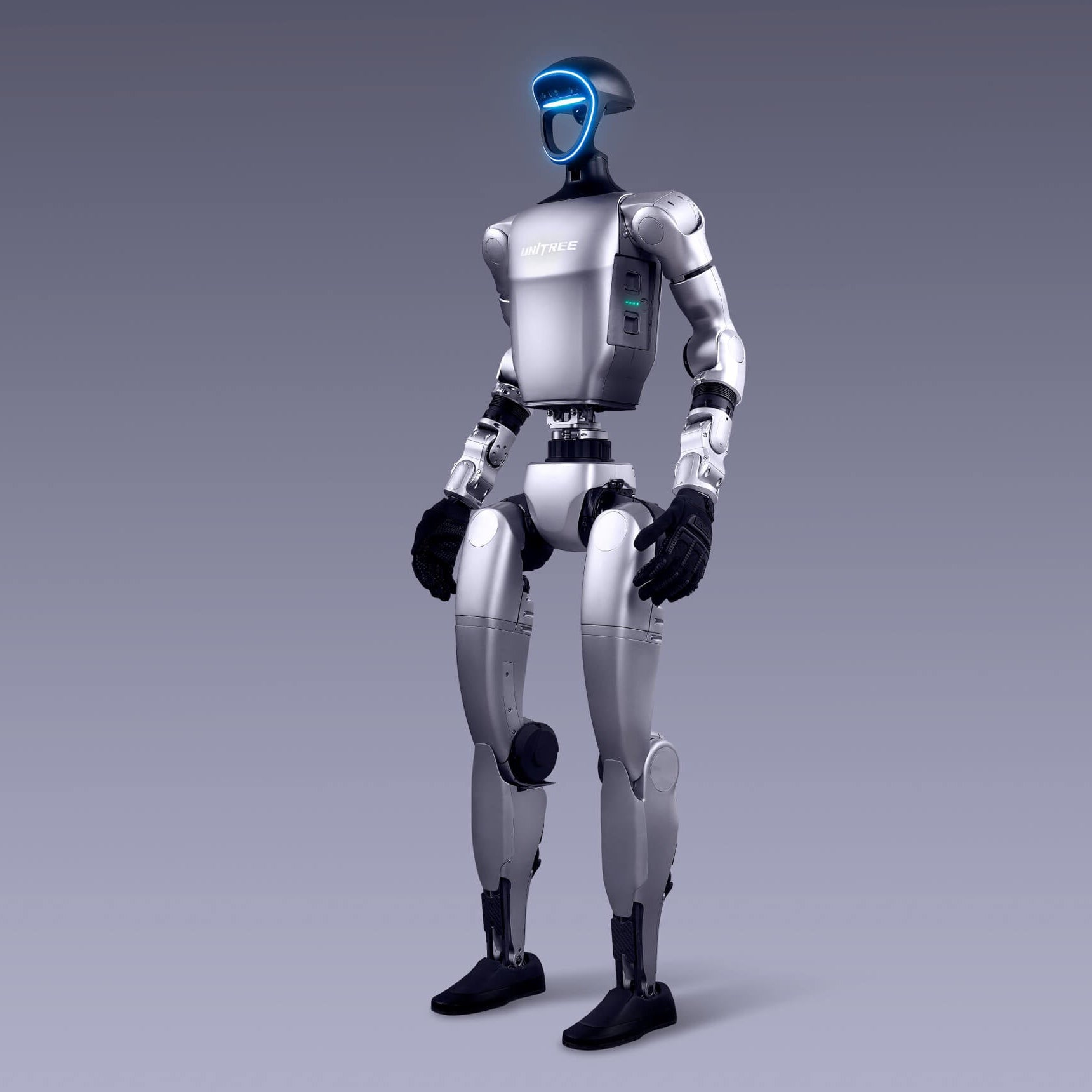
Unitree G1 EDU U2
G1 EDU is a natural humanoid-research direction for labs that need secondary-development access, expanded articulation and more onboard compute.
View G1 EDU U2 at SpeedyDrone
Unitree R1 EDU Standard
R1 EDU Standard adds development compute, high- and low-level control access, simulation resources and a lighter humanoid form.
View R1 EDU Standard at SpeedyDrone
Unitree B2
B2 shows why commercial robotics is not synonymous with humanoids. Inspection, terrain access, payload carriage and long-duration mobility can favour the quadruped form.
View Unitree B2 at SpeedyDroneAn IPO can accelerate the stack. It cannot remove the engineering between demo and deployment.
Capital-market belief is not the same as solved autonomy, safety or economics. Commercial usefulness appears task by task, often long before a humanoid becomes a general worker.
More capability, faster.
- Core robot and embodied-AI R&D
- Manufacturing capacity and supply-chain depth
- Compute, sensing, hands and new product development
- Documentation, developer tools and partner ecosystems
- More data from a larger installed base
The maturity gates remain.
- Reliable autonomy in unstructured environments
- Safe operation around workers and the public
- Task-specific grippers, fixtures and workflow redesign
- Battery, uptime, maintenance and support economics
- Cybersecurity, data governance and acceptance testing
Buy the current configuration for a measurable task — not the future promised by the valuation.
A larger public-market robotics company may invest more in R&D, manufacturing, software and new products. Canadian buyers still need to procure what exists now, with documented access, support and acceptance criteria.
Unitree IPO and Canadian robotics FAQ
How much is Unitree raising in its 2026 IPO?
At RMB 150.80 per share for 40,446,434 new shares, the gross offering size is approximately RMB 6.10 billion—roughly US$850 million at a contemporary exchange rate and commonly rounded to near US$900 million.
Was Unitree's IPO really more than 8,000 times subscribed?
Reuters reported that the portion offered to retail investors received demand exceeding 8,000 times the shares initially available in that tranche. This measures subscription demand, not future share performance or end-customer robot demand.
Does the IPO mean humanoid robots are now a mature commercial industry?
No. It shows strong capital-market interest and confidence that robotics can become a major industry. Commercial maturity still varies by task. Research, data collection and bounded inspection can be useful today, while general-purpose humanoid work remains uncertain.
Why is Unitree important to the Physical AI market?
Unitree combines quadrupeds, humanoids, dexterous hands, robotic arms, sensors and developer resources. That makes its hardware relevant to research connecting AI perception and decision-making with physical movement and manipulation.
Which Unitree robot is best for a Canadian university or AI lab?
G1 EDU and R1 EDU are logical starting points for many development projects, but the right choice depends on required control access, compute, degrees of freedom, hands, simulation support, payload and safety constraints. The exact configuration should be written into the quotation.
Should an industrial buyer choose a humanoid or quadruped?
Choose by task. B2 or another industrial quadruped may be stronger for difficult-terrain mobility and inspection. A humanoid may be more relevant when human-scale reach, bimanual manipulation or humanoid research is central. Neither form removes the need for integration and safety engineering.
Will IPO funding improve Unitree products?
It could support more R&D, manufacturing capacity, new products and embodied-AI development, consistent with the prospectus plan. Timing and customer impact are not guaranteed, so buyers should evaluate current documented capabilities.
Can Canadian buyers order Unitree robots through SpeedyDrone?
SpeedyDrone lists selected Unitree platforms and supports Canadian inquiries. Availability, configuration, pricing, software access and delivery details should be confirmed for the exact model before an order or procurement decision.
Primary reading and current product references
- Reuters: Unitree IPO and overseas revenue
- Shanghai Stock Exchange: IPO review and planned use
- China Securities Regulatory Commission: registration approval
- Unitree prospectus filed with the SSE
- Unitree: company and product timeline
- Unitree G1 official product information
- Unitree B2 official product information
- SpeedyDrone: Unitree G1 Basic
- SpeedyDrone: Unitree G1 EDU U2
- SpeedyDrone: Unitree R1 EDU Standard
- SpeedyDrone: Unitree B2
- SpeedyDrone: Unitree H2 EDU
Checked August 13, 2026. Offering details, exchange rates, listing status, product configurations, software access, prices and availability can change. This article is general robotics-industry information and is not investment, legal, safety or procurement advice. Product links reflect currently verified SpeedyDrone.ca listings as of the redesign date.
Explore Unitree robotics for a real project — not a headline.
Tell SpeedyDrone about the lab, inspection, education or humanoid-research requirement. The team can help narrow the platform and the exact configuration to evaluate.


