


Perception is now inside the motion loop
AGILE 2.0 links visual perception, whole-body locomotion and manipulation in a real-time closed loop. That is why AGIBOT's X2 demonstrations matter—and why they still need careful buyer interpretation.
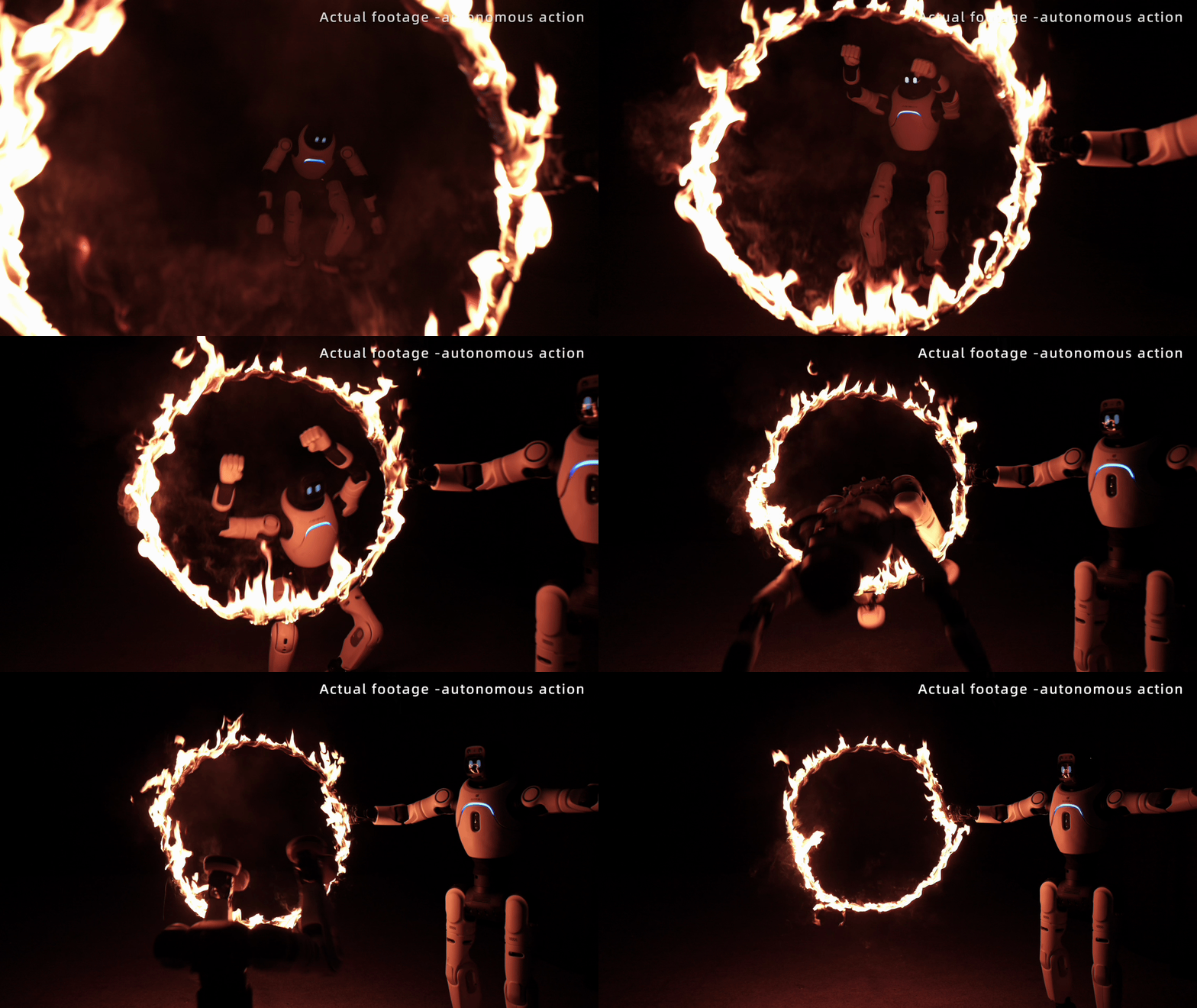
Quick answer
AGIBOT AGILE 2.0 is important because visual perception does not merely trigger a prepared move; it continuously informs localization, posture, contact and replanning while the robot is already moving. The X2 acrobatics demonstrate that control idea, but they do not establish universal autonomy, production readiness or an included feature set for every X2 or X2 Ultra sold.
AGILE 1.0 connected perception and motion. AGILE 2.0 makes perception continuously reshape motion.
AGIBOT describes AGILE as the AGIBOT Generative Intelligent Locomotion Engine. In its September 9 announcement, the company says AGILE 1.0 established a connection between perception and motion and allowed locomotion and manipulation to run concurrently. AGILE 2.0 moves visual perception directly into the locomotion-control loop.
That difference is easier to understand as a change in timing. A robot can perceive a scene, choose a motion and then execute that motion. A perception-driven closed loop keeps observing during execution. If the contact surface shifts, another robot changes phase or an object moves, the controller can update the body's posture, contact strategy and motion path instead of treating the original plan as fixed.
- 01 · ObserveRead the changing scene and robot state.
- 02 · UnderstandEstimate location, contact and constraints.
- 03 · ReplanUpdate posture, timing and motion path.
- 04 · ActCoordinate the whole body and manipulation.
- 05 · Observe againFeed the result back into the next decision.
Important definition: “Closed loop” does not mean a robot is generally intelligent or safe in every environment. It means observed state feeds back into control. The quality of sensing, models, constraints, testing and failure handling still determines what that loop can accomplish.
Closed-loop locomotion is more than playing back a routine
Even a scripted robot normally uses low-level feedback to keep joints and balance under control. The practical contrast is therefore not “feedback versus no feedback” in an absolute sense. It is whether the higher-level motion remains largely predetermined or can be reshaped by current visual and physical conditions.
| Question | Primarily scripted routine | Perception-driven closed loop |
|---|---|---|
| When is the path chosen? | Mostly before execution, with limited online adjustment. | Continuously updated as the environment and robot state change. |
| What happens when contact shifts? | The routine may pause, fail or rely on a narrow recovery behaviour. | Posture, contact decisions and the motion path can be replanned inside the ongoing action. |
| How are walking and handling related? | They may be separate phases: arrive, stop, then manipulate. | Locomotion and manipulation can share one whole-body motion representation. |
| What does success prove? | That a prepared routine works under its tested conditions. | That the feedback architecture handled the demonstrated variation—not every possible site or task. |
For a buyer, the meaningful question is not whether a demo looks spontaneous. It is what the system senses, which variables it can update, how quickly it recovers, what limits are enforced and whether the same behaviour repeats across the customer's real operating range.
Why a unified whole-body motion representation matters
AGIBOT says AGILE 2.0 introduces a unified representation that brings locomotion and manipulation into one motion framework. In practical terms, the controller is not forced to treat the legs as transportation and the arms as an unrelated task layer. It can reason about the robot's body as one coordinated system.
This is the foundation of loco-manipulation: handling an object while the body is still stepping, leaning, turning or recovering. Carrying a box with another robot, for example, changes balance, arm position, foot placement and the shared object's motion at the same time. A useful controller has to preserve task progress without sacrificing stability.
The concept is relevant well beyond acrobatics. A warehouse robot may need to adjust its stance while passing a tote. A factory robot may need to reposition its feet during a contact-rich task. A public-facing robot may need to slow or change its path around a person without abruptly abandoning an interaction. These are examples of the problem space the architecture is intended to address—not claims that the current demonstration validates each deployment.
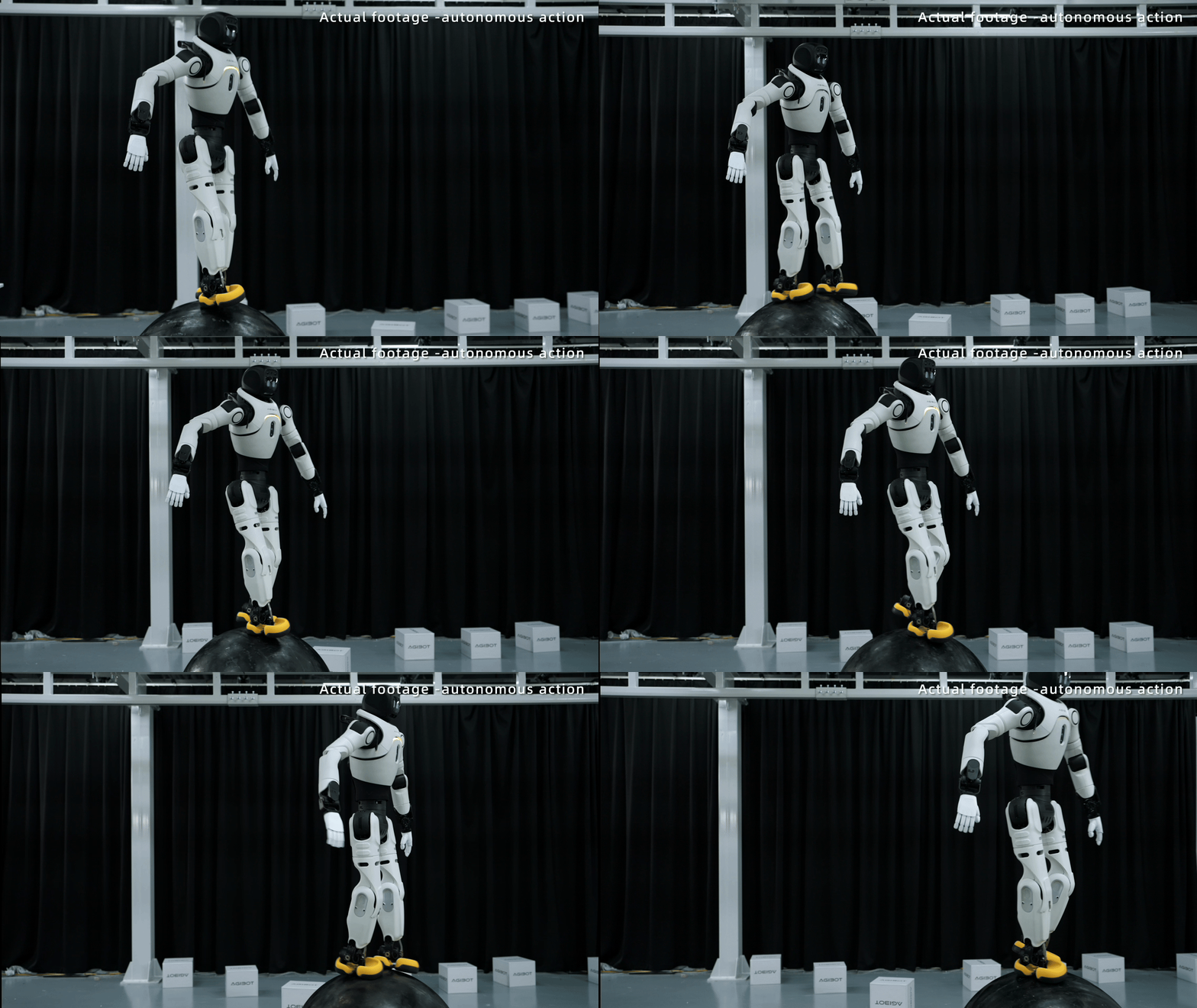
The ball demo tests changing contact, not a party trick alone
A large ball is an unstable support surface. As it rolls under the robot, the contact point, body orientation and centre-of-gravity relationship keep changing. AGIBOT says X2 adjusts posture and centre of gravity while coordinating whole-body motion to remain balanced and propel the ball.
The technical signal is continuous correction under unstable contact. The missing evidence is equally important: AGIBOT does not publish a success rate, disturbance range, duration benchmark or comparison against another controller in the announcement. The clip therefore supports a demonstrated capability, not a general performance guarantee.
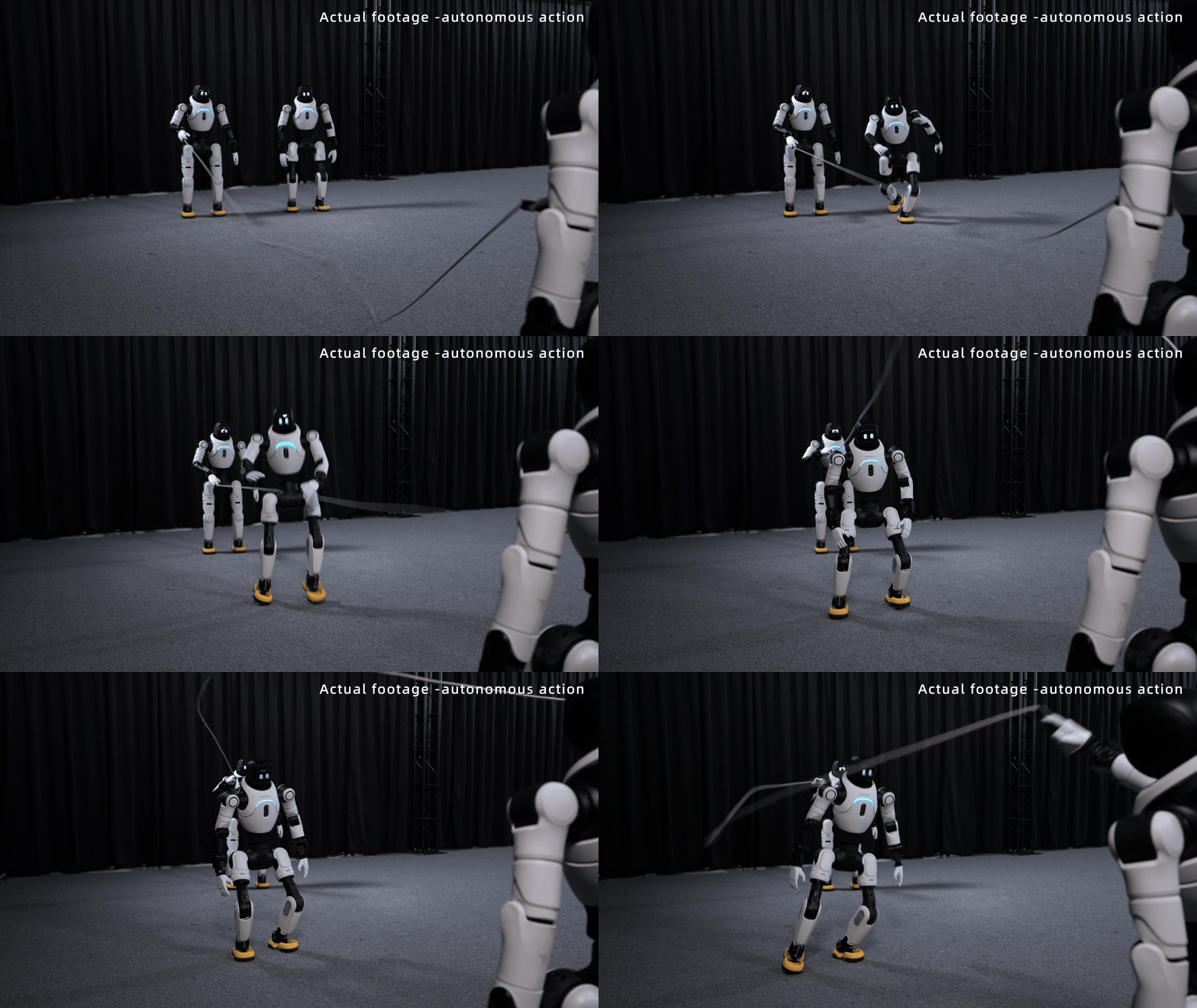
Three-robot rope jumping tests shared timing and partner state
In AGIBOT's description, two X2 robots swing the rope while a third tracks the trajectory and determines when to enter, jump and exit. That requires more than three independent routines beginning at the same time. The jumping robot must respond to the rope and to the other robots' motion states.
The demonstration is evidence of cross-robot state perception and coordinated timing in a prepared task. It is not evidence that a fleet can independently allocate work, negotiate traffic, handle arbitrary failures or operate safely in an uncontrolled facility. Those are separate system-level questions.
Collaborative handling shows why locomotion and manipulation cannot be separated
AGIBOT also reports a collaborative box-handling sequence in which two robots coordinate a transfer and precise stack. The object links both robots physically: if one robot changes height, timing or position, the other must respond without losing grasp stability or whole-body balance.
That is a clearer bridge toward practical loco-manipulation than a standalone pose. A future warehouse or factory workflow may require two systems to move around a shared load, but procurement still depends on the object's mass and geometry, grasp hardware, floor, path, cycle time, repeatability and recovery procedure. The announcement does not provide those acceptance metrics.
Perception, locomotion and manipulation operate together during dynamic tasks.
AGIBOT says the framework can recover from disturbances and posture deviations while maintaining task logic.
Measure success rate, intervention, recovery time and safe stop behaviour in the actual workflow.
What Acrobat BOT proves—and what it does not
AGIBOT's film is useful because each scene stresses a different relationship: unstable contact, continuous motion, manipulation during movement or coordination among robots. It is not a substitute for a deployment specification.
Reasonable conclusion
AGIBOT demonstrated AGILE 2.0 behaviours on X2 robots under prepared conditions, including real-time perception-driven locomotion, whole-body coordination and multi-robot timing.
Unsupported conclusion
Every retail X2 or X2 Ultra can reproduce every scene, ships with user-accessible AGILE 2.0 functions, or is ready for unsupervised factory work.
Reasonable next step
Use the demonstrations to identify the capability worth testing, then define the exact hardware, software package, development rights and acceptance criteria.
Separate safety question
Human-aware risk perception is a manufacturer-described capability direction; it is not a site-specific safety assessment or blanket authorization to operate around people.
AGILE 2.0 was demonstrated on X2—but X2 and X2 Ultra are not the same purchase
The AGILE 2.0 announcement names AGIBOT X2 robots as the demonstration platform. It does not map every demonstrated function to the software included with a specific SpeedyDrone SKU. That distinction matters because the current X2 and X2 Ultra listings have different hardware and development access.
Standard X2 is the 25-degree-of-freedom configuration focused on interaction, performance and agile motion. Its listed perception hardware is an interactive RGB camera; it does not list 3D LiDAR, RGB-D or a separate high-performance AI board, and secondary development is not supported. X2 Ultra lists 30 degrees of freedom, 3D LiDAR, RGB-D, front dual RGB and rear RGB cameras, an Orin NX board rated at 157 TOPS, expanded interfaces and secondary-development support.
Buying rule: choose the product around the project interface and sensing requirements, not around an Acrobat BOT clip. Confirm whether the required AGILE 2.0 functions, APIs, software packages and support scope are included in the exact quote.

AGIBOT X2
Start here for a defined compact-humanoid experience centred on expressive interaction and motion. Do not assume secondary-development access or the Ultra sensor stack.
View AGIBOT X2 at SpeedyDrone Canada
AGIBOT X2 Ultra
Start here when a project needs richer perception hardware, more onboard compute, expanded interfaces or secondary development. The hardware still does not prove that every AGILE 2.0 demo function is included.
View AGIBOT X2 Ultra at SpeedyDrone CanadaWhere perception-driven whole-body control could matter
The commercial value of AGILE 2.0 is not that factories need robots to balance on balls. The value is the control principle underneath: maintain task progress when the environment, contacts and partner motion do not remain perfectly fixed.
| Environment | Why the architecture is relevant | What still needs validation |
|---|---|---|
| Factory | Repositioning during handling, contact-rich work and recovery from small deviations. | Tooling, object tolerance, cycle rate, success rate, safe stop and integration. |
| Warehouse | Walking while carrying, coordinating around shared objects and adapting to changing paths. | Load range, grasp, floor, traffic, intervention rate and fleet orchestration. |
| Research | A platform for studying perception, locomotion and manipulation as one embodied system. | Exact SDK/API access, data rights, compute, sensors, software package and support. |
| Public-facing use | Smoother path and posture adaptation around people may improve interaction continuity. | Site safety, supervision, privacy, language scope, escalation and accessible behaviour. |
For earlier evidence about AGIBOT's locomotion work under competition conditions, read SpeedyDrone's analysis of AGIBOT's 2026 World Humanoid Robot Games results. For public-facing motion and international-market context, see the AGIBOT IFA 2026 analysis.
Questions a Canadian robotics team should answer first
A serious X2 project begins with the operating requirement, not the most impressive demo. Send the same task definition to the platform vendor, integrator and internal safety owner so everyone is evaluating one system boundary.
- What exact task must continue while the robot is walking, turning or recovering?
- Which objects, contacts, floor conditions and human interactions define the operating range?
- Is the requirement a finished interaction experience or a development platform?
- Which cameras, depth sensors, LiDAR, compute and interfaces are required?
- What AGILE 2.0 software, APIs or runtime functions are included in the quoted configuration?
- How will success rate, intervention rate, recovery time and safe stop behaviour be measured?
- Who owns integration, application software, updates, training and ongoing support?
- What privacy, cybersecurity, accessibility and site-safety review applies in Canada?
The AGIBOT X2 Series collection is the right place to compare the current Canadian product configurations before defining a pilot.
Questions buyers and robotics teams are likely to ask
What is AGIBOT AGILE 2.0?
AGILE 2.0 is AGIBOT's second-generation Generative Intelligent Locomotion Engine. The company describes it as a framework that integrates visual perception, environmental understanding, whole-body locomotion and manipulation in a unified real-time closed loop. Its core idea is that perception continues to influence localization, posture, contact decisions and replanning while the robot is moving.
What does perception-driven locomotion mean?
Perception-driven locomotion means current sensor observations are part of the movement-control loop, not only an input used before a motion begins. As the robot sees the environment or its contacts change, the controller can update posture, timing, contact strategy and the motion path. The term does not by itself specify accuracy, latency, operating range or safety performance.
What is whole-body control in a humanoid robot?
Whole-body control coordinates the robot's legs, waist, torso and arms as one physical system. This matters because a manipulation task changes balance and foot-placement requirements, while walking changes the position and stability of the hands. AGILE 2.0's unified whole-body motion representation is intended to support manipulation during continuous movement while preserving stability and motion continuity.
How is AGILE 2.0 different from AGILE 1.0?
AGIBOT says AGILE 1.0 connected perception with motion and enabled locomotion and manipulation to operate concurrently. AGILE 2.0 places visual perception directly in the locomotion-control loop and adds a unified whole-body motion representation. A concise way to state the difference is: perception informed motion in the first framework; in the second, perception continuously reshapes motion.
Why does AGIBOT X2 balance on a rolling ball?
The ball creates an unstable contact surface that keeps changing beneath the robot. Maintaining balance while propelling it requires continuous posture and centre-of-gravity adjustment across the whole body. It is a strong visual demonstration of online correction, but the clip does not provide a published success rate, disturbance limit or proof that the same controller is ready for every workplace surface.
What does the three-X2 rope-jumping demo show?
AGIBOT says two X2 robots swing the rope while a third tracks the rope trajectory and times its entry, jump and exit. That demonstrates coordinated timing and responsiveness to partner state in a prepared multi-robot task. It does not prove autonomous fleet management, general task allocation or safe multi-robot production deployment.
Does AGILE 2.0 make every AGIBOT X2 autonomous?
No such blanket conclusion is supported. AGIBOT demonstrated AGILE 2.0 behaviours on X2 robots, but the announcement does not say that every commercial X2 includes every Acrobat BOT capability, user-accessible AGILE tooling or general autonomy. Confirm the exact model, software package, enabled functions, development rights and integration scope in the project quote.
Is AGILE 2.0 included with AGIBOT X2 Ultra?
The public announcement does not establish AGILE 2.0 as an included retail feature of every X2 Ultra. X2 Ultra does provide the stronger product-side foundation for advanced work: richer perception hardware, an Orin NX compute board, expanded interfaces and listed secondary-development support. The specific AGILE runtime, APIs, demo behaviours and support scope still need written confirmation.
Should a research team choose X2 or X2 Ultra?
X2 can fit a defined interaction, performance or motion-demonstration requirement. X2 Ultra is the more relevant starting point when the research plan needs LiDAR, RGB-D, additional visual coverage, higher-performance onboard compute, network interfaces or secondary development. Selection should still follow the experiment, software-access requirement and acceptance test—not the model name alone.
Primary sources and related SpeedyDrone guidance
AGIBOT AGILE 2.0 announcement
AGIBOT Launches AGILE 2.0, Advancing Perception-Driven Locomotion for Humanoid Robots, September 9, 2026. Source for the framework description and Acrobat BOT demonstrations.
AGIBOT X2 specifications
Official AGIBOT X2 and X2 Ultra product specifications. Source for sensors, compute, interfaces and secondary-development differences.
SpeedyDrone Canada X2 records
Current AGIBOT X2, AGIBOT X2 Ultra and X2 Series collection. Product configuration and availability should be reconfirmed when quoting.
Evidence boundary
SpeedyDrone's World Humanoid Robot Games analysis separates competition evidence from deployment readiness.
Choose the hardware around the project—not the demo
Compare X2 and X2 Ultra based on whether your application requires interaction, perception, autonomy or secondary development, then confirm the exact software and project scope.
Explore the AGIBOT X2 Series

