


AGIBOT Wins 18 Gold Medals at the 2026 World Humanoid Robot Games — What the Results Actually Show
The medal count is striking. The useful buyer story is narrower: OmniHand, X2 and G2 were tested in three different capability areas, and each result answers a different technical question.
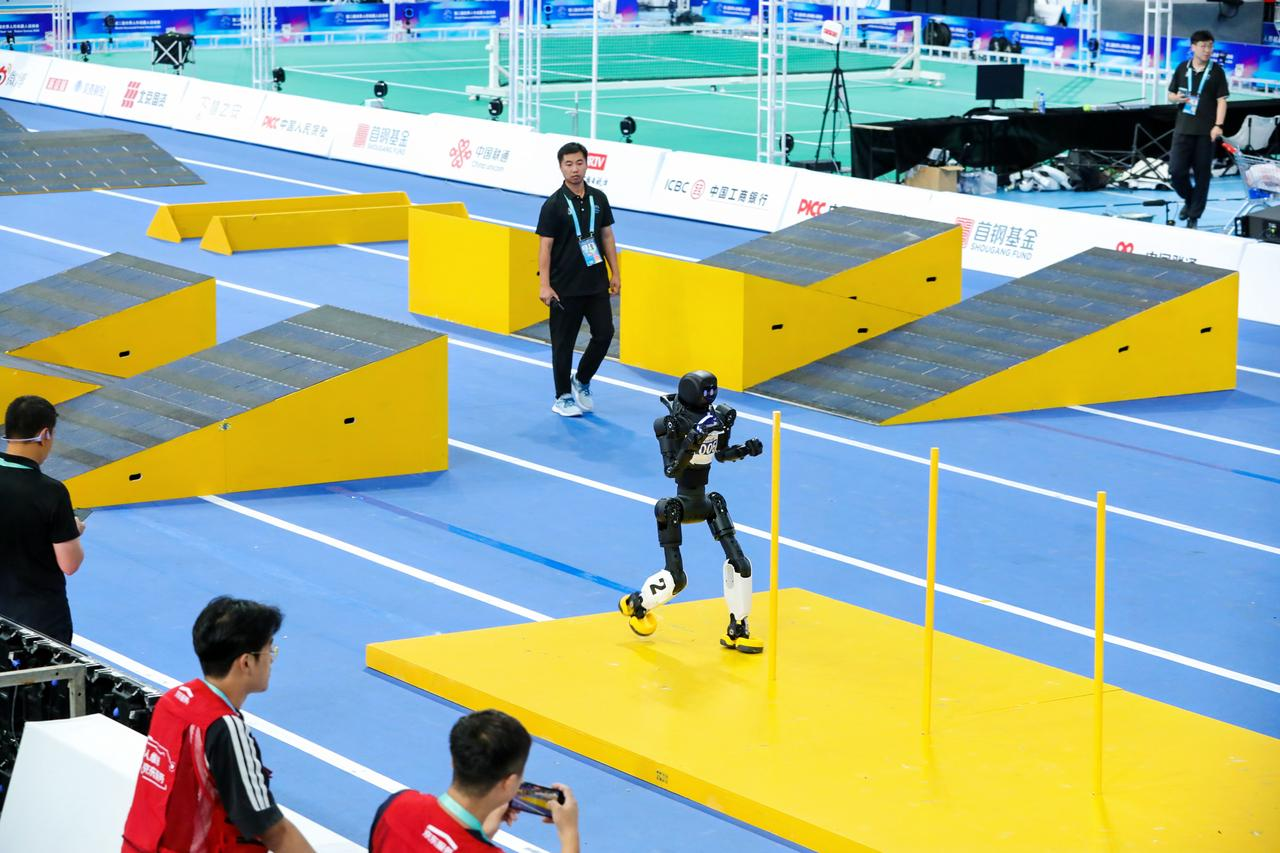
AGIBOT's 18 gold medals are evidence of progress across manipulation, locomotion and scenario execution. They are not proof that every AGIBOT robot can run an unsupervised production workflow.
OmniHand's results are relevant to fine object handling. X2's obstacle-race results show dynamic movement on a competition course. G2's hotel, library and emergency-response wins test longer task chains in staged scenarios. A Canadian buyer should use those results to decide what to test next, then validate repeatability, safety, integration, intervention rate and economics in the actual workplace.
For a broader guide to turning Games tasks into a procurement test, read our World Humanoid Robot Games 2026 buyer lessons. This article stays focused on AGIBOT's reported results and the three capability tracks behind them.
What AGIBOT actually won
AGIBOT said its competition lineup included OmniHand, G2, A3 and X2, with medals spanning dexterous manipulation, motion control and scenario-based tasks. The most useful way to read the result is by the type of technical risk each event exposed.
OmniHand: Why seven dexterous-manipulation golds matter
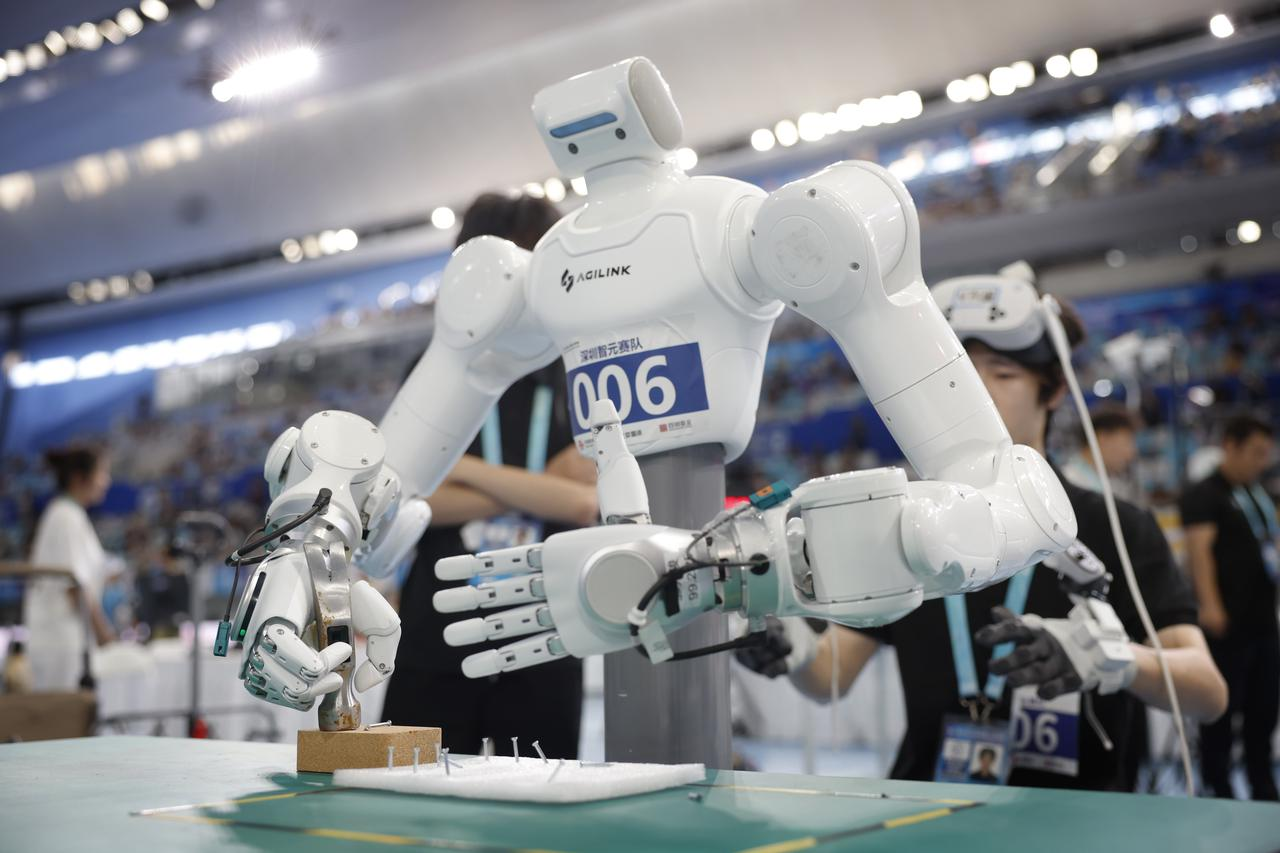
AGIBOT reported that OmniHand reached the final in all eight dexterous-hand events and won seven gold medals. Named tasks included block building, powder weighing and picking beans with tweezers. Those are useful tests because the hand must do more than close around a prepared object.
- Perceive
- Position
- Control force
- Manipulate
- Confirm
This chain is relevant to small-component handling, laboratory operations, electronics work, sorting and precision picking. It suggests that AGIBOT is testing fine manipulation rather than relying only on gross arm motion.
Buyer boundary: a controlled-task medal does not establish production-line throughput, acceptable error rate, uptime or long-term wear. The next test is the customer's real object set, lighting, tolerances, cycle count and recovery procedure.
AGIBOT X2: Testing movement beyond a choreographed demo
X2 won the 100-metre obstacle race and took silver and bronze in the 400-metre obstacle race, according to AGIBOT. The company also said the X2 used a mass-produced configuration and received no hardware modification specifically for the Games. That distinction is useful because it links the result to a repeatable product configuration rather than an unnamed one-off prototype.
AGIBOT attributes the movement stack to its AGILE locomotion framework, combining environmental perception with autonomous or semi-autonomous movement decisions, parameter identification and simulation-to-reality transfer. Sim2Real means a movement policy is developed or trained in simulation, then adjusted so it can operate on a physical robot despite friction, balance, sensor and timing differences.
Buyer boundary: an obstacle race tests balance, foot placement, route decisions and recovery under competition conditions. It does not prove that the robot can navigate every workplace floor, staircase, crowd or safety zone. It also does not transfer the competition claim to X2 Ultra, which is a separate SpeedyDrone SKU with a different sensing and development configuration.
AGIBOT G2: Why scenario-based tasks matter more for enterprise buyers
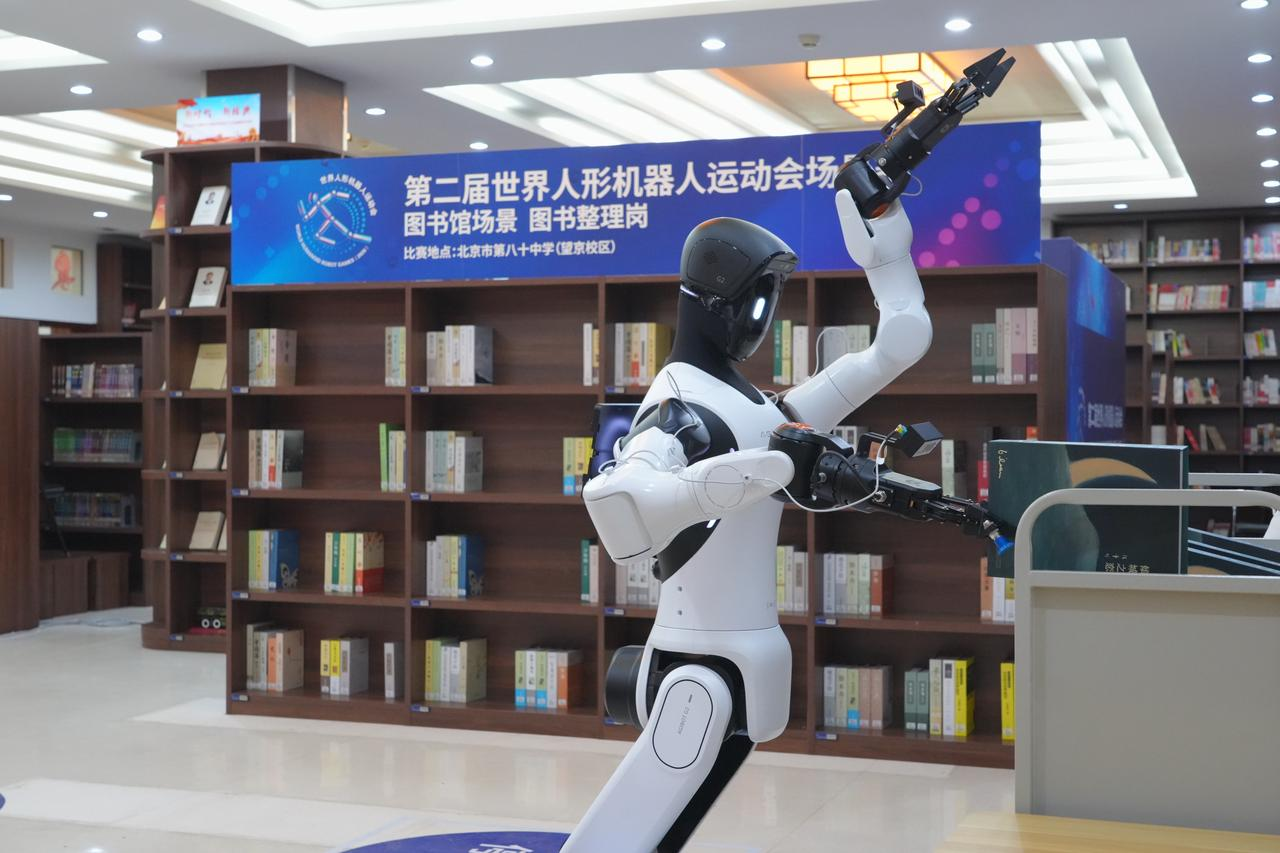
AGIBOT reported five gold medals in scenario-based tasks, including hotel service, library operations and emergency response. These events matter because a scenario usually connects perception, navigation, planning, manipulation and confirmation instead of scoring one isolated motion.
AGIBOT says the competition G2 uses its ViLLA embodied foundation model GO, world model GE and RW-RL system to support perception, planning and complex execution. It also says G2 has been deployed at factories operated by Longcheer and SAIC. These are manufacturer claims, and they should be treated as starting evidence for due diligence rather than as a promise of general autonomous intelligence.
Buyer boundary: the enterprise question is whether the exact G2 configuration can complete the customer's task at the required cycle time, with a defined intervention rate, safe-stop behaviour, software integration and support plan. A library win does not automatically validate a warehouse, hospital or factory workflow.
From competition to deployment
AGIBOT announced on June 28 that its 15,000th robot had rolled off the production line, and identified the milestone unit as G2. Production scale can support process consistency, supply planning and the ability to deliver hardware. It is different from a medal, which tests performance under defined event conditions.
The two signals become more useful when read together: competition can expose capability under pressure, while production can show whether a company is building repeatable units. AGIBOT also points to field deployments as a third signal. None replaces an acceptance test for the buyer's own environment.
The 15,000 figure should not be read as 15,000 humanoids completing unsupervised commercial work. AGIBOT describes a portfolio that includes humanoids, wheeled embodied robots, quadrupeds, dexterous systems and commercial cleaning platforms. Units produced, units shipped and units in validated production deployment are not the same metric.
What 18 gold medals do not prove
A medal can reduce uncertainty about a specific capability. It cannot settle every commercial question. Procurement still needs a separate evidence ledger.
| Competition evidence | What it can indicate | What the buyer must still verify |
|---|---|---|
| Dexterous-task win | Object perception, positioning and force-controlled manipulation under a defined task | Cycle time, object variation, miss rate, tool wear, recovery and safe handover |
| Obstacle-race result | Dynamic balance, foot placement and locomotion-policy execution on the course | Workplace surfaces, crowds, slopes, stairs, stop zones, fall risk and runtime |
| Scenario-task win | Multiple capabilities connected into a scored workflow | Integration, autonomy boundary, intervention rate, edge cases and useful output |
| Mass-produced configuration | A named product configuration exists beyond a competition prototype | Exact SKU, software entitlement, support, parts, training and acceptance criteria |
| Production milestone | Manufacturing scale and delivery capability | Canadian availability, maintenance, lifecycle cost and task-level ROI |
The table separates the manufacturer's reported evidence from the customer's remaining validation work. It is not a scoring system or an AGIBOT warranty.
Turn the medal result into a project test
Do not start with the highest medal count or the most advanced model. Start with a task that can be observed, timed and accepted.
- Define the taskName the object, action, route, completion condition and useful output. “Help in a warehouse” is not testable; “move these totes between these stations” is.
- Describe the environmentRecord floor transitions, stairs, doors, people, lighting, noise, network coverage, restricted areas and emergency-stop locations.
- Set payload and manipulation needsSpecify weight, dimensions, fragility, grasp points, tolerances, tool use and whether human-scale reach is necessary.
- Choose the autonomy boundaryDecide what may be autonomous, what remains supervised and when teleoperation or a safe stop is required.
- Plan integrationIdentify SDK and API access, sensors, compute, user accounts, network rules, data ownership and the systems that receive the robot's result.
- Write the acceptance testMeasure consecutive cycles, completion rate, intervention, recovery, runtime, charging, safety events and operator workload using the exact proposed configuration.
Which AGIBOT platform fits which application?
These are starting directions, not automatic recommendations. Confirm the exact configuration, development rights, sensors, end effectors and acceptance test before ordering.

AGIBOT X2
A compact humanoid direction for interaction, performance and agile-motion projects. Choose it when the project needs a defined product experience rather than secondary development access.

AGIBOT X2 Ultra
A separate X2-series option for research and development projects that need expanded sensing, onboard compute, interfaces and secondary-development support. The Games result discussed above applies to the competition X2 identified by AGIBOT, not automatically to X2 Ultra.

AGIBOT G2
An industrial embodied-robot direction for projects centred on force-controlled dual-arm manipulation and repeatable scenario execution. Buyers should define the workstation, object set, software integration and safe operating envelope before treating it as a production solution.
Compare the broader AGIBOT X2 Series, review the AGIBOT G Series, or visit SpeedyDrone's Authorized AGIBOT Dealer Canada hub.
The medal is a signal. Your acceptance test makes it evidence.
AGIBOT's results point to measurable progress in manipulation, locomotion and scenario execution. Some of the named platforms are also tied to production or deployment claims. A Canadian buyer still needs to prove repeatability, safety, integration and economics in the actual operating environment.
AGIBOT World Humanoid Robot Games 2026 questions
How many medals did AGIBOT win at the 2026 World Humanoid Robot Games?
AGIBOT reported 18 gold, 16 silver and 12 bronze medals, for 46 total. The company said it ranked first in both the gold-medal and overall medal tables.
Which AGIBOT robots competed in the Games?
AGIBOT identified OmniHand, G2, A3 and X2 in its competition lineup. This article focuses on OmniHand manipulation, X2 locomotion and G2 scenario execution because they represent three distinct buyer-relevant capability tracks.
What did AGIBOT OmniHand win?
AGIBOT said OmniHand reached the final in all eight dexterous-hand events and won seven gold medals. Named examples included block building, powder weighing and bean picking with tweezers.
Was the AGIBOT X2 modified specifically for the Games?
AGIBOT states that the competition X2 used its mass-produced configuration without hardware modifications specifically for the Games. Buyers should still confirm the exact SKU and software configuration being quoted for their project.
What does Sim2Real mean for a humanoid robot?
Sim2Real describes transferring a policy developed or trained in simulation to physical hardware. The team must account for differences in friction, balance, timing, sensor behaviour and other real-world conditions so the movement remains stable on the robot.
What do G2's scenario-based wins show?
They show that the competition system could connect several capabilities within scored hotel, library and emergency-response tasks. They do not establish general intelligence, unsupervised 24/7 operation or suitability for every enterprise workflow.
Does AGIBOT's 15,000-robot milestone mean 15,000 humanoids are deployed commercially?
No. It is a reported cumulative production milestone across AGIBOT's robot portfolio. Production, shipment and validated commercial deployment are different measures, and the portfolio extends beyond humanoids.
Are competition medals enough to choose a robot?
No. Use the result to identify the capability worth testing, then evaluate the exact product configuration, development rights, safety controls, cycle performance, error recovery, support and lifecycle cost in your environment.
Which AGIBOT platform should a Canadian project start with?
X2 can suit compact interaction and agile-motion projects, X2 Ultra can suit projects needing expanded sensing and secondary development, and G2 can suit industrial manipulation and scenario workflows. The correct starting point depends on the task, environment, autonomy boundary and integration plan.
Sources and methodology
- AGIBOT, “AGIBOT Wins 18 Gold Medals on World Humanoid Robot Games Debut,” August 26, 2026. Primary source for the medal counts, named platforms, events, X2 configuration, AGILE description and G2 claims.
- AGIBOT, “AGIBOT's 15,000th Robot Rolls Off the Production Line,” June 28, 2026. Primary source for the production milestone and G2 milestone unit.
- The Atlantic, “Scenes From the 2026 World Humanoid Robot Games,” August 24, 2026. Independent event context and photography coverage.
- SpeedyDrone product and collection pages were checked August 29, 2026 for current Canadian product names, positioning, images and links. Prices are intentionally omitted because they may change.
Editorial note: Competition and deployment claims are attributed to AGIBOT. SpeedyDrone sells AGIBOT products in Canada, so product guidance is separated from the reported Games results. No competition result is treated as a warranty, safety certification or guaranteed customer outcome.


