


How to Build and Budget a Humanoid Robotics Lab for a Canadian University
A practical framework for turning one humanoid robot into a safe, fundable and productive university research program—with realistic budgets for equipment, GPU compute, facility fit-out, staffing, governance and first-year operations.
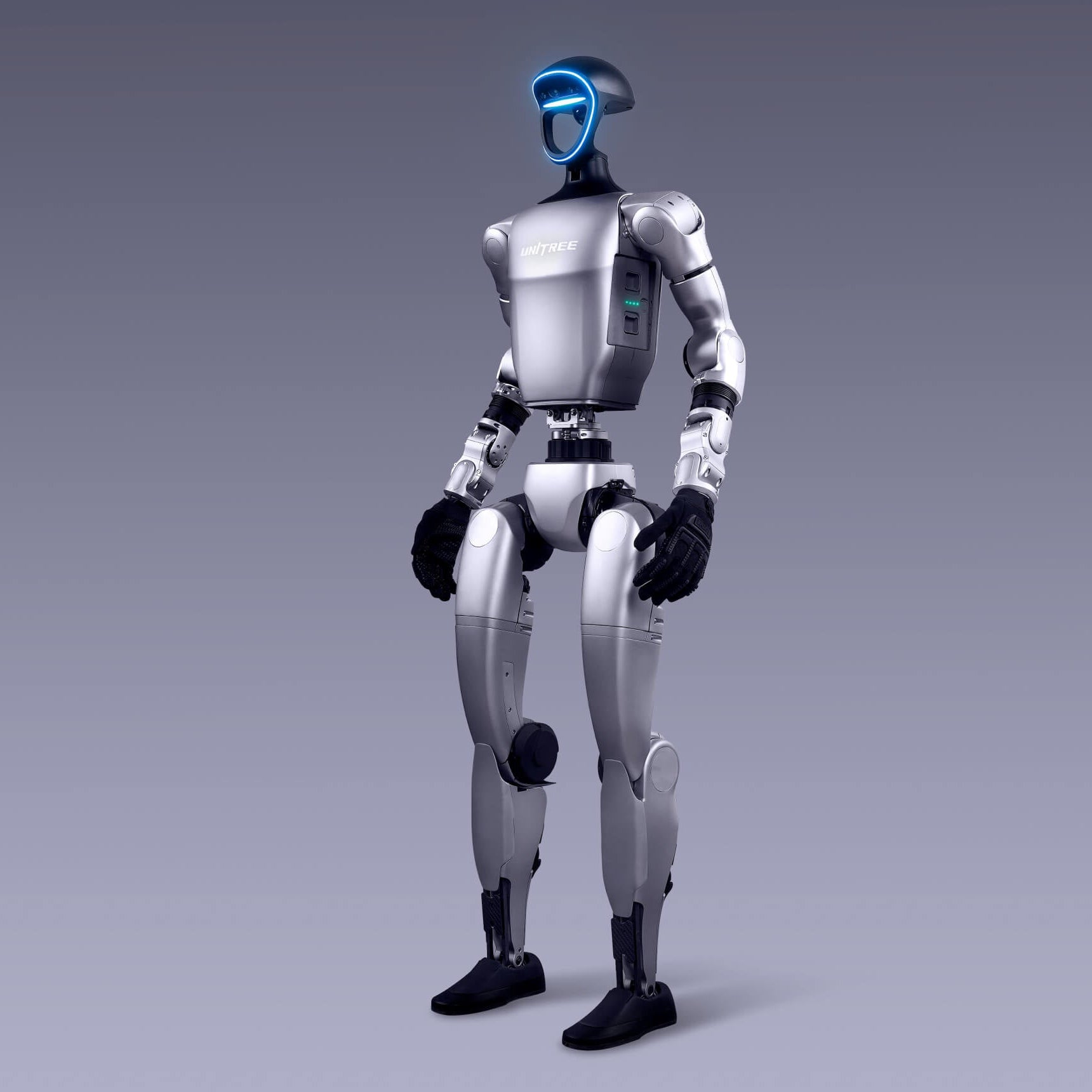
Budget the complete first-year research system, not only the robot. A compact teaching lab may require roughly CAD $100,000–$225,000; a serious G1 EDU research lab often needs CAD $225,000–$450,000; multi-platform or full-size humanoid programs can exceed CAD $500,000.
Start with a research mandate—not a robot model
The strongest lab proposal explains which research questions, courses, partnerships and outputs the infrastructure will enable. “We want a humanoid robot” is a purchase request. “We will create a shared embodied-AI facility supporting manipulation, HRI, motion control and industry-sponsored validation” is a lab strategy.
What knowledge will the lab create?
Define two or three research streams such as whole-body control, dexterous manipulation, multimodal perception, reinforcement learning, teleoperation or human-robot interaction.
How will students use it?
Identify courses, capstone projects, graduate training, lab rotations, safety certification and the number of users the facility must support each term.
Who will co-fund or use it?
Map industry partners, hospitals, manufacturers, public agencies, colleges, municipalities and researchers who can provide problems, datasets, equipment or matching funds.
What will success look like?
Specify publications, trained students, open-source tools, datasets, prototypes, demonstrations, patents or partner projects expected within 24 months.
Who controls access?
Decide whether the lab belongs to one principal investigator, a department, a faculty, a core facility or a multi-institution consortium.
What will the lab not attempt?
Exclude tasks that require certifications, facilities, payloads or staffing the first-year program cannot safely support.
Best first-year framing: build one reliable research pipeline, one repeatable teaching module and one external partnership use case. A narrower mandate produces a stronger budget, safer commissioning and clearer evidence for expansion.
Four realistic first-year humanoid-lab budget levels
The planning envelopes below include equipment, basic fit-out, compute, integration, spares and contingency. They do not represent supplier quotations, and they exclude major building construction and permanent faculty salaries.
Teaching and pilot lab
CAD $100K–$225KBest for a university or college entering humanoid development with one compact EDU platform.
- One R1 EDU or comparable compact EDU system
- One GPU workstation
- Small protected test zone
- Basic tools, batteries and spares
- Structured student access and operator training
Core G1 EDU research lab
CAD $225K–$450KBest all-round level for embodied AI, manipulation, perception and multidisciplinary research.
- One G1 EDU configuration
- Hands or manipulation reserve
- GPU workstation and network storage
- Fall-protection and commissioning infrastructure
- Integration, training and first-year operations
Multi-platform research centre
CAD $500K–$1.2MBest for shared facilities supporting several faculty members, courses and industry projects.
- Two or more humanoid platforms
- Multiple hand and compute configurations
- Dedicated teleoperation and simulation systems
- Research engineer or technologist capacity
- Expanded spares and fleet-management processes
Full-size humanoid centre
CAD $1.0M–$2.5M+Best for established centres pursuing H1, H1-2 or other full-size whole-body research.
- Full-size humanoid systems
- Engineered suspension and recovery systems
- Large protected research bay
- Dedicated technical staff
- High-capacity compute, storage and lifecycle reserve
Why the ranges are wide: the same robot body can be quoted with different degrees of freedom, hands, tactile sensors, compute, controllers, batteries, training and support. Facility conditions and internal staffing create equally large differences.
R1 EDU, G1 EDU or a full-size humanoid?
Select the smallest platform that can answer the approved research question. Lower mass generally reduces handling, transport, fall-energy and space requirements. Larger platforms add human-scale reach and dynamics but can multiply the facility budget.
On smaller screens, swipe the table left to compare lab-platform options.
| Planning factor | R1 EDU | G1 EDU | Full-size H1 / H1-2 class |
|---|---|---|---|
| Best role | Teaching, HRI, compact development and multi-unit programs | General embodied AI, manipulation and multidisciplinary research | Human-scale locomotion, reach, torque and high-load research |
| Approximate platform mass | About 29 kg | About 35 kg+ | About 47–70 kg |
| Published EDU articulation | 26–40 total joints by configuration | 23–43 total joints by configuration | 19–27 total joints in current H1 / H1-2 specifications |
| Perception | Binocular camera on R1 EDU | Depth camera + 3D LiDAR | Depth camera + 3D LiDAR |
| Listed runtime | About 1 hour | About 2 hours | Quick-replace battery; confirm mission runtime |
| Hands | Optional, including five-finger U5 configurations | Optional dexterous-hand and gripper configurations | Optional, with higher-load possibilities on full-size models |
| Current Canadian buying context | Custom pricing for R1 EDU U5 listing | G1 EDU U2 listed at CAD $76,980 when checked | Institutional configuration quote |
| Space and safety burden | Lowest | Moderate | Highest |
| Best university default | Budget-constrained or teaching-led program | Core research lab | Established specialist centre |
Do not buy G1 Basic as a substitute for G1 EDU when secondary development is required. SpeedyDrone listed G1 Basic at CAD $25,699, but Unitree’s public comparison positions secondary development on G1 EDU. The lower acquisition price may create re-procurement and lost research time.
Build the room around testing, recovery and supervision
A humanoid lab needs more than open floor area. The room must support receiving, charging, programming, instrumenting, safely restraining, testing and recovering the robot. These functions should be separated so one activity does not create hazards for another.
- Protected motion zone with controlled access
- Operator station outside the immediate fall envelope
- Battery charging and inspection area
- Robot storage and transport-cart location
- Workbench for hands, joints, sensors and cables
- Networked development and data station
- Camera coverage for experiment review
- Clear recovery path after a fall or shutdown
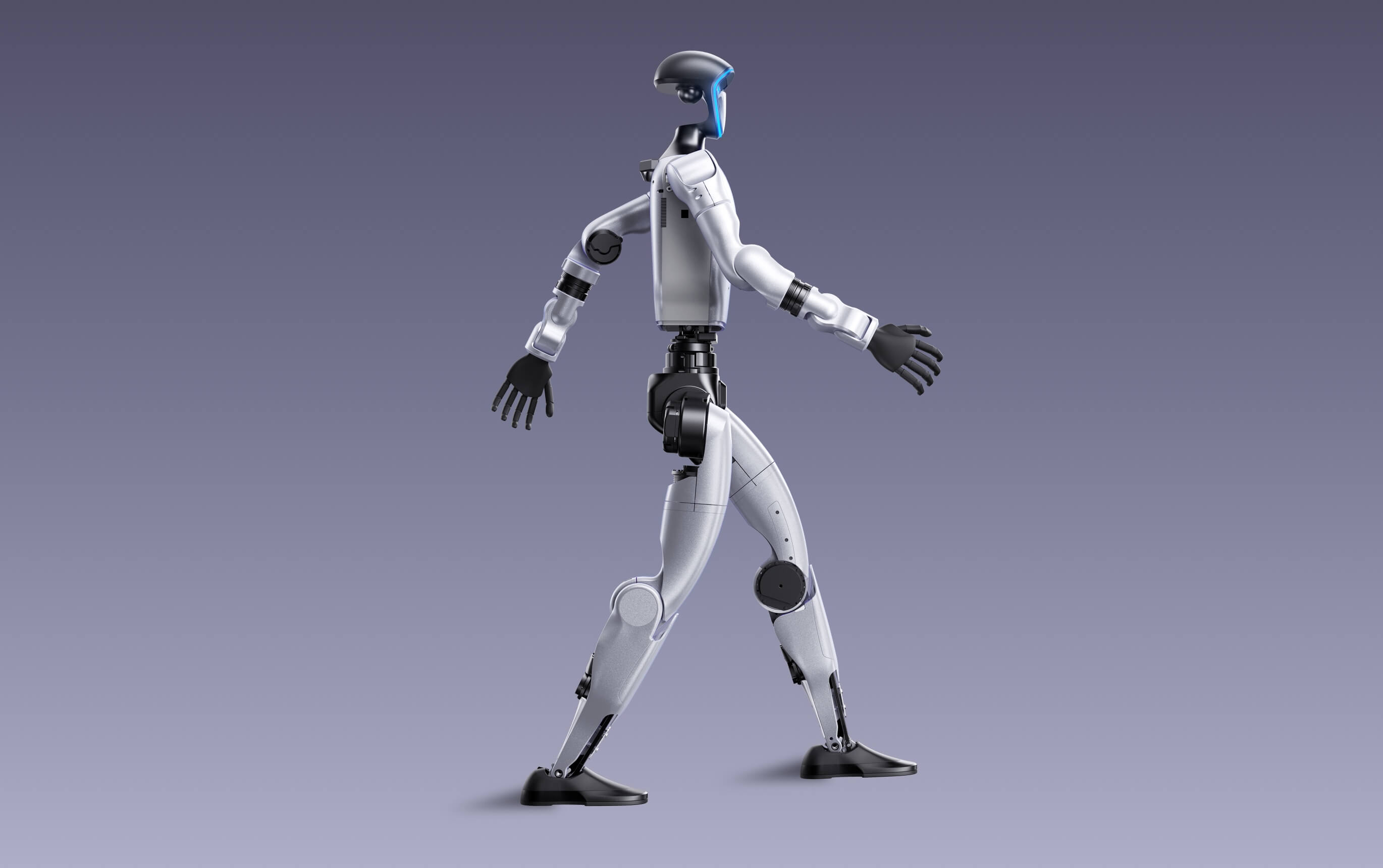
Approximately 500–900 sq. ft.
Can support a compact EDU robot, operator desk, workbench, storage and a modest protected motion area when the program avoids high-dynamic testing.
Approximately 900–1,800 sq. ft.
Supports larger protected zones, teleoperation, motion capture, shared student access and separate charging or maintenance functions.
Purpose-built bay
Full-size humanoids may require engineered overhead support, higher ceilings, rated anchors, larger fall clearance and lifting equipment.
Area figures are planning estimates, not building-code or engineering requirements. Final space, loading, electrical and anchoring requirements should be determined by the university and qualified professionals.
Safety infrastructure is core research equipment
Humanoid robots combine active joints, unstable balance, batteries, cameras, networked software and learned policies. Safety should be engineered into the room, operating procedure and software workflow before the first dynamic test.
Barriers and access control
Mark the motion zone, define observation points and prevent untrained users from approaching during tests.
Flooring and restraint
Use appropriate protective flooring and an engineered suspension or restraint method when validating low-level or high-energy control.
Independent stop and isolation
The shutdown method should not depend only on the experimental AI policy. Test controller stop, software stop and power isolation.
Inspection and storage process
Establish charging supervision, condition logs, storage rules, damaged-pack isolation and replacement criteria.
Plan how to move a disabled robot
Provide carts, lifting aids, approved grip points and enough trained personnel for the robot’s actual weight.
Progress from simulation to motion
Require review before moving from read-only telemetry to supported motion, free standing, walking, manipulation and public interaction.
Budget signal: allocate approximately CAD $25,000–$80,000 for safety and facility fit-out in a compact-to-core lab, and materially more for a full-size platform requiring an engineered overhead system.
Onboard compute does not replace the lab’s GPU and data infrastructure
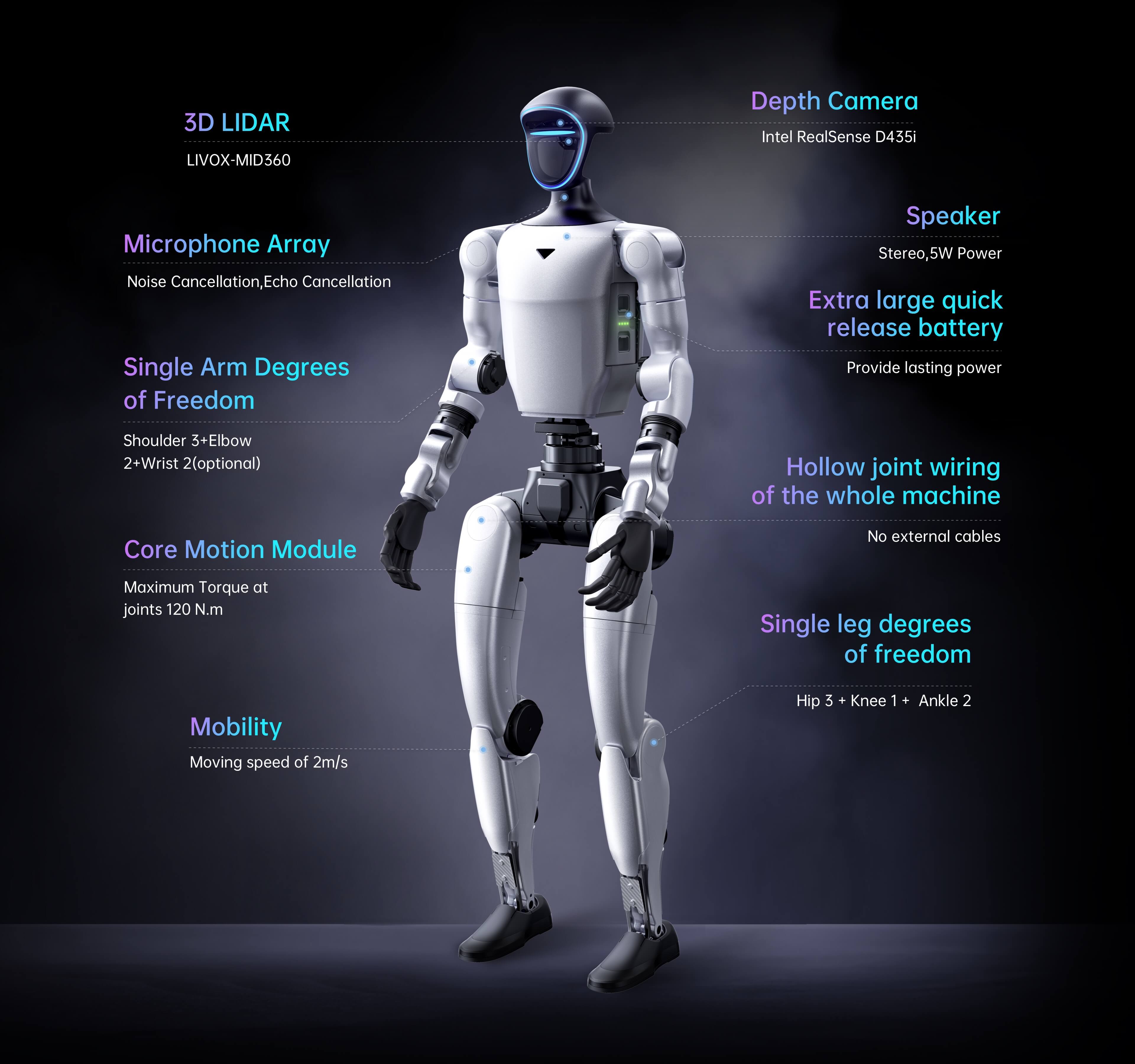
Humanoid development divides work across robot controllers, onboard development compute, operator workstations, simulation servers, storage and sometimes institutional clusters. The budget should reflect the workload, not only the robot’s published TOPS.
- High-end Linux development workstation
- GPU capacity for simulation, vision and policy training
- Fast local storage for datasets and rosbag files
- Network-attached storage or institutional research storage
- Managed robot VLAN or isolated research network
- Secure backup and version-control services
- Time synchronization and experiment logging
- Optional VR or XR teleoperation equipment
CPU, high-memory GPU, RAM, fast NVMe storage, displays and Linux support.
Higher GPU capacity for parallel environments, RL, synthetic data and digital twins.
Managed switching, network storage, backups, access control and data-retention capacity.
XR headsets, cameras, tracking, operator interfaces and data-collection equipment.
Capital-discipline option: use institutional GPU clusters for large training jobs and keep a responsive local workstation for robot-side debugging, simulation playback and experiment operations.
Design for simulation, controlled deployment and rollback
Robot model
URDF, MJCF or USD assets define joints, limits, frames and collision geometry.
SDK and DDS
Unitree SDK2 and documented interfaces connect state, services and commands.
ROS 2
Perception, logging, transforms, visualization and planning connect through managed nodes.
Simulation
MuJoCo, Isaac Lab or other tools validate control before physical deployment.
Data pipeline
Logs, videos, demonstrations and metadata create reproducible research evidence.
Policy layer
Control, imitation learning, reinforcement learning or multimodal models run tasks.
Governance
Versioning, approvals, security, rollback and experiment records control deployment.
Pin versions
Record robot firmware, SDK, ROS distribution, simulator, drivers, model versions and dependencies for every published experiment.
Separate research from deployment
Experimental branches should not move directly onto the robot. Use review, simulation, hardware-in-the-loop and approved release tags.
Log the complete experiment
Store configuration, seed, dataset, model hash, operator, environment, robot state and outcome—not only a final demonstration video.
A robot without technical ownership becomes expensive storage
Faculty vision is necessary, but shared infrastructure also needs daily technical ownership. The person who writes a paper is not always the person who maintains batteries, controls software versions, trains users and recovers the robot after a failed experiment.
0.25–0.5 technical FTE
Can support a limited-access teaching or research pilot when the platform, software scope and user count remain controlled.
0.75–1.5 technical FTE
Appropriate for a shared G1 EDU facility supporting multiple students, research streams and external demonstrations.
2+ technical FTE
Multi-platform and full-size programs require dedicated engineering, operations, safety and data-support capacity.
Budget staff time separately from equipment. A grant may purchase the robot while leaving the department responsible for technical salaries, student supervision, safety administration and software maintenance.
Illustrative CAD $325,000 first-year G1 EDU lab budget
This example assumes one G1 EDU U2-class platform and a serious but compact university lab. It is a planning model—not a quote—and should be adjusted for the university’s existing room, compute, staffing and procurement conditions.
| Budget category | Planning amount | What it covers | Budget risk |
|---|---|---|---|
| G1 EDU U2 platform | CAD $76,980 | Current SpeedyDrone listed platform price checked July 21, 2026 | Final package, tax, freight and lead time |
| Hands and configuration reserve | CAD $55,000 | Dexterous hands, wrist options, tactile sensors, controller or configuration changes | Highly configuration-dependent |
| GPU and data infrastructure | CAD $42,000 | Development workstation, GPU server contribution, managed network and storage | Existing university infrastructure may reduce cost |
| Safety and room fit-out | CAD $55,000 | Flooring, barriers, access control, restraint, cart, charging and recovery equipment | Engineering and room condition |
| Spares, batteries and tools | CAD $25,000 | Additional battery capacity, cables, tools, wear items and protected storage | Parts availability and freight |
| Training and commissioning | CAD $30,000 | Integration support, operator training, acceptance tests and documentation | Project complexity |
| First-year operating reserve | CAD $16,000 | Repairs, software services, data, freight and minor replacement items | Usage intensity |
| Contingency | CAD $25,020 | Approximately 8% reserve for procurement, installation and integration variance | Protects project completion |
| Illustrative total | CAD $325,000 | First-year capital and operating launch envelope | Excludes permanent faculty salaries and major construction |
Budget reduction strategy: the university can reduce the initial envelope by using existing GPU infrastructure, beginning without dexterous hands, reusing an approved robotics test room and limiting the first year to read-only, teleoperation and low-energy experiments.
Write the acceptance test before issuing the purchase order
Exact model and joint count
State EDU version, waist and arm axes, hand model, tactile sensors, compute module, controller and battery package.
SDK and interface access
Confirm documented high- and low-level functions, robot models, message definitions, examples and development-computer access.
List every component
Put hands, charger, batteries, controller, cables, adapters, tools, cases and spares directly in the purchase order.
Define test conditions
Verify sensors, joints, battery, controller, network, SDK examples and the approved baseline routines in the university’s room.
Define the Canadian pathway
Clarify diagnostic process, parts, freight, turnaround, remote support, responsibilities and escalation contacts.
Document software dependencies
Identify cloud services, outbound connections, accounts, telemetry, update mechanisms and data-export expectations.
Common procurement failure: approving “one G1 EDU robot” without specifying hands, compute, DoF, development access and acceptance criteria. The product can arrive functional while still failing the intended research program.
A realistic first-year laboratory roadmap
Design and procurement
Finalize mandate, funding, configuration, room design, risk assessment, data architecture and acceptance criteria.
Receiving and baseline systems
Inspect hardware, establish network and software baselines, train operators and validate read-only telemetry.
Controlled research pilot
Move from simulation to restrained motion, low-risk manipulation and a narrowly defined first research project.
Repeatability and shared access
Document failure modes, approve additional users, publish the lab handbook and decide whether to add hands or a second platform.
Telemetry and reproducibility
Capture joint, IMU, battery and sensor data through a versioned, repeatable and reviewable pipeline before motion development.
One controlled task
Select a known object, fixed environment and measurable success rate rather than attempting general-purpose autonomy.
Approved lab handbook
Publish user access, training, booking, data, safety, maintenance and incident procedures before broad student use.
Canadian funding pathways for humanoid research infrastructure
The strongest proposal connects infrastructure to talent recruitment, research excellence, partner demand, training outcomes and a sustainable operating plan. Program eligibility and deadlines should always be confirmed through the institution.
JELF and infrastructure programs
CFI normally funds up to 40% of eligible infrastructure costs. The John R. Evans Leaders Fund can support eligible institutions and researchers, subject to institutional allocation and program rules.
Research Tools and Instruments
RTI provides a primary route for eligible university researchers to seek support for research tools and instruments, with grants up to CAD $150,000.
Applied Research Tools and Instruments
ARTI supports eligible colleges purchasing equipment that strengthens applied research, industry partnerships and student training.
CFI Infrastructure Operating Fund
IOF helps cover a portion of operating and maintenance costs for CFI-funded infrastructure, reinforcing the need for a long-term O&M plan.
Sponsored research and Alliance-style projects
Partners can contribute cash, staff, datasets, facilities and use cases. Structure commitments around defined research outputs rather than equipment publicity alone.
Faculty, department and central funds
Use internal matching, renovation, technician, startup, strategic initiative and teaching-innovation budgets to close gaps grants may not cover.
Funding narrative: present the robot as shared research infrastructure that attracts faculty, trains highly qualified personnel, supports multiple disciplines and creates partner-facing capacity—not as a single-lab demonstration asset.
Research ethics, privacy and cybersecurity in Canada
Humanoid systems may capture identifiable video and audio, process data locally, connect to external services and execute autonomous actions. Governance should begin during procurement rather than after the first participant study.
Determine whether REB review applies
TCPS 2 is the official policy of Canada’s three federal research agencies. Research involving human participants, behaviour or identifiable recordings may require review.
Plan free, informed and ongoing consent
Human-robot interaction studies should explain physical risks, data collection, withdrawal, recordings and unexpected robot behaviour.
Map every data flow
Identify camera, microphone, telemetry and account data; where it is stored; and whether it leaves the university environment.
Segment and monitor the robot
The Cyber Centre’s edge-AI guidance emphasizes asset inventory, monitoring, supply-chain integrity, least privilege and protected update pipelines.
Keep independent override controls
Human operators must be able to intervene or shut down autonomous behaviour through controls that do not depend on the AI cooperating.
Record near-misses
Log software state, commands, operator action, sensor health and recovery so the lab can improve after anomalies without relying on memory.
This article is not legal, engineering or safety certification advice. Universities should involve their REB, privacy office, IT security team, environmental health and safety function, insurer, procurement office and legal counsel as appropriate.
Track research productivity and operational reliability
Publications, datasets, software releases, benchmarks, theses and partner prototypes.
Certified operators, student projects, course hours and graduate researchers supported.
Available research hours, failed sessions, repair days and experiment repeatability.
Follow-on grants, industry contributions, shared projects and infrastructure utilization.
Cost per usable robot hour
Divide annual operating and lifecycle cost by hours available for approved teaching or research—not by calendar ownership time.
Repeatable experiments per term
A lab that completes ten documented experiments may create more value than one producing a single high-visibility demonstration.
External funding generated
Track how the infrastructure improves grant competitiveness, faculty recruitment, industry projects and interdisciplinary collaboration.
Plan the complete humanoid laboratory before ordering the robot
SpeedyDrone Canada supports universities, colleges, AI laboratories and research centres evaluating Unitree R1 EDU, G1 Basic, G1 EDU and advanced humanoid configurations. Send the research mandate, preferred platform, hand requirements, compute needs, room constraints, budget and target delivery date for a configuration and lab-planning discussion.
Humanoid systems are configuration-sensitive special-order products. Confirm final model, joints, hands, sensors, compute, development access, batteries, controller, warranty, training, freight and lead time before purchase.
Canadian humanoid robotics lab FAQ
How much does it cost to build a humanoid robotics lab in Canada?
A compact teaching or pilot lab may require approximately CAD $100,000–$225,000. A core G1 EDU research lab commonly needs a planning envelope around CAD $225,000–$450,000. Multi-platform and full-size programs can exceed CAD $500,000 and may reach several million dollars.
Why does the lab cost more than the humanoid robot?
The complete budget includes hands, compute, storage, network, protective flooring, barriers, restraint, batteries, spares, tools, training, integration, staffing, repairs, freight and contingency in addition to the robot.
Which Unitree humanoid is best for a new university lab?
R1 EDU is a strong lower-mass option for teaching and compact development. G1 EDU is the strongest all-round choice for many multidisciplinary research labs because it combines 3D sensing, development access, manipulation options and a mature public ecosystem.
Can a university use G1 Basic for research?
G1 Basic can support evaluation and controlled demonstrations, but it should not be assumed to provide the same secondary-development capabilities as G1 EDU. A lab requiring SDK access or custom control should confirm an EDU configuration.
How much was Unitree G1 EDU U2 in Canada when checked?
SpeedyDrone Canada listed G1 EDU U2 at CAD $76,980 on July 21, 2026. The page described a 29-DoF, 100-TOPS configuration and noted that hands are not included in many U2 packages.
Should a humanoid lab buy dexterous hands immediately?
Not always. A lab focused first on locomotion, sensing, telemetry or HRI can delay the hand purchase. Manipulation-focused labs should specify hand model, active DoF, tactile sensing, wrists, payload and software interfaces before ordering.
How much room does a humanoid robotics lab need?
A compact lab may operate in roughly 500–900 square feet, while a shared core research lab may use approximately 900–1,800 square feet. Full-size humanoids may require a purpose-built bay and engineered overhead support.
What safety equipment should the budget include?
Include protected flooring, barriers, access control, tested emergency stops, an approved restraint or suspension method, transport equipment, charging controls, protective storage and recovery tools appropriate to the robot’s mass.
Does the university need a GPU server?
Most serious labs need local GPU capacity for simulation, computer vision, model inference and debugging. Large training jobs may use an institutional cluster or cloud environment, reducing the need for a dedicated high-end server.
How many staff members are needed?
A controlled pilot may operate with 0.25–0.5 technical FTE. A shared core lab often needs 0.75–1.5 technical FTE, while multi-platform and full-size centres may require two or more dedicated technical staff.
Can CFI help fund a humanoid robotics lab?
Eligible institutions may use CFI infrastructure programs, subject to program and institutional rules. CFI normally provides up to 40% of eligible infrastructure costs, and its Infrastructure Operating Fund supports part of eligible operation and maintenance costs.
Can NSERC RTI fund humanoid research equipment?
NSERC’s Research Tools and Instruments program is a primary equipment-funding route for eligible university researchers and provides grants up to CAD $150,000. Applicants should confirm the current competition and cost eligibility with their research office.
Does human-robot interaction research require ethics review?
It may. Research involving human participants, identifiable recordings, behavioural observation or physical interaction may require institutional REB review under TCPS 2 and the university’s own policies.
How should a university secure a humanoid robot?
Maintain an asset inventory, segment the robot network, use least privilege, monitor activity, protect software and model updates, map data flows, preserve independent shutdown controls and document incident response.
Where can a Canadian university request a lab assessment?
Contact SpeedyDrone Canada for Unitree configuration guidance, Canadian pricing, financing questions, Toronto consultation and university humanoid-lab planning.
- Unitree R1 official product page and R1 EDU configuration range
- Unitree G1 official product page and G1 / G1 EDU specifications
- Unitree H1 and H1-2 official specifications
- Unitree R1 official SDK development guide
- Unitree G1 official SDK development guide
- Unitree official manipulation models and datasets
- SpeedyDrone Canada G1 Basic listing
- SpeedyDrone Canada G1 EDU U2 listing
- SpeedyDrone Canada R1 EDU Pro C / U5 listing
- Tri-Council Policy Statement: Ethical Conduct for Research Involving Humans – TCPS 2 (2022)
- Canadian Centre for Cyber Security edge-AI deployment guidance
- Canadian Centre for Occupational Health and Safety robot and cobot guidance
- Canada Foundation for Innovation John R. Evans Leaders Fund
- Canada Foundation for Innovation Infrastructure Operating Fund
- NSERC Research Tools and Instruments grants program
- NSERC Applied Research Tools and Instruments grants
Information and Canadian listings were checked on July 21, 2026. Prices, configurations, hands, sensors, computing, development access, software, funding rules, package contents, warranty procedures and lead times can change. Budget figures are planning estimates rather than supplier quotations. Manufacturer maximum figures are configuration-dependent results, not guarantees. Verify the exact Canadian configuration, institutional requirements, funding eligibility and acceptance criteria before purchase or project approval.


