


DJI Agras T50 vs Traditional Farming: Cost Savings, Efficiency and ROI
Traditional tractors and sprayers remain essential tools. The DJI Agras T50 creates value where farms lose time, damage crops, wait for soil conditions, face labour limits or need access to difficult areas.
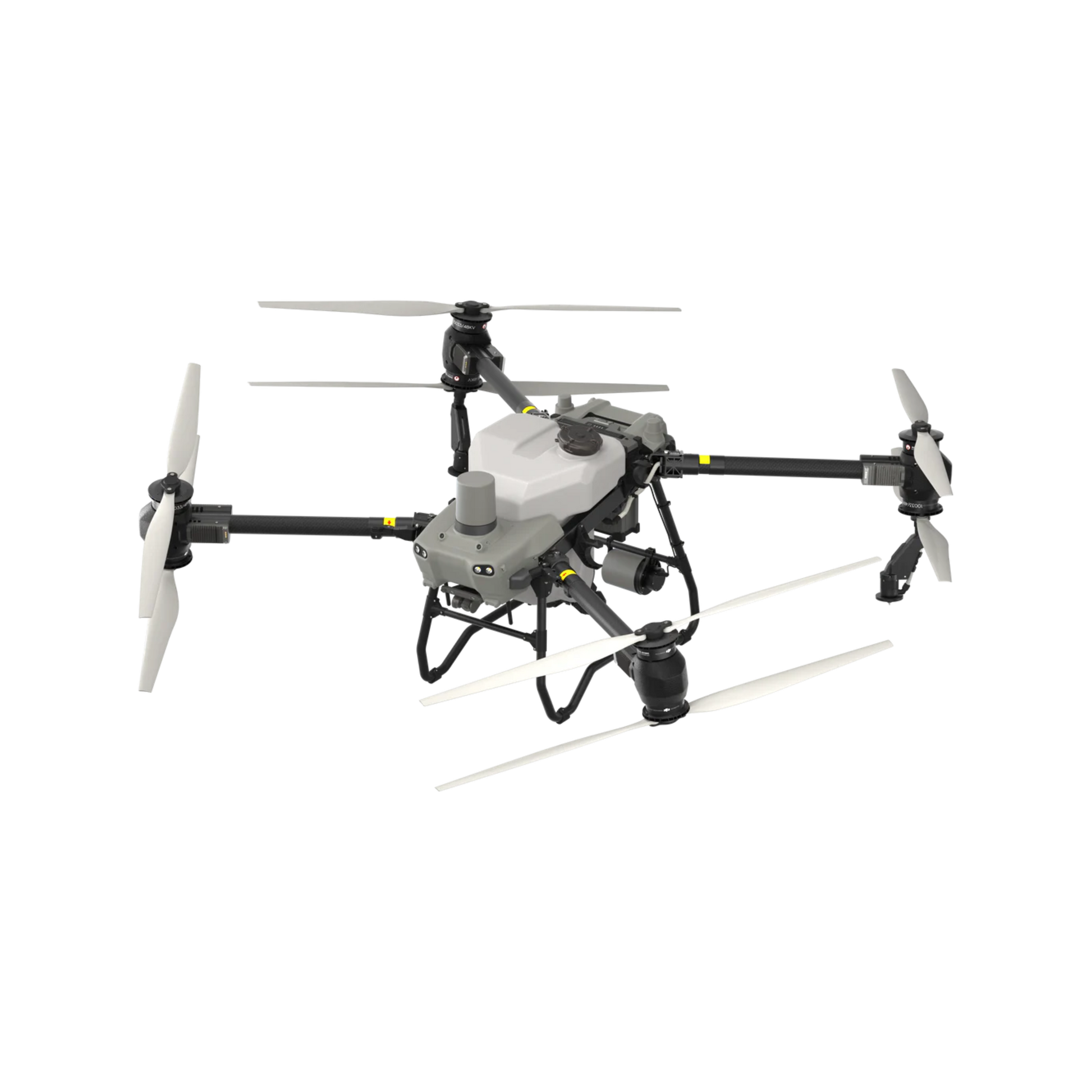
DJI Agras T50: 40 L spray tank, 50 kg spreading payload, dual atomizing system, RTK, radar and binocular vision.
The question is not drone versus tractor. It is where each system creates more value.
Large ground sprayers can remain highly efficient on continuous acreage. T50 becomes compelling where access, timing, soil conditions, crop contact or localized work create a recurring cost.
Traditional strength
Established infrastructure, high-volume continuous work, familiar service networks and large-acreage productivity.
T50 advantage
Minimal field contact, flexible staging, rapid response, spot treatment and access to wet or difficult blocks.
Best farm strategy
Use both systems where they perform best instead of forcing one machine to handle every acre and every weather window.
Compare the complete operating system.
The correct comparison includes capital, labour, fuel, transport, water, batteries, charging, insurance, training, licensing, maintenance, crop contact and the value of completing work on time.
| Factor | Traditional sprayer or tractor workflow | DJI Agras T50 workflow |
|---|---|---|
| Best operating environment | Large, accessible and continuous fields | Wet fields, difficult blocks, crop edges, tall crops and localized work |
| Field contact | Wheel traffic may create compaction, rutting or crop contact | Aircraft does not drive through the crop or soil |
| Labour structure | Machine operator, filling and support workflow | Qualified pilot, mixing or loading support, batteries and field logistics |
| Power cost | Diesel, maintenance and tractor or chassis ownership | Batteries, generator or electrical service, cooling and replacement planning |
| Response time | May depend on dry soil, machine availability and travel | Can be staged rapidly when the legal, weather and crew conditions align |
| Application capacity | Often stronger for high-volume continuous acreage | Strong for targeted, time-sensitive or difficult-access work |
| Compliance | Equipment, pesticide, worker and road requirements | Transport Canada, aircraft assurance, pesticide label, provincial licence, crew and insurance |
Savings come from avoided problems, not from a universal per-acre promise.
The value of T50 varies by crop, weather, farm layout, application rate and existing equipment. Build the case from records rather than promotional averages.
Access value
Measure the acres that can be treated when wet soil, crop height or field geometry prevents ground access.
Timing value
Estimate the financial impact of completing work during the preferred weather or crop-development window.
Crop-contact value
Quantify rutting, compaction or crop contact only where the farm can support the estimate with actual records.
Labour value
Compare total crew hours for planning, mixing, loading, flying, refilling, charging, cleaning and documenting.
Service revenue
Custom applicators can compare billable acres with travel, downtime, insurance, licensing and equipment depreciation.
Equipment flexibility
A drone may avoid mobilizing a larger machine for a small, remote, irregular or time-sensitive block.
Efficiency depends on the crop and staging system.
The aircraft cannot outperform a weak refill, charging, crew or calibration workflow.


Calculate break-even from net value per treated acre.
Use low, expected and high utilization scenarios. Include bad-weather seasons and regulatory delays, not only the best possible operating month.
Annual system cost
Equipment depreciation, financing, batteries, insurance, training, licensing, support and storage.
Variable operating cost
Labour, generator fuel, travel, water, maintenance, replacement parts and cleaning.
Net value per acre
Service contribution, avoided access loss, timing value and measurable crop-contact savings.
T50 cost, efficiency and traditional-equipment questions.
Can DJI Agras T50 save money compared with traditional spraying?
Potentially. The result depends on utilization, crop value, access, timing, labour, fuel, equipment ownership, charging, maintenance and compliance costs.
Does T50 replace a tractor or ground sprayer?
Not automatically. Many farms use T50 as a complementary tool for wet fields, tall crops, spot work, edges, specialty crops and narrow weather windows.
Where does T50 usually create the strongest value?
T50 is most compelling where the farm has a recurring access, timing, labour, crop-contact or custom-service problem.
Is drone spraying always cheaper per acre?
No. Ground equipment may remain more economical for large, continuous and accessible acreage. Drone economics improve when flexibility and avoided losses have measurable value.
How much can T50 carry?
DJI specifies a 40 L spray tank with a 40 kg operating payload and a 75 L spread tank with a 50 kg internal load.
Can T50 spray pesticides in Ontario?
Potentially, but only when the product permits aerial application and all Health Canada, Transport Canada, Ontario licensing, label, PPE, insurance, crew and recordkeeping requirements are met.
Should a small farm buy T50?
Acreage alone is not enough. A smaller high-value farm with repeated access and timing problems may justify ownership, while a larger farm may prefer a contractor or service-first model.
What should be included in a complete cost comparison?
Compare the aircraft, batteries, charger, generator, transport, labour, training, licensing, insurance, maintenance, crop contact, access and timing value.
Compare your current farming workflow with a T50 deployment.
Send the crop, acreage, current equipment, application rate and biggest operational bottleneck. SpeedyDrone can evaluate ownership, leasing, demonstration and service-first options.
Request a farm fit-check


