


Battery · charging · field rotation
The T100 works only when the power loop keeps up.
How DB2160 batteries, the C12000 grid charger and the D14000iE generator shape real turnaround time on Canadian farms.
Quick answer: which T100 power setup should you choose?
Choose the C12000 when suitable three-phase electrical service is available where batteries will be charged. Choose the D14000iE when field independence matters more than weight, fuel handling and generator logistics.
Do not choose by the “8–9 minute” number alone. DJI publishes that time for charging a DB2160 from 30% to 95% under stated conditions. It is not a zero-to-full claim, and it does not include landing, removal, cooling, connection, refill or the next swap.
A three-battery rotation is a sensible starting architecture: one battery flies, one cools or waits ready, and one charges. It is not an automatic guarantee of nonstop work. The loop succeeds only if cooling plus charging finishes before the aircraft needs that battery again.
| Your operating reality | Best starting point | Why | Verify before buying |
|---|---|---|---|
| Suitable three-phase service at a fixed base | C12000 Intelligent Power Supply | Silent, grid-powered charging with DJI's full 12,000 W rating at three-phase 380 V | Voltage, phase, breaker/circuit capacity, connector and installation with a qualified electrician |
| Only ordinary single-phase service | C12000, but with lower expected throughput | DJI rates it at 3,000 W on single-phase 220 V—not the 12,000 W three-phase figure | Actual site supply and the resulting charge time for your landing state of charge |
| Remote fields without dependable power | D14000iE Multifunctional Inverter Generator | Integrated 11,500 W DC charging output and a dedicated cooling-output workflow | Transport, outdoor placement, fuel, noise, maintenance and the exact North American unit |
| Existing C10000 owner | C10000 plus required DB2160 adapter | DJI confirms compatibility through an adapter cable | Adapter availability and realistic throughput; compatibility does not turn it into a C12000 |
How the Agras T100 power system actually works
The aircraft is only one part of the production system. Every flight starts a second workflow on the ground: land safely, remove the depleted battery, assess its condition and temperature, cool it as required, connect it to a compatible power source, then return it to the ready queue. Refilling and other ground tasks happen in parallel, but they still affect when the aircraft can launch again.
That is why a charger specification cannot be read as a productivity specification. The charger controls one segment. Battery temperature, the electrical source, crew pace, field layout, material refill and the actual landing state of charge control the rest.
DB2160: the numbers that matter for planning
The DJI DB2160 Intelligent Flight Battery is rated at 41,000 mAh and 52 V and weighs 14.7 ±0.3 kg. DJI highlights a triple air-channel cooling design and a carry handle intended to improve the ground workflow.
Those specifications describe the battery, not the number of hectares or minutes a crew will complete. Actual duty cycle changes with payload, application rate, speed, route geometry, wind, ferry distance, temperature, battery condition and the state of charge at landing.
SpeedyDrone's current DB2160 listing identifies the T100 and T70P as compatible aircraft and gives an operating-temperature range of −5°C to 45°C. That lower limit is especially important in Canada: being inside the permitted range does not mean cold performance will match a warm test day.

What does the 8–9 minute DB2160 charge time really mean?
For both the C12000 and D14000iE, DJI's published DB2160 reference is 30% to 95% in 8–9 minutes. DJI's test note adds important conditions: sea-level operation, an ambient temperature from 15°C to 40°C, a battery-cell temperature from 15°C to 75°C during fast charging, and variation based on input power, altitude, initial state of charge and other factors.
Three details change how that claim should be used:
- It is not 0% to 100%. Landing lower than the reference starting point means more energy must be returned.
- It is a charging interval, not a complete ground cycle. Handling, inspection, cooling, connection and queue time sit outside it.
- It assumes adequate input. A C12000 connected to lower-power single-phase service cannot be expected to behave like the published 12 kW three-phase condition.
Planning rule: measure from aircraft landing to that same battery becoming ready for safe reuse. That is the turnaround time your rotation must beat.
C12000 vs D14000iE: same battery job, different infrastructure
Both products can serve the same DB2160 fast-charging workflow and both carry the same published 8–9 minute reference. Their purchase logic is still very different. The C12000 converts available electrical service into charging power; the D14000iE brings a gasoline engine, generator and charging system to the field.

DJI C12000 Intelligent Power Supply
Best fit: a fixed base with verified electrical service. It weighs 13.13 kg and provides silent charging without transporting or fuelling a generator.
Main constraint: input power. DJI rates 12,000 W at three-phase 380 V and 3,000 W at single-phase 220 V.

DJI D14000iE Multifunctional Inverter Generator
Best fit: remote-field charging where dependable grid power is absent. It provides 11,500 W DC charging output and carries a 30 L fuel tank.
Main constraint: logistics. At 87 ±0.5 kg, it needs a transport, placement, fuel, ventilation and maintenance plan.
| Decision factor | C12000 | D14000iE |
|---|---|---|
| Power source | Utility or compatible generator input | Integrated gasoline generator; DJI says it cannot connect to the grid |
| Rated charging power | 12,000 W at three-phase 380 V; 3,000 W at single-phase 220 V | 11,500 W DC charging output |
| Published DB2160 reference | 8–9 minutes, 30% to 95% | 8–9 minutes, 30% to 95% |
| Weight | 13.13 kg | 87 ±0.5 kg |
| Operational advantage | Quiet, lighter and simpler once the right electrical service exists | Moves high-output charging to remote fields |
| Operational burden | Electrical infrastructure must be verified before deployment | Fuel, exhaust, outdoor placement, transport and engine maintenance |
Comparison uses DJI-published specifications and current SpeedyDrone product records reviewed September 15, 2026. Confirm the actual North American product nameplate, connections, package contents and availability before ordering.
C12000 grid charging: the input side decides the result
The C12000 accepts three-phase input from 175 V to 520 V and single-phase input from 200 V to 264 V. Those broad ranges do not mean every connection produces the same output. DJI's full 12,000 W rating is tied to three-phase 380 V; its listed rating at single-phase 220 V is 3,000 W.
That distinction matters in Canada because a site described casually as having “power” may still lack the phase, voltage, circuit capacity or connector arrangement needed for full-output charging. A standard household outlet should never be treated as evidence of a 12 kW workflow.
Have a qualified electrician verify the intended location and the current equipment documentation. Record the real supply available at the charging point—not merely the service entering another building—and confirm the complete connection plan before the season starts.
Using a separate generator with the C12000? DJI specifies a three-phase generator rated at least 15,000 W. Confirm electrical compatibility and safe installation; a generic generator wattage claim alone is not enough.
D14000iE: field independence, not a faster headline
The D14000iE's buying case is mobility. It brings an 11,500 W DC charging path to a remote field and provides a dedicated 12 V/6 A output for the compatible air-cooled radiator. DJI lists a 30 L fuel tank, 0°C to 40°C operating range and reference fuel consumption of 500 mL/kWh.
It is not a shortcut around generator planning. At roughly 87 kg, the unit needs suitable transport and secure handling. It must be operated outdoors under the current manufacturer instructions, with its exhaust, clearances, fuel and maintenance managed deliberately. The D14000iE does not connect to utility grid power; use a separate charger when grid charging is required.
Regional electrical details can vary. SpeedyDrone's current record is specifically for the North American T100/DB2160 configuration, but the actual unit nameplate and supplied documentation remain the authority for outlet, frequency and connection details.
Can an existing C10000 charge the DB2160?
Yes, with the required adapter cable. DJI's T100 FAQ says the DB2160 interface is not directly compatible with the C10000, so the adapter is not optional. Confirm the exact cable and charger condition before relying on an existing system.
Compatibility should not be confused with equal performance. An adapted C10000 does not become a C12000, and the C12000's charging figures should not be copied onto an older setup. Treat the existing charger as a separate workflow and measure its actual turnaround with the DB2160, site power and operating conditions.
How many DB2160 batteries does a T100 operation need?
There is no honest universal number. SpeedyDrone's current T100 package includes three DB2160 batteries and a C12000 Intelligent Power Supply, making three batteries the logical starting point for many buyers. Whether that count sustains the desired pace depends on the slowest step in the loop.
In the aircraft
Powers the active flight. Its duration depends on the real payload, route, wind, ferry and landing reserve.
Cooling or ready
Creates a buffer between a hot return and the next launch, provided handling and temperature are managed correctly.
On the charger
Returns energy at the rate allowed by the battery, charger, power source and current operating conditions.
The rotation stays balanced when a used battery can cool, charge and re-enter the ready queue before the other usable batteries are consumed. If not, the aircraft eventually waits. An additional battery can add buffer, but it does not repair inadequate input power, slow cooling or poor ground organization.
Charge time is not turnaround time
A field-ready battery cycle is the sum of several intervals. Some can overlap, but none should be erased from the plan:
and inspection
queue time
and reconnection
The aircraft's own cycle is also more than flight time. It includes landing, refill or reload, checks, launch and sometimes ferrying to the work area. A long refill can give the charging loop breathing room; a very efficient refill crew can expose a power bottleneck sooner.
The cleanest planning question is: does measured battery turnaround stay below the interval before that battery is needed again, with a reasonable buffer? If the answer is close, design for variance rather than assuming every cycle will match the best observed run.
What usually becomes the bottleneck?
- Input power: the charger cannot deliver its highest rated output when the site supply is the limiting factor.
- Battery temperature: a battery returning from a demanding flight may not move directly into the fastest part of the charging cycle.
- Low landing state of charge: returning below the 30% reference point increases the energy and time required.
- Cold conditions: DB2160 use is specified from −5°C, while DJI's published fast-charge test starts at a warmer ambient and cell temperature.
- Ground handling: unclear battery status, long carry distances or a single congested landing/refill area adds avoidable delay.
- Aircraft cycle variability: field shape, turns, ferry, payload and application rate change how quickly the next battery is demanded.
Track those variables during water-only proving runs. Label each battery, record landing time and state of charge, note when cooling and charging begin and end, and compare the sequence with the aircraft's actual relaunch times. A short log will reveal more than repeating the brochure number.
Three example Canadian power plans
These are planning patterns, not performance guarantees. Each one still needs an equipment, electrical and site review.
Farm shop with suitable three-phase service
Start with the C12000 and three DB2160 batteries. Verify the exact circuit and connection, then measure whether charging and cooling beat the aircraft/refill cycle. This is the lightest and quietest high-output arrangement once infrastructure is confirmed.
Remote fields far from dependable power
Start the comparison with the D14000iE. Build transport, fuel, outdoor placement, maintenance and spare-energy logistics into the same plan as battery rotation. Its value is taking the charging source to the worksite.
Mixed sites and an existing C10000
Verify the DB2160 adapter and measure the existing charger's actual turnaround before replacing it. If the older system cannot keep up, compare a C12000 at powered sites with a D14000iE for remote work instead of assuming one answer fits every location.
A Canadian pre-season power checklist
- Map every intended charging location and classify it as verified grid, generator-supported or fully remote.
- Have a qualified electrician confirm phase, voltage, circuit capacity, protective devices and connector requirements for the C12000 location.
- Confirm the exact North American charger or generator revision, package contents and documentation.
- Plan safe battery movement between aircraft, cooling area, charger and ready queue.
- Account for spring and fall temperatures instead of using only summer performance assumptions.
- For the D14000iE, plan transport, fuel, approved outdoor operating position and current maintenance requirements.
- Run a water-only field test and log complete landing-to-ready turnaround for every battery.
- Add buffer for temperature, longer routes, deeper discharge, crew changes and unexpected delays.
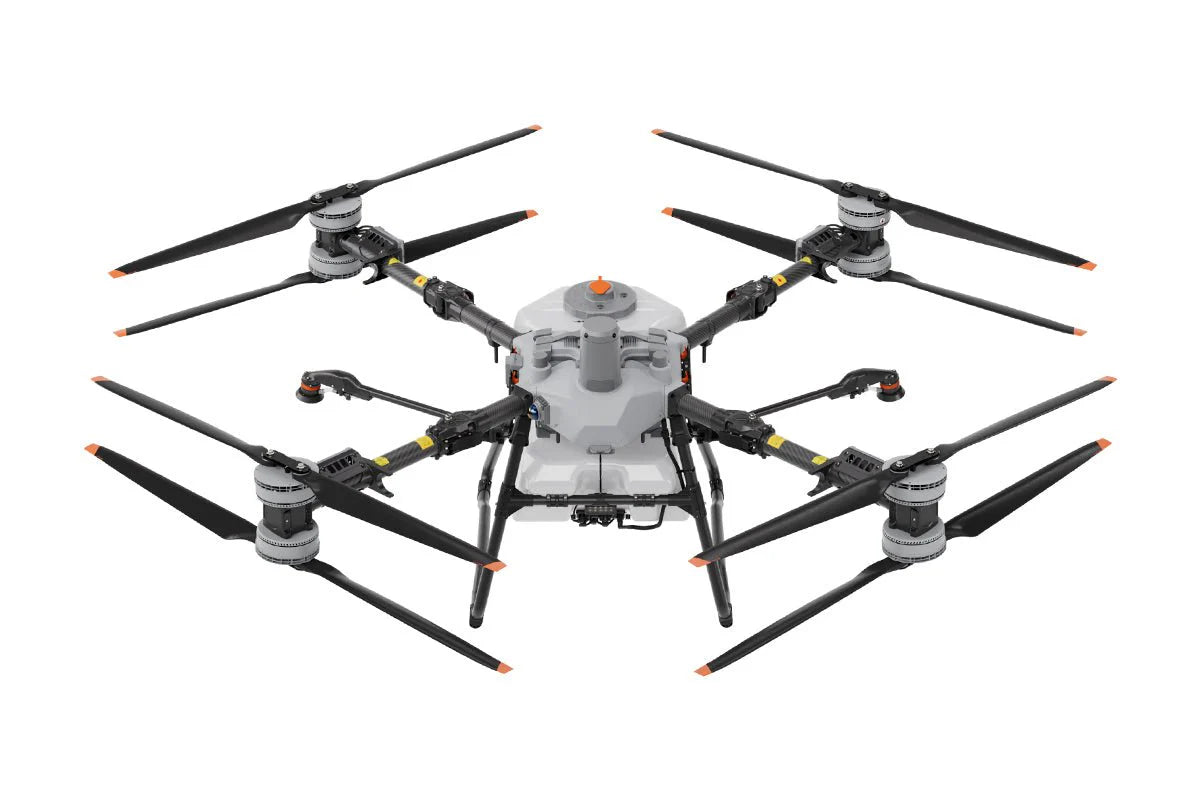
For the aircraft and current included components, review the DJI Agras T100 package. For capacity, coverage and business-level tradeoffs, use the separate T100 ROI guide.
DJI Agras T100 battery charging FAQ
Does the DB2160 fully charge in 8–9 minutes?
No. DJI's 8–9 minute reference is specifically for charging from 30% to 95% under stated test conditions. It is not a 0% to 100% charge-time claim.
What affects DB2160 charge time?
DJI says charging varies with input power, altitude, initial state of charge and other factors. Battery-cell temperature, ambient temperature and time spent cooling or waiting also affect the full landing-to-ready turnaround.
Does the C12000 need three-phase power?
The C12000 accepts both three-phase and single-phase input, but not at the same rated output. DJI lists 12,000 W at three-phase 380 V and 3,000 W at single-phase 220 V.
What generator does DJI specify for the C12000?
DJI says a generator used with the C12000 should be a three-phase model rated at least 15,000 W. Electrical compatibility and installation still need to be confirmed for the actual equipment and site.
Should I choose the C12000 or D14000iE?
Choose the C12000 when suitable electrical service is available and verified. Choose the D14000iE when remote-field independence justifies the additional transport, fuel, exhaust and maintenance requirements.
Can the D14000iE connect to utility grid power?
No. DJI's T100 FAQ says the D14000iE cannot connect to the grid. Use a separate compatible charger for grid-powered DB2160 charging.
Can the C10000 charge a DB2160 battery?
Yes, but DJI says the DB2160 interface is not directly compatible with the C10000, so the required adapter cable must be used. Confirm the cable and measure the older system's actual throughput.
How many DB2160 batteries are needed for the T100?
Three batteries are a practical starting rotation and are included in SpeedyDrone's current T100 package, but there is no universal guarantee. Battery count must be checked against measured flight, cooling, charging and ground-cycle times.
Will three batteries keep the T100 running continuously?
Only if cooling plus charging finishes before each battery is needed again, with enough buffer for normal variation. Input power, landing state of charge, temperature, refill pace and field geometry can all break the rotation.
What changes in cold Canadian weather?
SpeedyDrone's current DB2160 listing specifies use from −5°C to 45°C, while DJI's fast-charge reference uses warmer test conditions. Expect temperature to affect the workflow and follow the current battery instructions rather than assuming summer turnaround.
Primary sources and related SpeedyDrone guidance
DJI technical sources
Exact SpeedyDrone product records
DJI Agras T100 package, DB2160 Intelligent Flight Battery, and D14000iE Multifunctional Inverter Generator.
Planning resources
Use the SpeedyDrone Agriculture Solutions hub for system-level support and the T100 ROI guide for the separate capacity and business case.
Build a T100 power plan around your real site
Share your available voltage and phase, distance to the field, typical route and landing state of charge, battery count, refill pace, and preference for grid or generator logistics. SpeedyDrone can help map a DB2160 rotation and the right charging path before equipment reaches the farm.
Request a T100 power-system reviewCurrent product configuration, compatibility and availability must be confirmed. Electrical work must be assessed and completed by qualified personnel under applicable requirements.


