


Battery & charging buyer guide
DJI Osmo 360 II Battery Guide: Runtime, Fast Charging & Battery Extension Rod Explained

Osmo 360 II is rated for up to 100 minutes of 8K/30 panoramic recording, or up to 120 minutes in Endurance Mode, and DJI says fast charging can reach 80% in 22 minutes. The camera accepts the new 2150mAh battery as well as DJI’s older 1950mAh and 1770mAh Action batteries. The Osmo 360 II Battery Extension Rod targets long, continuous handheld sessions, taking total 8K/30 recording time up to 4.5 hours under DJI’s lab conditions.
Fast answer
Most travellersStart with one or two spare batteries.
Long handheld eventsConsider the II Battery Extension Rod.
Cold Canadian daysCarry warm spares; charge only at 5°C–40°C.
All three are DJI laboratory references, not guarantees for every temperature, setting or shooting pattern.
The buying decision in one table
Battery Options for Osmo 360 II
Choose by how you shoot. More capacity inside the camera, extra batteries in a pocket and external power on a handle solve different problems.
Swipe to see every column.
| Power option | Official compatibility | Best for | Key limitation |
|---|---|---|---|
| Extreme Battery Plus 2150mAh | Osmo 360 II and Osmo 360 | Maximum in-camera capacity and cold-weather flexibility | Still requires a battery swap or charging break |
| Extreme Battery Plus 1950mAh | Osmo 360 II, Osmo 360 and several Action models | Reusing an existing DJI Action battery pool | Lower stated capacity than the 2150mAh battery |
| Extreme Battery 1770mAh | Osmo 360 II and supported older cameras | Backup power you may already own | Lowest capacity of the three compatible batteries |
| Osmo 360 II Battery Extension Rod | Osmo 360 II only | Long, continuous handheld shooting | Not waterproof; not for high-frequency vibration mounts |
Read the test conditions
How Long Does the Osmo 360 II Battery Last?
DJI’s headline figure is up to 100 minutes at 8K/30 in panoramic video mode. Turn on Endurance Mode and DJI lists up to 120 minutes. Those are useful comparison points because they are tied to a specific capture mode, but they are not promises that every owner will see the same clock time.
The published test was conducted at 25°C with Wi-Fi, Gesture Control, Voice Control and Editing Assistant turned off, and with the screen off. Turning on wireless features, reviewing clips, using the display heavily, recording in a different mode or operating in cold conditions can change the result. DJI also notes that actual experience may vary by region and testing environment.
Do not turn “100 minutes” into a blanket runtime claim. It is an up-to figure for 8K/30 panoramic recording under specified laboratory conditions. DJI does not publish an equivalent figure for every resolution, frame rate and feature combination on the FAQ page.
For a real shoot, plan in clips rather than assuming one uninterrupted battery-long take. Starting and stopping, changing settings, connecting to the app and checking footage all use power. A conservative plan also leaves enough charge to save the current file and verify the result before the next location.
Useful between locations
How Fast Does Osmo 360 II Charge?
DJI says Osmo 360 II can fast-charge to 80% in 22 minutes. Its FAQ specifies a USB-C PD 3.0 charger with a maximum PD output of at least 30 W. A high number printed on a random adapter is not enough by itself: the charger and cable must negotiate the supported power-delivery profile.
The camera can also record while charging. That is useful for a static interview, time-lapse-like setup or a long indoor capture with a secure cable route. It does not automatically make recording unlimited: heat, storage capacity, cable strain and the shooting environment still matter. For action use, a loose external cable is usually less practical than a charged internal battery.
Updated August 19, 2026
Which DJI Batteries Work With Osmo 360 II?
DJI’s newest accessory matrix answers this more clearly than several product pages: all three removable battery generations below are marked compatible with Osmo 360 II.
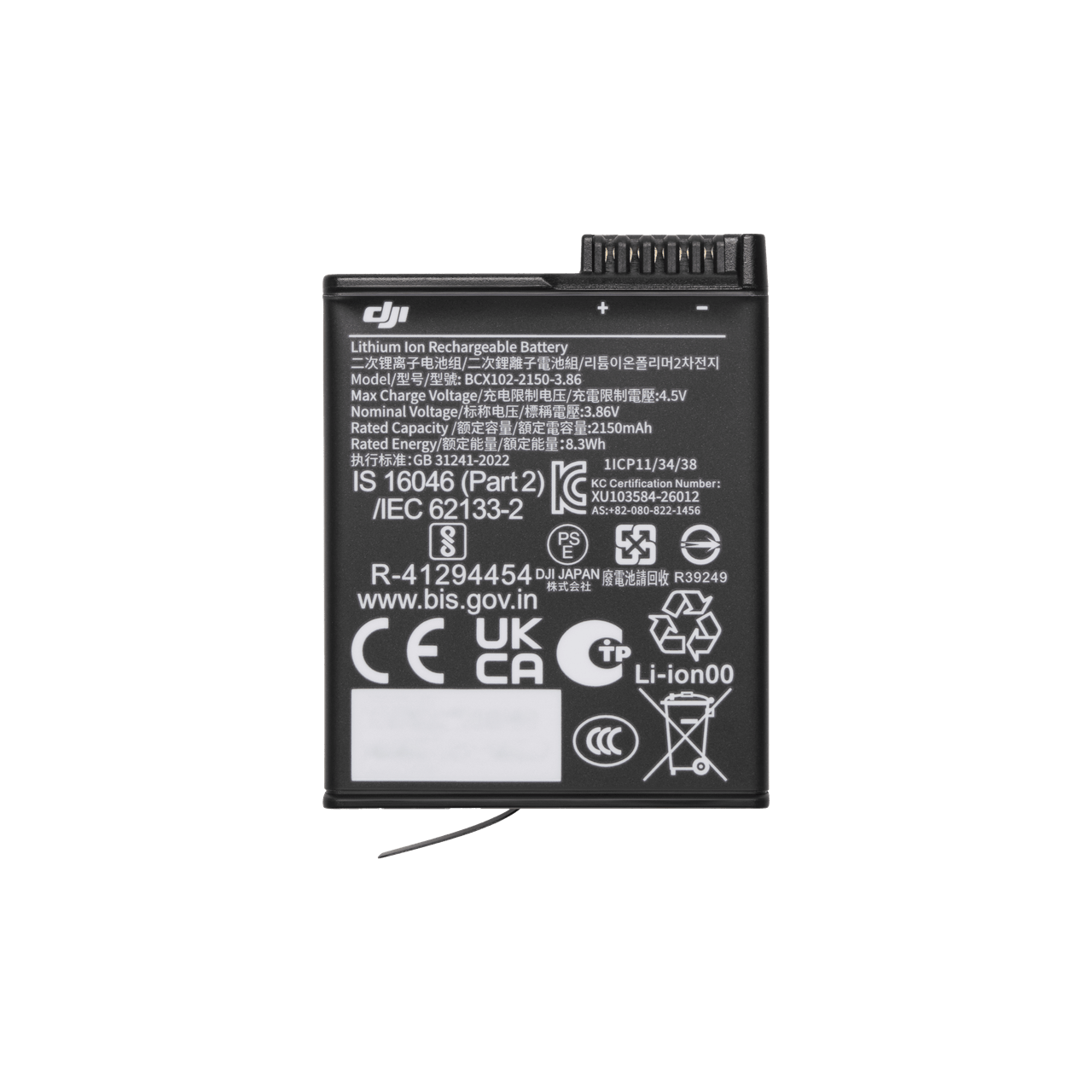

What 200mAh really means
2150mAh vs 1950mAh: Is the New Battery Worth It?
On capacity alone, 2150mAh is about 10.3% more than 1950mAh. That arithmetic describes stored-charge capacity; it does not prove that every recording mode will run exactly 10.3% longer. Camera load, temperature, screen use and power-management behaviour still affect recording time.
Both battery pages list a 34 g weight and a -20°C to 45°C operating range. That makes the 2150mAh model attractive for a new buyer who wants the most capacity per in-camera battery without adding listed weight. The 1950mAh battery remains the better-value answer when you already own several compatible units or share batteries across an Osmo Action kit.
The 1770mAh battery is officially compatible too. Treat it as a useful backup rather than the first purchase for maximum endurance. There is no need to discard working older batteries simply because a larger-capacity option exists.
Canadian winter planning
Battery Life in Cold Weather
Low temperature reduces the immediately available energy from lithium-ion batteries and can make the camera shut down earlier than it would indoors. DJI’s wide operating-temperature figure does not mean cold has no runtime effect. It means the supported operating envelope extends to that temperature under the product’s stated conditions.
For skiing, snowmobiling from a safe handheld stop, winter travel or a cold outdoor event, keep spare batteries in an inside pocket where body heat can protect them. Swap a cold battery for a warm one instead of trying to charge it on the hill. Keep contacts dry, avoid condensation when moving between cold air and a warm vehicle, and wait until the battery is within the 5°C–40°C charging range.
Do not place loose batteries next to keys, coins or other metal objects. A small battery case keeps contacts protected and makes it easier to separate charged batteries from depleted ones.
Power and control in one handle
What the Osmo 360 II Battery Extension Rod Adds
The generation-specific Osmo 360 II Battery Extension Rod contains about 15.5 Wh of built-in energy. DJI says it can extend total 8K/30 recording time to up to 4.5 hours under its laboratory conditions. DJI’s launch announcement describes the increase as 180 minutes; the 4.5-hour figure is total time, not an extra 4.5 hours.
The rod extends to 90 cm and can control camera sleep/wake and recording start/stop. Magnetic power delivery removes the need for a hanging USB-C cable during compatible handheld use. At 289 g, however, it changes the feel and packed size of the setup much more than a 34 g battery.
It is not an all-purpose powered mount. DJI says the rod is not waterproof, must not be used underwater or in seawater/corrosive liquids, is for handheld use only and should not be used in high-frequency vibration environments. That rules it out for underwater capture and makes it a poor recommendation for motorcycle, vehicle or similar vibration-heavy mounts.
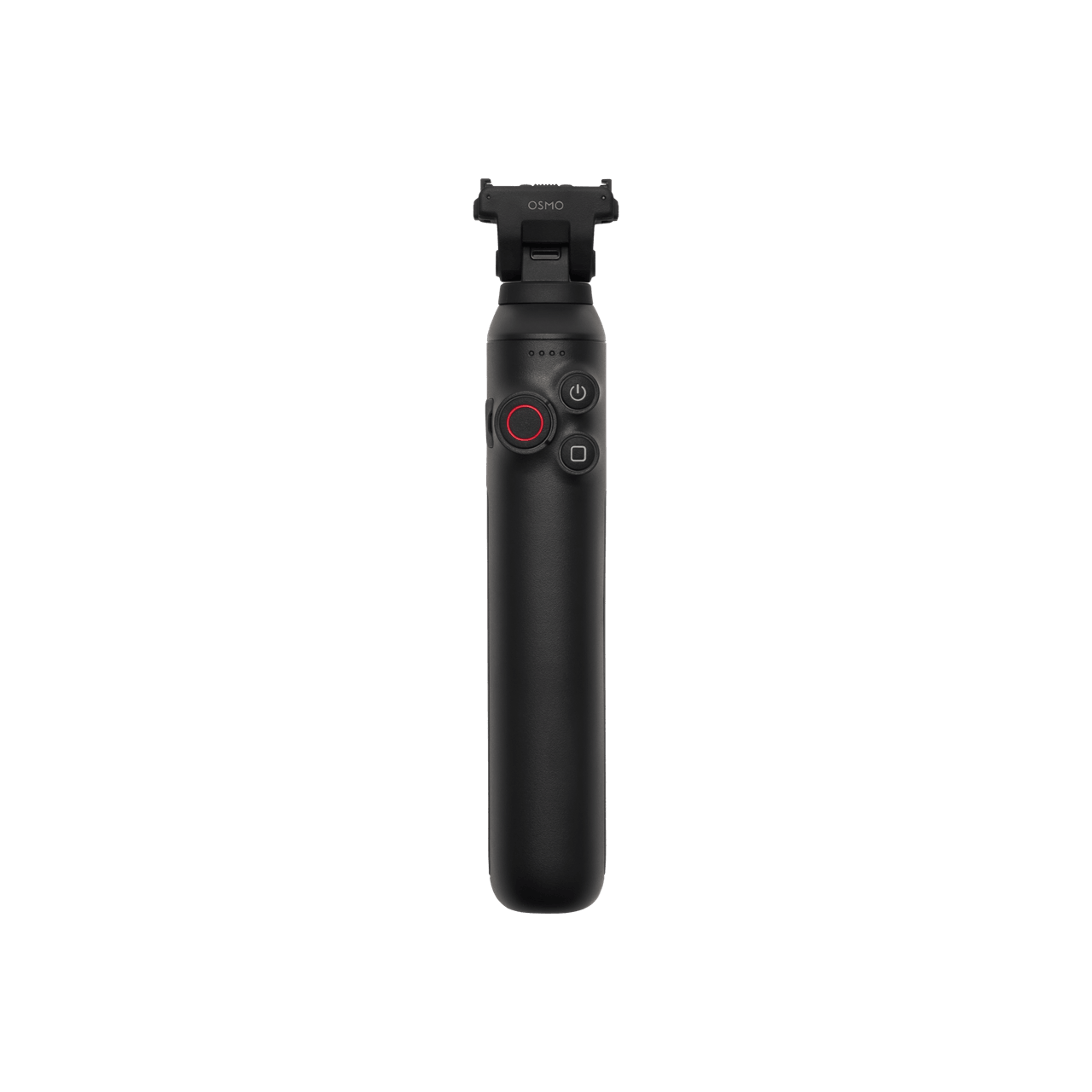
Do not mix the generations
Is the Original Osmo 360 Battery Extension Rod Compatible?
No. DJI’s August 2026 accessory matrix marks the original Osmo 360 Battery Extension Rod for the first-generation camera and the Osmo 360 II Battery Extension Rod for Osmo 360 II. The removable batteries have broad cross-generation compatibility; the powered rods do not.
That distinction matters when buying used accessories or reusing a first-generation kit. Match the full accessory name, not only the words “Battery Extension Rod,” and recheck the current compatibility chart before ordering.
Choose by interruption tolerance
Spare Batteries vs Battery Extension Rod
Spare batteries maximize mobility and weather flexibility. The rod minimizes interruptions during long handheld capture.
Swipe to see the recommendation.
| Scenario | Better starting point | Why |
|---|---|---|
| City travel and day trips | One or two spare batteries | Small, quick to swap and easy to distribute across a compact bag. |
| Skiing and cold outdoor use | Warm spare batteries | You can keep spares inside a jacket and avoid charging below 5°C. |
| Long walking tour or event | II Battery Extension Rod | Longer continuous handheld operation and integrated controls reduce interruptions. |
| Motorcycle or vehicle mount | Spare batteries | DJI says the rod is handheld only and not for high-frequency vibration environments. |
| Underwater filming | Charged internal batteries | The rod is not waterproof and must not be used underwater or in seawater. |
| Static indoor capture near power | USB-C PD power may work | The camera can record while charging, if heat, storage and cable routing are controlled. |
Our practical recommendation
Build the Kit in This Order
- 1. Start with compatible removable batteries
- For most buyers, a second 2150mAh battery—or existing 1950mAh units you already trust—adds the most flexibility for the least bulk.
- 2. Add reliable charging
- Use a compatible USB-C PD 3.0 charger with at least 30 W maximum PD output and a suitable cable. Keep charging temperature within 5°C–40°C.
- 3. Add the II rod only for the right shoot
- It becomes compelling when continuous handheld runtime and integrated controls matter more than pocketability, waterproofing or vibration-mount use.
Battery health between trips
How to Store and Maintain Osmo Batteries
DJI’s Osmo 360 II manual says to use official batteries and to fully discharge and charge the battery once every three months. Do not store it fully discharged for an extended period. If it will not be used for 10 days or more, DJI advises discharging it to 40%–65% to extend service life.
- Use official compatible batteries
- Keep battery contacts clean and dry
- Do not insert a wet or damaged battery
- Protect loose contacts from metal objects
- Store at 40%–65% for 10+ days
- Complete a full discharge/charge cycle every three months
- Do not leave a battery fully discharged long-term
- Let a cold battery enter the charging-temperature range
Before a trip, charge early enough to observe whether an older battery behaves normally. Swelling, damage, unusual heat or unreliable status is a reason to stop using it and follow current DJI and local battery-disposal guidance.

Check the Exact Canadian Battery Setup Before Ordering
The DJI Osmo 360 II Standard Combo includes the camera, one 2150mAh battery and protective essentials. For additional batteries and the II Battery Extension Rod, browse the Osmo 360 collection or ask SpeedyDrone to confirm the exact accessory, generation and package contents before ordering.
If you already own DJI Action batteries, tell the team their exact battery name and capacity. If you want the powered rod, specify Osmo 360 II Battery Extension Rod so it is not confused with the first-generation accessory.
Osmo 360 II Battery FAQ
Short answers for charging, compatibility and field planning.
How long does the DJI Osmo 360 II battery last?
DJI lists up to 100 minutes of 8K/30 panoramic recording, or up to 120 minutes with Endurance Mode on. Testing was at 25°C with Wi-Fi, Gesture Control, Voice Control and Editing Assistant off, and with the screen off. Actual runtime varies.
How quickly does Osmo 360 II charge?
DJI says fast charging can reach 80% in 22 minutes. Its FAQ calls for a USB-C PD 3.0 charger with a maximum PD output of at least 30 W. Charger, cable, battery temperature and conditions all matter.
Can I record while Osmo 360 II is charging?
Yes. DJI’s FAQ says the camera can be used while charging. Plan for heat, storage space and a secure cable route; an external cable is usually better for static use than action mounting.
Can Osmo 360 II use the 1950mAh Action battery?
Yes. DJI lists the Osmo Action Extreme Battery Plus 1950mAh as compatible with Osmo 360 II. The 1770mAh Extreme Battery is also listed as compatible.
Can the 2150mAh battery work in the original Osmo 360?
DJI’s August 19, 2026 accessory compatibility matrix marks the Osmo Extreme Battery Plus 2150mAh as compatible with both Osmo 360 II and the original Osmo 360. That newer matrix is more specific than the standalone product page, which currently names Osmo 360 II.
Does the Battery Extension Rod add 4.5 hours?
No. DJI says the Osmo 360 II Battery Extension Rod extends total 8K/30 recording time to up to 4.5 hours under stated lab conditions. DJI’s launch announcement describes the extension as 180 minutes.
Can I use the Battery Extension Rod on a motorcycle or underwater?
No. DJI says it is for handheld use only, should not be used in high-frequency vibration environments, and is not waterproof. Do not use it underwater or expose it to seawater or other corrosive liquids.
What temperature can I charge an Osmo 360 II battery at?
DJI’s charging guidance for Osmo 360 II and Osmo 360 is 5°C–40°C. This is narrower than the listed -20°C to 45°C operating range of the 2150mAh and 1950mAh batteries.
Sources and Verification Notes
Runtime, Endurance Mode, charging requirements, charging-while-recording and compatible removable batteries were checked against DJI’s current Osmo 360 II FAQ. The 22-minute fast-charge claim was checked against DJI’s launch announcement. Battery specifications and operating range were checked against DJI’s current 2150mAh and 1950mAh product data. Extension-rod runtime, power, size, controls and use restrictions were checked against DJI’s current product data. Cross-generation compatibility was checked against DJI’s August 19, 2026 Osmo Series Accessory Compatibility List. Battery storage guidance was checked against the Osmo 360 II User Manual v1.0.
DJI Osmo 360 II FAQ
DJI Osmo 360 II launch announcement
DJI Osmo Extreme Battery Plus 2150mAh
DJI Osmo Action Extreme Battery Plus 1950mAh
DJI Osmo 360 II Battery Extension Rod
DJI charging troubleshooting and temperature guidance
DJI Osmo Series Accessory Compatibility List
DJI Osmo 360 II User Manual v1.0
Capacity comparison and scenario recommendations are editorial analysis based on the cited manufacturer data. SpeedyDrone has not independently replicated DJI’s laboratory runtime or charging tests. Availability and compatibility can change; recheck current Canadian listings and DJI documentation before publication and purchase.
Start With Spares; Add the Rod for Long Handheld Days
The 2150mAh battery is the highest-capacity in-camera choice, while existing 1950mAh and 1770mAh batteries remain officially useful. Add the II Battery Extension Rod when its 4.5-hour total runtime and controls solve a real continuous-shooting problem—not for underwater or vibration-heavy mounting.


