


Hypershell · Canadian winter
Snow assistance is not waterproofing—or ice grip.
Check the exact model, battery, temperature guidance and surface conditions before planning a winter outing.

Hypershell can be relevant to winter walking, but snow, cold and water exposure need separate checks. X Ultra S lists Snow Mode, two Anti-Cold Batteries and a −20°C operating floor; X Pro S and X Max S list a −10°C floor and no dedicated Snow Mode. All three are IP54-rated, not waterproof.
There is also a source distinction to resolve before colder trips: Hypershell’s general Safety Guidelines recommend a narrower −10°C to 35°C operating and storage environment. The wider model specification is not a reason to ignore that guidance. Ask the manufacturer to clarify your exact setup before relying on use below −10°C.
Neither Snow Mode nor an Anti-Cold Battery provides footwear traction, fall prevention or guaranteed winter range. This guide covers terrain, moisture, temperature, clothing and return planning. For capacity, charging speed and pack-count decisions, use our separate Hypershell Battery & Range Guide.
Which S-series features matter in winter?
Start with the exact model rather than a generic “Hypershell works at −20°C” statement. The current Canadian manufacturer comparison distinguishes the three devices, while the S-series manual identifies their battery packages and terrain recognitions.


| Feature | X Pro S | X Max S | X Ultra S |
|---|---|---|---|
| Device operating specification | −10°C to 60°C | −10°C to 60°C | −20°C to 60°C |
| Protection rating | IP54 | IP54 | IP54 |
| Dedicated Snow Mode listed | No | No | Yes |
| Terrain / motion recognitions | 10 | 10 | 12, including Snow and Dune |
| Included batteries | 1 × Intelligent Battery | 1 × Intelligent Battery | 2 × Anti-Cold Batteries |
| Winter selection point | Consider for suitable milder outings within all applicable guidance | Higher performance does not lower its −10°C floor | Dedicated snow assistance and lower published cold rating; clarify narrower safety guidance |
Phone: swipe inside the table. Keyboard: focus this area and use arrow keys. Terrain recognitions are not the same as output settings such as Eco or Hyper.
Ultra S has the clearest winter-specific feature combination, but “Canada” does not automatically mean you need it. A short outing on a cleared path can present a different task from a snow-covered trail. Max S’s higher output is not, by itself, an improvement in its official minimum operating temperature.
What Snow Mode does—and what it cannot do
Snow Mode concerns the device’s assistance behaviour. Hypershell describes snow assistance as addressing the extra resistance of deeper snow and the way a loaded stride changes on snowy terrain. Within the current S lineup, only Ultra S lists Snow; Pro S and Max S do not.
That is not traction control. Snow Mode does not change the grip between your footwear and the ground. It does not remove black ice, heat the battery, seal the electronics or make an unsuitable route safe.
Hypershell also lists Mountain recognition separately. A snowy mountain route can involve both elevation and snow resistance, but the two names do not establish a stronger/weaker ranking. Do not assume that simultaneously enabling multiple terrain modes is an available workflow, or that a dusting of snow always requires Snow Mode. Follow the current app and manual for your device.
Snow Mode is not new to the S generation. The original Hypershell X Ultra also lists 12 terrain recognitions, including Snow and Dune. Existing Ultra owners should check their own generation’s instructions rather than assume S-series onboarding or battery compatibility applies unchanged.
Snow imagery and mode names are not approval for downhill skiing or other extreme activities. The Safety Guidelines exclude downhill skiing and unverified high-impact uses. Choose the activity on its own merits, not because the equipment appears in an alpine photograph.
Anti-Cold means a lower operating floor, not more Wh
The S manual lists the Intelligent Battery at −10°C to 60°C and the Anti-Cold Battery at −20°C to 60°C. Both have the same nominal 5000mAh / 72Wh capacity. Anti-Cold is therefore a temperature distinction, not a larger-capacity pack.
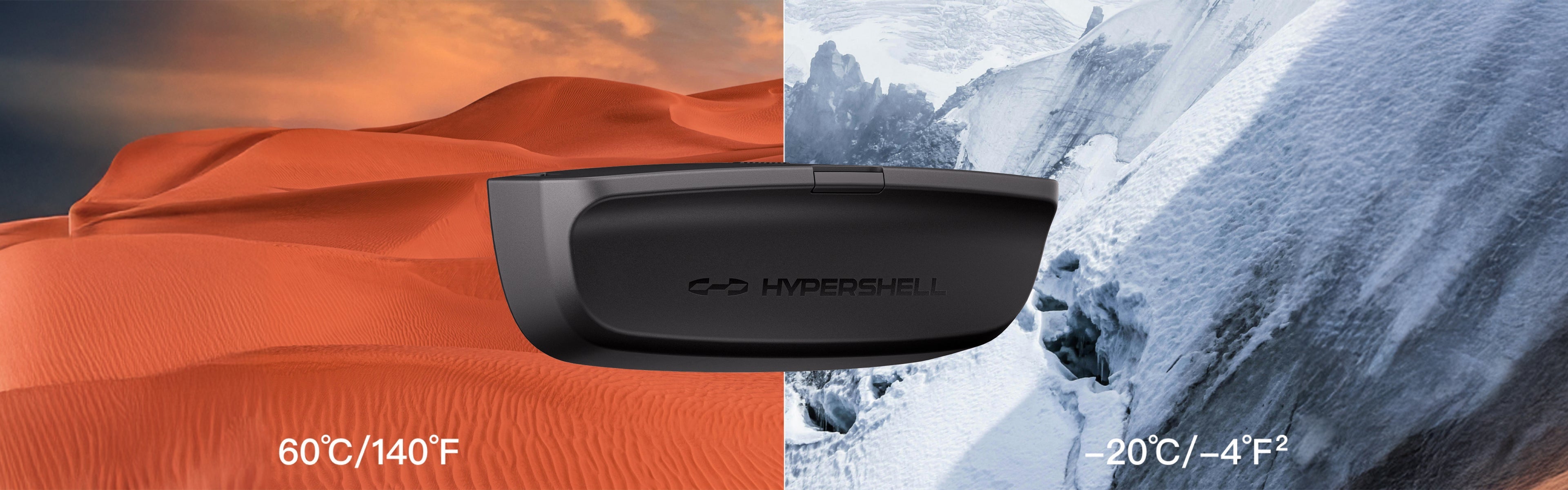
Check the entire device-and-battery combination. The S manual maps Intelligent Batteries to Pro S/Max S and Anti-Cold Batteries to Ultra S. It does not authorize extending Pro S or Max S to −20°C by swapping in a different pack. Confirm the exact approved battery before purchasing a spare.
Ultra S’s two included packs can support reserve planning, but the second battery is not a guarantee that you can double a winter route. Keep a spare protected, dry and suitably insulated within the manufacturer’s limits, with its terminals protected from damage or short circuits. Do not improvise active heating.
IP54 is environmental resistance, not waterproofing
All three S models list IP54. Hypershell’s support guidance describes light rain and damp conditions as generally acceptable but explicitly says the device is not waterproof. It advises avoiding submersion and heavy rain unless the applicable manual specifically permits them.

The separate environmental support article also warns against extreme rain or snow unless specifically allowed by the manual. Snow Mode and IP54 answer different questions: the first concerns movement assistance; the second concerns resistance to environmental ingress. Neither grants unrestricted wet-snow use.
Dry snow, wet slush and ice need different decisions
Dry snow adds cold, walking resistance and uncertain footing. Wet snow and slush add moisture exposure; salted road slush also leaves residue on straps and hardware. Ice can defeat footwear traction even when the battery and electronics are functioning normally.
As a practical precaution, avoid immersing any part of the device in puddles or deep slush. Do not rely on IP54 for stream crossings or use a hose to clean away road salt. The manual prohibits submersion, high-pressure washing and high-velocity water.
If conditions exceed the guidance you have confirmed, shorten or abandon the outing. A suitable battery cannot compensate for poor grip, unsafe footing or excessive water exposure.
Plan the return, not the maximum advertised kilometres
Operating temperature describes a published environmental specification; range describes a performance outcome. A −20°C rating does not establish identical distance to a mild-weather test. Hypershell support notes that extreme cold can reduce battery performance, without providing one universal winter reduction percentage.
High assistance adds another variable. One generic support example describes approximately 30 minutes under Hyper Mode at 100%, Low-Speed Mode and fast or brisk movement. That is not an Ultra S cold-weather benchmark or a fixed timer for every Hyper session; it illustrates why settings and activity matter.
Our planning suggestion is to begin with a shorter, familiar outing that has easy exits, monitor charge and adjust future plans from comparable observations. Do not turn a maximum distance, or a percentage display, into a guaranteed remaining kilometre allowance.
Consider ambient temperature, snow depth, surface, moisture, elevation, expected time, load, assistance setting and your ability to return if powered assistance ends. A dry −5°C cleared path and a −5°C slushy trail with deep snow are not equivalent outings. Carrying a spare does not remove those differences.
Keep actual air temperature separate from a weather app’s “feels like” value. Environment and Climate Change Canada explains that wind chill concerns heat loss and perceived cold; it does not make objects colder than the air through wind chill alone. Use ambient temperature for the published environmental comparison, while still taking wind and personal exposure seriously.
Returning indoors: dry first, then charge within 0–40°C
The S manual explicitly specifies a 0°C to 40°C battery charging range. Anti-Cold’s lower operating floor does not lower that charging floor. A battery brought indoors may remain cold even when the room air is suitable.
Allow the battery to reach the permitted charging conditions and keep the battery terminals and USB-C charging port dry before connecting. Do not assume a heated vehicle or cabin instantly changes the pack temperature. The manufacturer does not provide a universal rewarming wait here; this guide does not invent one.
Cold equipment entering a warm space may develop moisture. Remove visible snow and surface moisture, inspect the joints, straps and battery area, and allow the equipment to dry. After salted slush exposure, wipe away exterior residue without forcing liquid into openings. This is practical cleanup guidance, not a salt-water protection claim.
Do not put a pack against a heater, rinse the device, bypass a charging warning or charge a visibly wet setup. The manual also says to let a battery cool after use before charging. “Warm enough” and “not overheated” are both relevant; inspect for swelling, leakage or damage and stop if present. Store the equipment clean, dry and ventilated indoors, following its storage instructions.
Winter layers require a new fit check
A fit established over summer trousers is not automatically appropriate over base layers and snow pants. Extra bulk can alter belt position, strap tension and hardware clearance. Recheck the hip-joint alignment, leg straps, clearance above the knee and automatic wearing detection before leaving.

Adjust mechanical settings with the device off. Wear it over clothing rather than bare skin, but avoid loose fabric that interferes with straps, buckles or moving parts. Do not tighten through painful pressure or ignore a wearing-detection failure because you are already outside.
For measurement landmarks and the S-series wearing sequence, read our Hypershell Size & Fit Guide. Complete first-use onboarding in a safe indoor area; winter terrain is not the place to discover an initial fitting problem.
A Canada winter checklist
This checklist is SpeedyDrone’s planning aid, not a manufacturer safety certification. It cannot make a route or user suitable. Read the applicable eligibility and medical-clearance requirements; Hypershell does not provide balance assistance or fall prevention.
Before leaving
- Confirm the model, approved battery and applicable temperature guidance; clarify colder use where sources differ.
- Charge in permitted indoor conditions and verify the actual charge of each required pack.
- Check weather, surface moisture, footing, route exits and a conservative return plan.
- Recheck winter clothing, straps and detection; inspect the device and footwear.
During the outing
- Watch remaining charge rather than assuming the maximum stated distance still applies.
- Use assistance appropriate to the task instead of treating maximum output as the default.
- Avoid ice hazards, immersion and extreme wet/snow conditions outside confirmed guidance.
- Stop for unusual operation, poor alignment or snow buildup that interferes with movement; adjust with power off.
After returning
- Remove visible snow and wipe exterior moisture or salt residue using the manual’s cleaning method.
- Inspect joints, straps, ports and battery condition; let the equipment become dry.
- Charge only within the battery’s permitted temperature conditions and with dry connections.
- Store indoors in a dry, ventilated location—not in a wet bag or exposed vehicle overnight.
Do you need Ultra S for your winter use?
If your normal use is on suitable, cleared routes in milder cold within the applicable guidance, Pro S or Max S may meet the task. Ultra S becomes more relevant when dedicated snow assistance and its lower published operating floor address a real need—after the narrower safety recommendation has been clarified.
Describe the conditions before choosing: temperature, snow type, surface, duration and clothing. Use the Hypershell X Series S collection and our S-series model comparison for the broader purchase decision. Winter suitability is not decided by motor power alone.
Hypershell winter FAQs
Does every X Series S model have Snow Mode?
No. Ultra S lists Snow and Dune among its 12 terrain recognitions. Pro S and Max S list 10 without dedicated Snow. That does not mean every snowy outing requires Ultra S; assess the actual terrain and all environmental restrictions.
Can I use X Ultra S at −20°C?
Its published model operating specification reaches −20°C, but the general Safety Guidelines recommend −10°C to 35°C. Ask Hypershell to clarify the applicable guidance for your exact setup before planning below −10°C. Neither statement guarantees a particular winter distance or safe footing.
Does Anti-Cold mean a bigger battery?
No. Both types list nominal 5000mAh / 72Wh in the S manual. Anti-Cold has a lower published operating floor. The device’s own limit, approved battery mapping, charging conditions and actual use still matter.
Can an Anti-Cold Battery upgrade Max S to −20°C?
Do not assume that. Max S’s device specification remains −10°C, and the S manual maps its Intelligent Battery separately from Ultra S’s Anti-Cold Battery. Confirm exact compatibility rather than using a shared capacity label as evidence of an approved swap.
Is IP54 enough for wet snow or heavy rain?
IP54 is not waterproofing. Hypershell advises avoiding submersion and heavy rain unless specifically permitted, and its environmental guidance restricts extreme snow conditions too. Snow Mode does not override these limits. Avoid deep slush immersion and confirm uncertain exposure with the manufacturer.
Does Snow Mode prevent slipping on ice?
No. It concerns assistance behaviour, not footwear-to-ground traction or fall prevention. Choose suitable footwear and a safe surface independently; working motors and a charged battery cannot remove black ice.
Can I charge immediately after a freezing outing?
Charge only when the battery is within 0–40°C and the connections are dry. Indoor air temperature alone does not confirm a cold battery has reached that range. There is no universal wait time here; do not force heating or bypass warnings.
How much range will I lose in Canadian winter?
No verified universal percentage is available. Cold, terrain, load and assistance can affect use differently. Start conservatively, observe comparable outings and preserve a workable return plan rather than treating maximum manufacturer kilometres as a winter allowance.
Do winter clothes change the fit?
They can. Repeat alignment, strap and clearance checks over the intended layers. Keep loose fabric away from the mechanisms and complete wearing detection correctly. Mechanical adjustments should be made with power off.
Planning a winter Hypershell purchase?
Tell SpeedyDrone your intended temperature, snow conditions, route length, clothing and model. We can help clarify the published model and battery information, including questions that need manufacturer confirmation.
Ask SpeedyDrone about winter useSources and limits
Checked October 1, 2026. Model specifications: the Canadian manufacturer comparison linked above. Battery capacity, charging, fit and cleaning: X Series S User Manual v1.3. Its printed page 7 gives battery charging limits; pages 34 and 41–42 cover care. The Safety Guidelines’ narrower temperature recommendation is linked beside the model table.
Environmental cautions and cold performance: rain and cold support guidance and environmental-use guidance. The contextual high-output example is from Hyper Mode battery support; it is not an S-specific winter test. Original Ultra Snow Mode: official Original Ultra feature page.
This guide is not an individual safety or medical assessment. Follow the applicable manual, user restrictions and manufacturer clarification for your exact device and conditions.


