


DJI Agras T50: built for the acres ground equipment cannot reach on time.
This complete Canadian buyer's guide explains the T50 spraying and spreading systems, current SpeedyDrone package pricing, field workflow, batteries, Ontario pesticide requirements, Transport Canada rules, and the farm profiles most likely to benefit.
T50 is the balanced Agras platform for practical commercial farm work.
The DJI Agras T50 is a strong fit when a farm or custom applicator needs flexible spraying, dry-material spreading, wet-field access, spot work, field-edge coverage, orchard routes, or a faster response during narrow application windows. It should be treated as a complete operating system, not just an aircraft: drone, batteries, charger or generator, water and material handling, trained crew, compliance, weather limits, maintenance, and recordkeeping all matter.
DJI's 21 ha/h or approximately 50 acres/h test used 15 L/ha dosage, 11 m width, 7 m/s speed, and 3 m operating height. Real output changes with field shape, refill time, dosage, wind, obstacles, crew workflow, and legal limits.
Ten questions that reveal whether T50 fits the farm.
The correct recommendation depends on the operation. A farm with 1,500 open acres and a self-propelled sprayer has a different T50 use case from a vineyard, vegetable grower, wet-field operation, or custom applicator.
Crop type
Corn, soybean, wheat, vegetables, orchard, vineyard, nursery, or mixed?
Relevant acreage
How many acres or blocks actually need a drone workflow?
Current method
Owned sprayer, contractor, custom applicator, labour crew, or no current solution?
Access problem
Wet ground, tall crop, slope, small block, field edge, or hard-to-reach area?
Material
Water, labelled pesticide, biological, fertilizer, seed, cover crop, or granule?
Application rate
What L/ha or kg/acre is required by the agronomic plan and product label?
Daily workload
Spot work, occasional blocks, routine ownership, or commercial service volume?
Crew and transport
Who pilots, mixes, refills, charges, transports, and records operations?
Compliance path
Advanced pilot, drone registration, safety declaration, airspace, pesticide licensing?
Buying path
Drone-only, complete package, pre-owned package, financing, or service-first trial?
One aircraft. Three jobs: survey, spray, and spread.
DJI designed the T50 around a coaxial twin-rotor structure, a 40 L spraying tank, an optional 75 L spreading system, front and rear phased-array radar, binocular vision, a high-resolution FPV gimbal camera, and the DJI RC Plus controller. For the farm, the value is not the feature list by itself. The value is being able to map a block, generate a route, apply liquid or dry material, and retain a repeatable operating record.
- Use the FPV camera and controller workflow to assess fields and orchard blocks.
- Generate routes for repeatable spraying or spreading operations.
- Use RTK-assisted positioning where the workflow and service support it.
- Monitor route progress, payload, battery status, and obstacle information.
- Review operation records after the job rather than relying on memory.
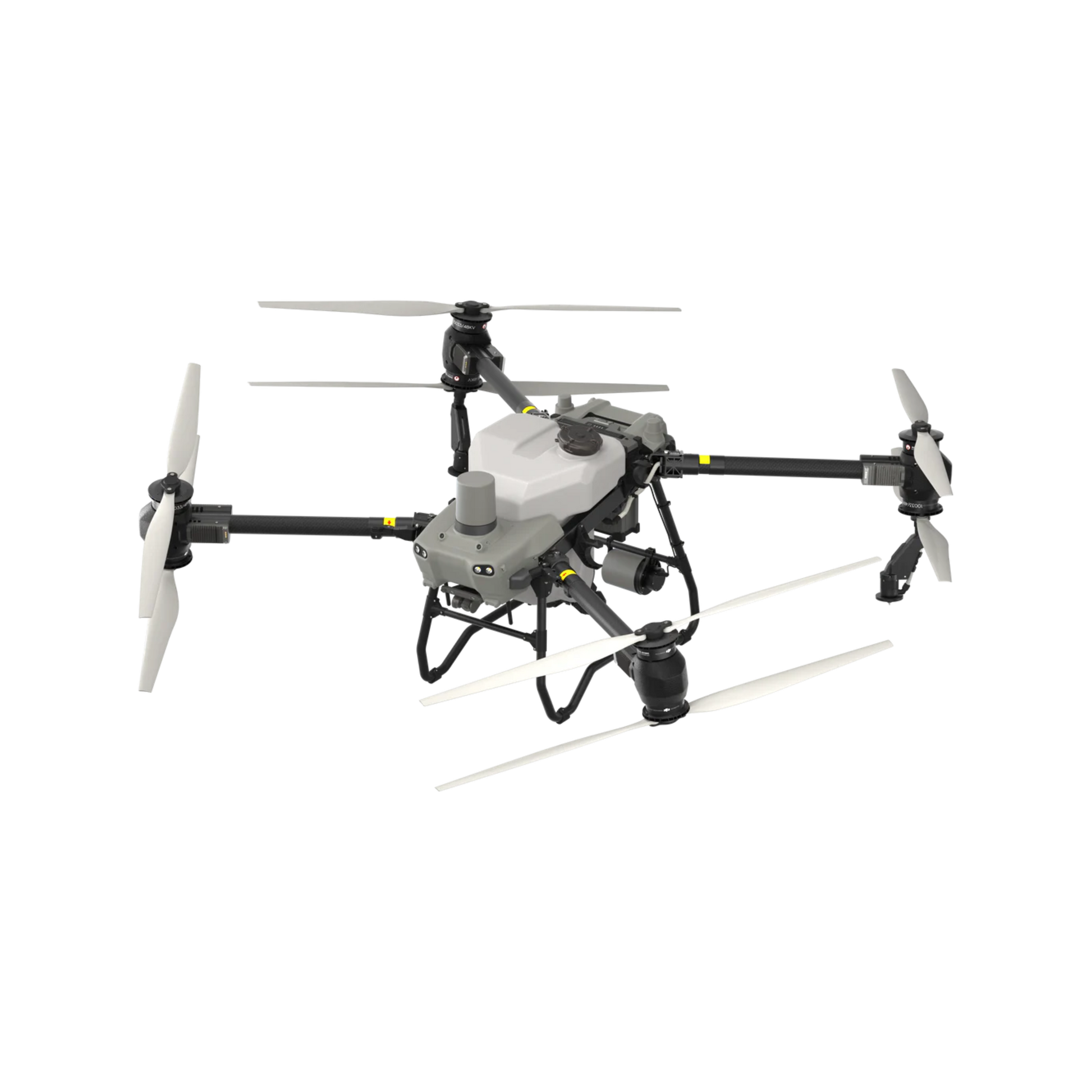
Liquid spraying and dry spreading require different operating plans.
The T50 can carry both systems, but material behaviour, refill method, calibration, swath, rate, weather, cleaning, and legal requirements change between liquid and dry application.

Control droplets, flow, and swath.
The standard two-sprinkler system supports up to 16 L/min, adjustable 50 to 500 micron droplets, and an effective spray width of 4 to 11 m at 3 m above the crop. The optional four-sprinkler configuration can reach up to 24 L/min for higher-flow work such as orchard applications.

Move seed and granules without ground compaction.
The T50 spreading system supports a 50 kg payload in a 75 L tank, dry granules from 0.5 to 5 mm, an 8 m reference spread width, and up to 108 kg/min under DJI test conditions. Actual performance depends on granule size, density, surface smoothness, moisture, calibration, and route settings.
Can T50 replace a ground sprayer?
Usually not across every field and every application. The stronger positioning is complementary: wet fields, hard-to-reach blocks, tall crops, spot work, field edges, smaller areas, orchard and vineyard blocks, and narrow timing windows where ground equipment is unavailable or undesirable.
Can T50 spread cover crop seed or fertilizer?
It can spread compatible dry granules, including certain seed and fertilizer workflows, but material must be tested for diameter, density, flow behaviour, moisture, and desired rate. Calibration and a short test area are essential before full deployment.
Does the highest flow rate apply to every product?
No. Maximum figures are test results. Real flow depends on the material, nozzle or gate configuration, pump and system settings, aircraft speed, route, weather, and legal application directions.
Start with the difficult acres, not the easy marketing claims.
A T50 purchase is easiest to justify when the farm can name recurring tasks that are expensive, slow, inaccessible, or poorly served by current equipment.
Enter when heavy ground equipment risks delay, ruts, or soil compaction.

Use mapped routes, terrain following, and higher-flow options where appropriate.
Target smaller blocks and problem areas without mobilizing a full ground rig.

Build a service line for farms needing flexible spraying or spreading access.
The aircraft is only one part of a productive T50 day.
Output is created by the entire crew and support system. A strong deployment plan reduces refill delays, battery waiting, material errors, route mistakes, and avoidable downtime.
Confirm crop, acreage, material, rate, current method, access problem, and buying objective.
Verify pilot privileges, registration, drone declaration, airspace, pesticide licensing, label, insurance, and records.
Map boundaries, wires, trees, roads, people, animals, takeoff areas, refill point, and emergency landing options.
Choose route, height, speed, swath, rate, droplets or spreading settings, obstacle strategy, and return-to-home plan.
Fly, refill, cool, charge, inspect, rotate batteries, monitor weather, and record each operation.
Batteries determine whether the drone works as a system or as a demonstration.
The DB1560 Intelligent Flight Battery has a 30 Ah capacity and is rated by DJI for up to 1,500 charge cycles under its stated conditions. DJI's reference fast-charging claim is approximately 9 minutes from 30% to 95% with the specified charging setup and suitable battery temperature. Real charging time and battery life vary with temperature, power source, cell condition, load, flight profile, cooling, and maintenance.
- Plan a minimum practical battery rotation for the intended daily workload.
- Choose utility-power charging, generator-based field charging, or both.
- Allow proper cooling before charging and follow battery safety instructions.
- Track battery cycles, condition, storage state, and unusual temperature behaviour.
- Include spare cables, controller batteries, tools, and cleaning supplies.

Choose the package around deployment readiness, not only the aircraft price.
The public SpeedyDrone listings below were checked in July 2026. Live pricing, stock, condition, battery cycles, package contents, shipping, training, and financing terms can change. Open the product page before purchasing.
DJI Agras T50 Drone Only
- Brand-new T50 aircraft
- DJI RC Plus controller
- Battery cooler fan adapter cable
- Atomized sprinkler package
- Best for buyers building a custom power system
T50 Pro Package Pre-Owned
- Demonstration-used T50 system
- Three pre-owned DB1560 batteries
- C10000 power supply
- DJI Relay and supporting accessories
- Verify battery cycles and exact condition before purchase
T50 Pro Package With 3 Batteries
- Brand-new T50 aircraft and RC Plus
- Three pre-owned Grade AAA+ DB1560 batteries
- Pre-owned Grade AAA+ C10000 power supply
- DJI Relay and listed field accessories
- Strong fit for buyers prioritizing faster deployment
Should I buy drone-only or a complete T50 package?
Choose drone-only when you already understand the power, battery, transport, training, and compliance system or are building a customized deployment. Choose a complete package when the priority is faster field readiness and a clearer operating workflow.
Can SpeedyDrone discuss financing or lease options?
Yes. Financing or leasing may help preserve working capital or match payment timing to the operating plan. Approval, rates, terms, residuals, and monthly payments depend on the finance provider and applicant.
Can I start with a demo or service-first trial?
Yes. For qualified projects, a fit-check, technical call, on-farm demonstration discussion, or service assessment can help validate the workflow before the farm commits to ownership.
A T50 operation has aviation rules and application rules.
Buying the aircraft does not automatically authorize the mission. Confirm the current Transport Canada, airspace, pesticide, product-label, insurance, worker-safety, and recordkeeping requirements before any field application.
T50 is a medium drone in Canada.
DJI lists a maximum takeoff weight of 92 kg for spraying and 103 kg for spreading. Transport Canada defines medium drones as more than 25 kg and not more than 150 kg. Medium-drone VLOS operations are advanced operations or higher.
Advanced privileges are only part of the path.
The drone must be registered and marked. A medium drone also needs the applicable Safety Assurance Declaration for the intended operation. Confirm the exact aircraft configuration and declaration status before flying.
Distance and permissions depend on the operation.
Transport Canada lists a medium-drone VLOS operation away from uninvolved people as more than 152.4 m or 500 ft. Near people, over people, controlled airspace, poor visibility, hazardous payloads, and other special conditions may require additional declarations or an SFOC.
Ontario treats aerial pesticide work separately.
Ontario's licensing guide lists an Aerial exterminator licence for pesticide use by aerial application according to the product label. Commercial pesticide businesses may also need an operator licence, and some applications may need a permit. Confirm the product label, crop, rate, buffer, PPE, drift controls, and records.
Do I need an Advanced Pilot Certificate for the T50?
Medium drones are advanced operations or higher under the current Canadian framework. An Advanced Pilot Certificate is part of the normal VLOS path, but the aircraft declaration, registration, operating environment, airspace, distance from people, and payload also matter.
Can I spray any pesticide that I already use on the farm?
Do not assume so. The product must be used according to its label and all applicable federal and provincial requirements. Confirm whether the label permits aerial application, the crop and target are listed, the rate and buffer directions are met, and the operator has the required licence or exemption.
When might an SFOC-RPAS be needed?
An SFOC may be required when the operation falls outside basic, advanced, or Level 1 Complex rules, including certain hazardous-payload, poor-visibility, BVLOS, foreign-operator, advertised-event, or other special operations. Use the current Transport Canada operation-category guidance.
Buy T50 when the workflow is already visible.
T50 is a strong fit when:
- The farm has recurring wet-field, access, spot-work, field-edge, orchard, vineyard, or spreading tasks.
- The operator can support batteries, charging, refill, transport, cleaning, maintenance, and records.
- The business understands the aviation and application compliance path.
- The drone complements current ground equipment or creates a defined custom-application service.
- The buyer can calculate value from avoided delay, access, labour, or new service revenue.
Start with a demo or service assessment when:
- The relevant acreage or application rate is still unclear.
- The farm expects the drone to replace every ground application.
- The pilot, pesticide, insurance, or aircraft declaration path is unresolved.
- The buyer has not planned batteries, charging, transport, mixing, and crew roles.
- The operation wants proof on its own field conditions before purchasing.
How much does the DJI Agras T50 cost in Canada?
As of July 2026, SpeedyDrone publicly lists the new T50 drone-only package at CAD $17,999, a pre-owned Pro Package at CAD $22,999, and a new-aircraft three-battery Pro Package at CAD $29,999. Check the live product page because stock, package contents, condition, and prices can change.
How many acres per hour can the DJI Agras T50 spray?
DJI reports a test result of up to approximately 50 acres or 21 hectares per hour using 15 L/ha dosage, 11 m spraying width, 7 m/s speed, and 3 m height. Real output is usually lower after refill, battery, turning, transport, weather, obstacles, and compliance time are included.
What is the DJI Agras T50 spray tank capacity?
The T50 spray tank volume and operating spray payload are 40 L and 40 kg respectively under DJI's stated conditions.
Can the T50 spread fertilizer and seed?
The optional spreading system supports a 50 kg payload, 75 L tank, and compatible dry granules from 0.5 to 5 mm. Fertilizer and seed performance depends on density, diameter, surface, moisture, gate selection, calibration, and the required rate.
What is the T50 spraying flow rate?
The standard two-sprinkler system supports up to 16 L/min. With four sprinklers, DJI lists a maximum flow of 24 L/min. These are maximum system figures, not guaranteed field rates for every product.
Does the DJI Agras T50 need to be registered in Canada?
Yes. Transport Canada's current registration overview states that all drones weighing at least 250 g must be registered and clearly marked with the registration number.
Can an Advanced drone pilot fly the T50 in Canada?
Medium-drone VLOS operations are advanced operations or higher, but the pilot certificate is not the only requirement. Confirm the aircraft Safety Assurance Declaration, registration, distance from people, airspace, payload, visibility, and any SFOC conditions.
Can the T50 spray pesticides in Ontario?
Potentially, but the operation must comply with the pesticide label and Ontario requirements. Ontario identifies an Aerial exterminator licence for pesticide application by air, and commercial operators may have additional licence, permit, insurance, and recordkeeping obligations.
Is T50 suitable for orchards and vineyards?
Yes, when route mapping, terrain, canopy, obstacles, flow requirements, droplet strategy, and legal application directions are suitable. DJI offers an optional four-sprinkler configuration for higher-flow orchard work.
Should I choose T50 or T100?
T50 is the more balanced starting point for many farm-owned spraying and spreading workflows. T100 is designed for higher capacity and broader operational headroom, making it more relevant to large farms, co-ops, and high-volume custom applicators.
Does SpeedyDrone provide T50 training and on-farm demos?
SpeedyDrone can discuss fit-check calls, package guidance, training, setup, on-farm demo coordination, maintenance planning, financing, and service assessments. Actual application work is subject to crop, acreage, material, label, weather, operator, insurance, airspace, and final scope confirmation.
Specifications, regulatory summaries, and package information in this guide were checked against the following official or first-party pages.
Send us your crop, acreage, location, and current method.
We will help identify whether the next step should be a T50 quote, package comparison, financing discussion, technical call, on-farm demo assessment, service-first trial, or a larger T100 workflow.
Planning a farm open house, dealer day, or community event? Ask about combining an Agras technical display with robot demonstrations or a STEMAX youth robotics activation.


