


DJI Agras T50 in Ontario: Spraying, Spreading, Compliance, Cost and ROI
A practical 2026 guide for Ontario farms, custom applicators, co-ops, vineyards, orchards, and agricultural service providers evaluating the DJI Agras T50. The real decision is not only whether the aircraft can do the job. It is whether the crop, label, crew, airspace, licensing, power workflow, economics, and support system all fit.
Canada changed the federal pesticide policy for RPAS.
On June 30, 2026, Health Canada published SPN2026-02. The policy allows RPAS application of products that are already registered for conventional aerial application, provided the operator follows the label and the policy. It does not create blanket permission to spray any product by drone.
2026
Check the aerial label before planning the flight.
If the label permits aerial application, RPAS application may be allowed under the new policy, unless the registrant has added a specific prohibition against RPAS.
If the label says "Do not apply by air" or does not include aerial application, the product cannot be applied by RPAS.
Application rate, minimum aerial spray volume, retreatment interval, aerial buffer zones, PPE, mixing, loading, and other label directions still apply.
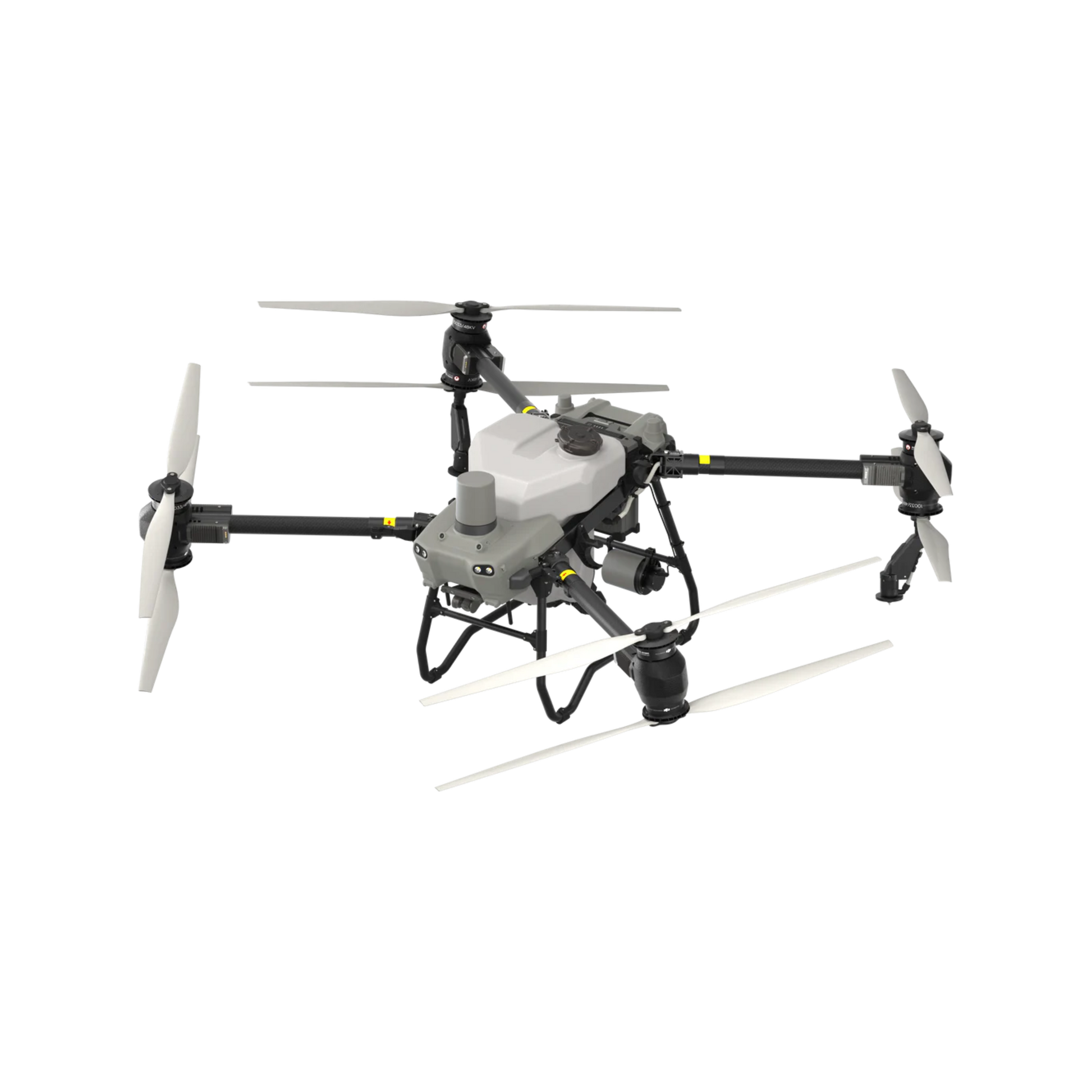
A production platform, not a consumer drone.
The T50 weighs 52 kg with its battery and reaches a maximum takeoff weight of 92 kg when spraying or 103 kg when spreading. That places it in Canada's medium-drone category and changes the pilot, aircraft, safety-assurance, transport, insurance, and site-planning requirements.
Dual atomizing system, 50-500 micrometre droplets, 4-11 m effective swath, and up to 16 L/min with two sprinklers or 24 L/min with four.
Compatible with 0.5-5 mm dry granules, 8 m nominal spread width, and up to 108 kg/min under DJI's material-specific test conditions.
About 50 acres per hour in DJI's test using 15 L/ha, an 11 m swath, 7 m/s speed, and 3 m height. Refill, turning, weather, crew, and legal limits change real output.
DJI states a 9-12 minute full charge for DB1560 under qualifying conditions. The launch test also reported about 9 minutes from 30 to 95 per cent with the generator and cooling workflow.
Use it where timing and access are the problem.
T50 should not be sold as an automatic replacement for every ground sprayer. Its strongest Ontario use cases are the situations where ground equipment is delayed, creates crop damage, cannot reach the block, or is inefficient for a localized task.

Wet fields, tall crops, edges and spot work.
Corn, soybeans, wheat, grain, and specialty crops may benefit when a ground machine is not the best tool for the immediate window.

Block-level access and terrain-following workflows.
Review slope, rows, obstacles, canopy, swath, wind, label, water volume, and whether the optional four-sprinkler workflow is appropriate.

A new service line requires more than aircraft ownership.
Commercial work needs licensed people, operator structure, insurance, records, mixing and loading roles, logistics, customer contracts, and a reliable seasonal support plan.

Radar and vision assist the crew. They do not replace it.
Wires, fine branches, dynamic obstacles, low contrast, rain, fog, light, speed, and obstacle material can affect sensing.
The first question is not "How many acres?"
Acreage matters, but the strongest buying signal is a recurring operational problem: wet-field access, application timing, spot work, small blocks, crop height, slope, or a custom-service opportunity.
Ground access becomes unreliable.
Evaluate wet conditions, tall-crop access, field edges, isolated pressure, cover-crop or granular spreading, and time-critical windows.
Strong fit-checkSmall blocks and repeated crop cycles.
High-value crops, tight timing, multiple plantings, and labour constraints can justify a flexible platform when label and coverage requirements align.
Strong fit-checkRows, slopes and localized blocks.
Do not assume replacement of an airblast sprayer. Test actual canopy coverage, droplet size, volume, drift, terrain and route planning.
Demo firstThe drone becomes a billable service.
Model customer demand, application pricing, crew roles, insurance, licences, seasonal utilization, response time, and equipment redundancy.
High-value fitOne platform can support many members.
A demonstration day, shared-service model, referral relationship, or custom-application partner may make more sense than a single-unit sale.
Partnership fitThe economics may not be ready.
When current equipment meets timing, access, coverage, labour, and cost targets, start with a demo, seasonal service, or mapping workflow instead of immediate ownership.
Service firstFour approvals must align before application begins.
A farm can have the aircraft, a willing pilot, and a labelled product, yet still be unable to proceed if the aircraft assurance, airspace, Ontario licence, crew plan, insurance, or operating conditions do not align.
Transport Canada aircraft and pilot rules
T50 is a medium RPAS at its spraying and spreading takeoff weights. Medium-drone VLOS work is an Advanced operation or higher.
- Register and mark the aircraft.
- Use the pilot certificate appropriate to the operation.
- Verify the exact model and operation in Transport Canada's current Safety Assurance list.
- Obtain controlled-airspace permission when required.
- Use an SFOC when operating beyond Advanced or Level 1 Complex rules.
Health Canada pesticide label and SPN2026-02
RPAS application is not a separate permission to rewrite the label. Follow the conventional aerial directions and the new policy.
- The product must permit aerial application.
- Do not reduce spray volume below the aerial-label minimum.
- Use required aerial rates, intervals, buffer zones, PPE, and precautions.
- Check whether the registrant has opted out of RPAS application.
- Calibrate actual swath, droplet, and coverage before use.
Ontario aerial pesticide licensing
Ontario requires the appropriate Aerial-class land exterminator licence for land extermination performed by aerial application.
- Do not assume Certified Farmer status alone authorizes aerial application.
- Normal farmer exemptions generally do not extend to aerial application.
- A commercial extermination business may also require an Operator licence.
- Keep aerial application records for the required period.
- Confirm any permit or notification requirements for the use site.
Crew, PPE, insurance and site controls
The operation is a crew system, not a one-person flight. The clean controller, contaminated aircraft, product handling, batteries, and public access must be separated.
- The pilot must not mix pesticide.
- Loading by the pilot is limited by label and closed-transfer conditions.
- All handlers and crew follow the required PPE.
- Keep pilot and crew out of the downwind spray path.
- Confirm aviation, liability, pollution, vehicle and equipment insurance.
The aircraft is only one part of the system.
A reliable T50 operation depends on field planning, crew separation, refill logistics, charging, calibration, communication, records, cleaning, inspection, and a clear abort decision.
Confirm the legal use case.
Crop, pest, product label, aerial directions, Ontario licence, pilot certificate, aircraft assurance, airspace, insurance, and weather.
Map hazards and boundaries.
Wires, trees, roads, homes, workers, livestock, water, sensitive habitat, neighbouring crops, refill point, launch zone, and emergency landing area.
Calibrate the application.
Verify actual swath, application rate, flow, droplet class, speed, height, overlap, coverage, and drift under the current settings.
Separate clean and contaminated work.
Keep the remote controller and clean surfaces away from contaminated gloves, aircraft surfaces, mixing tools, containers, and used PPE.
Run the battery cycle.
Plan batteries, cooling, charging power, generator fuel, fire separation, cable routing, weather protection, and rotation timing.
Close the job with records.
Save the route, date, field, product, rate, weather, crew, incidents, cleaning, maintenance, battery status, and customer sign-off.
Continuous work is a charging-and-cooling problem.
DJI's fast-charge number is useful only when the power source, cable, battery temperature, cooling, generator, fuel, fire separation, and battery rotation are designed as one workflow.

Do not quote charging time without its conditions.
DJI lists a 30,000 mAh, 52.22 V battery weighing approximately 12.1 kg. Charging time depends on power, altitude, cable, and cell temperature.
Plan the vehicle, not only the field.
T50 folds to approximately 1115 x 750 x 900 mm, before accounting for batteries, charger, generator, water, product, PPE, tools, spill response, and secure transport.
The aircraft price is not the deployment price.
Current public SpeedyDrone listings create two useful anchors. Final cost must also account for tax, freight, aircraft declaration status, batteries, charging, generator or power, training, licences, insurance, PPE, transport, service, replacement parts, and seasonal support.
Start with the aircraft and controller.
Public listing reviewed July 20, 2026. Confirm current stock, exact package contents, tax, freight, warranty, aircraft declaration status, and required accessories before payment.
- Brand-new T50 with RC Plus controller.
- Does not represent a complete continuous-operation field system.
- Best for buyers building a custom power and battery package.
Three-battery operational package.
The reviewed listing combines a brand-new aircraft with pre-owned Grade AAA+ C10000 charging equipment and three pre-owned DB1560 batteries listed at about 100-150 cycles.
- Three DB1560 batteries.
- C10000 battery station.
- DJI Relay and listed field accessories.
- Condition, cycle count, warranty and package details must be confirmed.
Break-even begins with the acres that need a drone.
Do not calculate value by multiplying the entire farm by a marketing acreage rate. Start with the acres where the drone solves a recurring access, timing, crop-damage, labour, or service-revenue problem.
Count avoided losses and new revenue separately.
The result should be tested against low, expected, and high utilization, not a single optimistic season.
Buy, lease, service-first, or wait?
Ownership is strongest when demand is recurring, the crew is trainable, the compliance path is clear, and the aircraft will be used enough to justify the full operating system.
| Situation | Best next step | Why |
|---|---|---|
| Recurring wet-field, tall-crop, edge, or spot-work demand | Ownership or lease fit-check Strong fit | The operation has a repeated problem the platform may solve. |
| One or two uncertain jobs per season | Service-first or demo Test demand | Avoid building a full system before utilization is proven. |
| Custom applicator with customer pipeline | Commercial deployment plan High-value fit | Revenue can be modelled against licensed crew, insurance, equipment and seasonal capacity. |
| No Aerial-class pesticide licensing path | Do not schedule pesticide work Stop | Ontario aerial application licensing must be resolved first. |
| Product label does not permit aerial application | Do not apply by RPAS Stop | The 2026 policy does not override a missing or prohibited aerial use. |
| Spreading seed or non-pesticidal fertilizer only | Separate spreading assessment Different rules | Pesticide-label rules may not apply, but aviation, material, site, workplace and environmental requirements still do. |
Buy the operating system, not only the aircraft.
Final scope and pricing depend on aircraft package, battery condition, site, travel, training, regulatory requirements, and seasonal support.
Equipment handover.
- Serial number and exterior inspection.
- Activation and firmware check.
- Controller, tank, pump, nozzle and spreader review.
- Official warranty-path explanation.
Field-ready orientation.
- Everything in Basic.
- Battery, cooling, charging and transport workflow.
- Mapping, RTK, route and obstacle-planning orientation.
- Dry-run setup and crew-role review.
Deployment program.
- Everything in Plus.
- Farm fit-check and field workflow design.
- Calibration and recordkeeping SOP framework.
- Seasonal inspection and support plan.
- Mavic 3M and SmartFarm workflow options.
The questions that decide whether a project can proceed.
Can DJI Agras T50 legally spray pesticides in Ontario in 2026?
Potentially, but only when the product permits aerial application under the current Health Canada policy and every applicable federal label, Transport Canada, Ontario licensing, PPE, crew, insurance, recordkeeping, airspace, and operating requirement is met. This is not blanket permission for every pesticide or every field.
What changed under Health Canada's June 30, 2026 policy?
Health Canada now permits RPAS application of products already registered for conventional aerial application without requiring a separate RPAS label amendment, unless the product label prohibits aerial use or the registrant opts out of RPAS use. Operators must still follow the aerial label and the new policy.
Can a Certified Farmer spray by drone under the normal farmer exemption?
Do not assume so. Ontario's general farmer exemptions generally exclude aerial application. Aerial land extermination requires the appropriate Aerial-class land exterminator licence. Confirm the current licensing path with Ontario authorities and qualified advisors.
What Transport Canada certificate is required for T50?
T50 is a medium RPAS at its spraying and spreading takeoff weights. Visual-line-of-sight medium-drone work is an Advanced operation or higher. The pilot needs the appropriate certificate and the exact aircraft model must have the applicable RPAS Safety Assurance for the intended operation.
Does T50 need an SFOC?
Not every VLOS medium-drone operation automatically requires an SFOC under the current rules. An SFOC is required when the planned operation falls outside Basic, Advanced, or Level 1 Complex permissions, including certain special, high-complexity, dangerous-payload, adverse-weather, event, or other operations.
How much can T50 spray and spread?
DJI specifies a 40 L spray tank with a 40 kg operating payload, plus a 75 L spreading tank with a 50 kg internal load. The app may recommend a lower payload based on aircraft status, altitude, and conditions.
Can T50 really cover 50 acres per hour?
DJI reports about 50 acres or 21 hectares per hour in a specific test using 15 L/ha, an 11 m swath, 7 m/s speed, and 3 m height. Actual productivity is reduced by field shape, turning, refilling, weather, buffer zones, application rate, crew, calibration, and legal operating limits.
Can the pilot mix and load pesticide?
Health Canada's 2026 policy separates key roles. The person who mixes pesticide must not be the RPA pilot. Pilot loading is permitted only where the label allows loading of premixed product through a closed system and another person completed the mixing.
Is T50 a replacement for a ground sprayer?
Not automatically. It is often strongest as a complementary tool for wet fields, tall crops, spot work, small blocks, edges, orchards, vineyards, and tight timing windows where ground equipment is not ideal.
How many batteries are needed?
The answer depends on charge power, cooling, generator or utility supply, field distance, application rate, refill time, temperature, and desired uptime. DJI promotes a two-battery continuous workflow under qualifying fast-charge conditions, but many commercial operators add redundancy for downtime and logistics.
How much does DJI Agras T50 cost in Canada?
When reviewed on July 20, 2026, SpeedyDrone publicly listed the brand-new aircraft-only package at CA$17,999 and a three-battery Pro Package at CA$29,999. Prices, stock, tax, freight, condition, battery cycles, warranty, training, insurance, licensing, and supporting equipment can change.
Can SpeedyDrone help with training, financing or grant documents?
SpeedyDrone can discuss equipment configuration, activation, training, demo planning, deployment SOPs, financing or lease options subject to approval, and supporting documents such as quotes, specifications, workflow descriptions, and training plans. Financing, grant eligibility, approval, and payback are not guaranteed.
Turn the technology into a credible farm-tech demonstration.
For grower associations, co-ops, farm open houses, school visits, and agricultural events, SpeedyDrone can structure an education-first program: static T50 display, mapping and application workflow explanation, Unitree robot interaction, and a STEMAX agricultural-technology workshop.
Checked against current official material.
Start with a 15-minute T50 fit-check.
Send the crop, acreage, current application method, recurring access problem, target material or pesticide label, location, timing, crew status, and whether you prefer equipment ownership, lease review, service-first, a demo, or grant-support documents.


