


How to Obtain Your Pesticide Applicator Licence for Drone Spraying in Canada
There is no single licence that makes drone spraying legal across Canada. A compliant operation must align the Transport Canada pilot and aircraft requirements, the Health Canada pesticide label, and the province or territory's applicator, business, permit, insurance and recordkeeping rules.
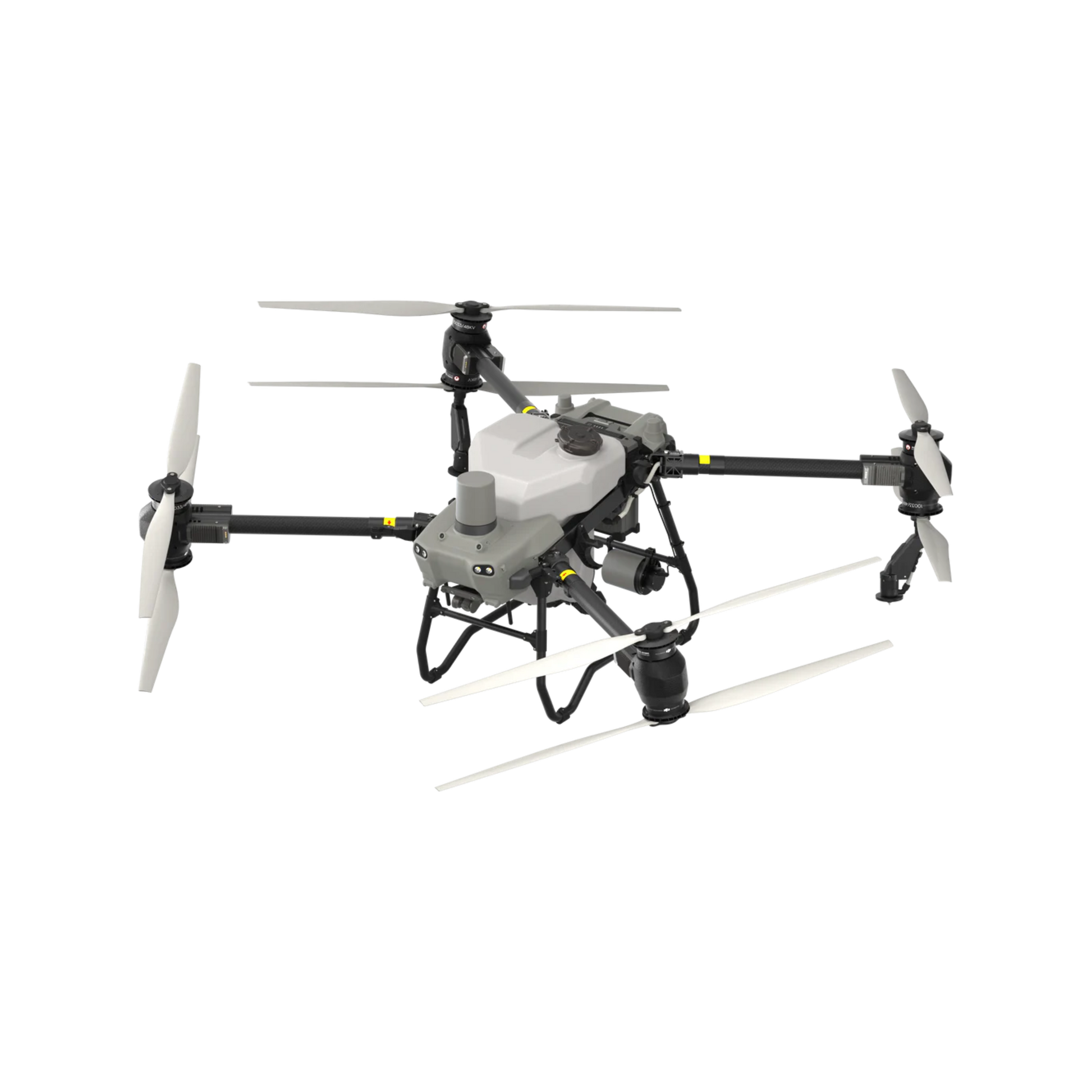
DJI Agras T50
T50 is a medium drone under its agricultural operating weights. Equipment ownership does not authorize flight or pesticide application.
Start with your province, not with the drone.
The correct pesticide credential depends on where the application occurs, whether you are spraying your own farm or working for customers, the pesticide class and use site, and whether the province has an aerial category, an RPAS-specific category or a current prohibition.
Flight permission, label permission and provincial permission.
Passing the Advanced drone exam is not enough. Completing a pesticide course is not enough. The product label, aircraft Safety Assurance, pilot privileges, provincial applicator credential and any business permit must all match the operation.
One operation, three separate regulatory systems.
Each system answers a different question: can you fly, can the product be applied by air, and are you licensed to handle and apply it in that province?
Transport Canada
Regulates the aircraft, pilot, operating category and airspace.
- Pilot Certificate - Advanced Operations or higher for medium drones.
- Aircraft registration and marking.
- Safety Assurance for the exact operation.
- VLOS, people separation and airspace authorization.
- SFOC when the mission falls outside standard permissions.
Health Canada
Regulates the pesticide product and legal directions for use.
- The registered label must permit aerial application.
- Follow aerial rate, volume, buffer, PPE and interval directions.
- Do not use a product that says not to apply by air.
- Check whether the registrant has opted out of RPAS application.
- Separate the pilot from pesticide mixing duties.
Province or territory
Regulates applicator competency and local pesticide operations.
- Aerial or RPAS applicator certificate.
- Business, operator or service licence where required.
- Application permits, notices or approvals.
- Insurance, storage, mapping and records.
- Provincial supervision and renewal rules.
From first research to your first legal application.
The order matters. Do not complete a course or purchase a chemical until the regulator confirms the correct category for your province and business model.
Define the province and exact use case.
- Own farm or paid service?
- Crop, forestry, mosquito, industrial or aquatic use?
- Drone model and maximum takeoff weight?
- VLOS or a higher-complexity mission?
Obtain the Transport Canada pilot certificate.
For T50-style medium-drone VLOS work, complete the Advanced online exam, pass an Advanced flight review and apply for the Advanced certificate. Transport Canada requires a score of at least 80 percent on the 50-question exam.
Register the aircraft and check Safety Assurance.
Registration does not prove the aircraft is eligible for every Advanced operation. Confirm the exact model and operation in Transport Canada's current Safety Assurance list.
Check the pesticide label before training around a product.
The label must permit conventional aerial application. Do not reduce below the minimum aerial spray volume, ignore aerial buffers or substitute ground directions.
Contact the provincial pesticide regulator.
Ask which individual certificate, business licence, course, manual, exam, permit and insurance documents apply specifically to RPAS pesticide application.
Complete the required pesticide training and exam.
Study pesticide core knowledge, aerial or RPAS application, provincial legislation, calibration, drift, PPE, emergency response, storage and records.
Apply for the individual credential.
Submit the exam result, identification, age requirement, Transport Canada credential and fee required by the province.
Register the business or service operation.
Commercial operators may need a separate operator, service or business licence, proof of insurance, storage details and a certified employee.
Build the crew and contamination-control SOP.
Separate pilot, mixer, loader, battery handler and observer roles. Protect the controller and other clean surfaces from contaminated gloves.
Complete a water-only demonstration.
Validate mapping, swath, droplets, spray pattern, battery rotation, refill flow and emergency procedures before using any pesticide.
Obtain site-specific permits and authorizations.
This may include airspace authorization, provincial use permits, sensitive-area setbacks, public notice, maps, agronomic prescriptions or customer approvals.
Operate, verify and maintain records.
Record the product, rate, field, weather, crew, aircraft, route, calibration, incidents, cleaning and maintenance required by the label and province.
Aerial-labelled products may now be eligible for RPAS.
Health Canada's SPN2026-02 allows RPAS application of products already registered for conventional aerial use, unless the label prohibits aerial use or the registrant adds an RPAS prohibition. Provincial permission is still required.

The aerial label remains the controlling document.
Use the labelled application rate, minimum spray volume, aerial buffer zones, retreatment interval, PPE and other directions.

A certificate does not prove the spray pattern.
Determine the actual swath and droplet performance before the first application and whenever operational parameters change.
The licence name and process change across Canada.
This table is a starting directory, not an authorization. Confirm the current category, training manual and RPAS eligibility directly with the provincial regulator before applying.
| Province | Individual credential | Business or permit layer | Key process | Current caution |
|---|---|---|---|---|
| Ontario | Aerial-class land exterminator licence | Operator licence for commercial services; permits for specified aerial applications | Ministry-approved course and exam; age 16 or older; apply online; licence valid five years | Normal farmer exemptions do not authorize aerial application Clear aerial class |
| Quebec | CD1 Aerial Application certificate | C1 or D1 Aerial Application permit for the business | Pass prescribed or recognized exams; individual certificate valid five years; business permit valid three years | Maps, treatment limits, sensitive-element distances and records apply Clear drone category |
| Saskatchewan | RPAS pesticide applicator licence | Pesticide service licence for hire or reward | Complete recognized training; age 18 or older; provide the Transport Canada credential required by the province; annual application fee listed at $100 | New RPAS category introduced in 2026; GPS records and drift insurance requirements apply RPAS-specific |
| Alberta | Special: Remotely Piloted Aircraft Systems applicator certificate | Aerial/RPAS pesticide service registration through DRAS for service businesses | Home-study material and class exam through Lakeland College; passing grade at least 70 percent | Confirm whether another applicator class is also needed for the product and site RPAS-specific |
| British Columbia | Aerial pesticide applicator certificate | User service licence, non-service licence, permit or confirmation may apply | Write the BC Aerial exam or use approved out-of-province training plus the BC law exam; exam fee listed at $90 | Official Aerial page still describes helicopter and fixed-wing use; confirm RPAS acceptance before enrolling Confirm with BC |
| Manitoba | Aerial commercial pesticide applicator licence | Commercial licensing, insurance and application package requirements | Province states that drone applicators must apply for a Manitoba pesticide applicator licence | Provincial online wording may lag Health Canada's June 2026 policy; obtain written current guidance Confirm current policy |
| Prince Edward Island | Class K - RPAS certificate | Confirm company and site requirements with the department | Age 18 or older; application form; written exam with at least 75 percent; certificate fee listed at $75 | Use only products and applications permitted by federal and provincial rules RPAS-specific |
| New Brunswick | Class A aerial applicator certificate | Pesticide use permit required; operator licence for fee or reward | Self-study core and aerial manuals; schedule exam through NBCC; annual commercial certificate fee listed at $25 | Permit conditions can include setbacks, weather, reporting and notice Aerial pathway |
| Newfoundland and Labrador | Provincial pesticide applicator licence with category exams | Operator licence may apply for business activities | Pass the National Core exam at 75 percent and the required category exam; licence term listed at five years | Confirm the current aerial or RPAS category before booking the exam Confirm category |
| Nova Scotia | No current RPAS pesticide category | Aerial approvals exist for conventional aircraft, but not RPAS pesticide application | Official provincial FAQ states that drones may not currently apply pesticides | Do not schedule pesticide drone work Currently prohibited |
| Other provinces and territories | Varies | Varies | Contact the pesticide regulator and request written RPAS guidance | Do not assume reciprocity or federal policy automatically creates provincial permission Direct confirmation |
The pesticide licence does not replace the pilot certificate.
T50-style aircraft are medium drones. Medium-drone VLOS operations are Advanced operations or beyond, and the aircraft must meet the applicable Safety Assurance requirements.
Advanced exam
The official exam has 50 multiple-choice questions, a 60-minute limit and an 80-percent passing score.
Flight review
After passing the exam, complete an Advanced flight review with an authorized flight reviewer.
Certificate application
Apply through the Drone Management Portal. Transport Canada lists a $25 issuance fee for the Advanced certificate.
Aircraft registration
Register and mark the aircraft and carry proof of registration during operations.
Safety Assurance
Verify the exact aircraft and declaration required for the distance from people and controlled-airspace operation.
SFOC or Level 1 Complex
Higher-complexity, dangerous-payload, adverse-weather, advertised-event and other special missions may require additional permission.
Your personal certificate may not authorize the company.
Commercial pesticide work commonly requires two separate approvals: the individual who applies the product and the business that advertises, contracts, stores, transports or provides the service.
Individual applicator
- Completes the training and exam.
- Holds the correct aerial or RPAS category.
- Carries the certificate during work.
- Works only within the certificate scope.
- Renews or recertifies before expiry.
Business or operator
- Registers or licenses the pesticide service.
- Employs the required certified person.
- Maintains insurance and storage compliance.
- Obtains use permits or approvals.
- Maintains customer and regulatory records.
Build the crew before the chemical job.
Health Canada's policy separates key roles to reduce pilot exposure and contamination of clean flight controls.
RPA pilot
Controls the aircraft and monitors the flight. The pilot must not mix pesticide.
Mixer and loader
Prepares the product and handles loading under the label, PPE and closed-transfer requirements.
Battery handler
Health Canada recommends that the mixing/loading person also handle battery changes to reduce transfer of pesticide residue to the controller.
Visual observer
Health Canada states that visual observers must hold at least a Basic RPA pilot certificate.
PPE
Follow the groundboom or airblast PPE requirements for the crop and use site, unless the product is registered only for aerial application.
Downwind control
Do not position the pilot, observer or crew downwind of the spraying drone.
A licence is the start of compliance, not the finish.
Complete these checks for the exact field, product, aircraft, route and crew before application.
Product label
Current label, aerial use, crop, pest, rate, volume, buffers, PPE and intervals.
Registrant status
Check whether the manufacturer has added an RPAS prohibition to the label.
Provincial permits
Use permit, site approval, public notice, map or prescription where required.
Airspace
Controlled-airspace permission, aerodromes, NOTAMs and local restrictions.
Calibration
Actual swath, droplets, flow, speed, height, overlap and spray-pattern verification.
Records
Field, product, weather, crew, aircraft, map, route, calibration and maintenance.

Power, cooling and safe staging belong in the operating plan.
Charging logistics do not replace chemical-handling, fire-safety, transport or contamination controls.
Ownership does not authorize operation.
Confirm the pilot, aircraft declaration, pesticide label, province, business, insurance and site before scheduling.
Common questions from Canadian farms and applicators.
Is there one pesticide applicator licence for drone spraying across Canada?
No. Canada does not issue one national pesticide applicator licence. Health Canada regulates the pesticide label, Transport Canada regulates the aircraft and pilot, and each province or territory controls its own pesticide applicator certificates, business licences, permits, supervision and recordkeeping rules.
Do I need both a drone pilot certificate and a pesticide applicator licence?
Yes. A Transport Canada pilot certificate does not authorize pesticide application, and a provincial pesticide credential does not authorize the flight. Both systems must be satisfied, along with the aircraft Safety Assurance and the pesticide label.
What Transport Canada certificate is normally required for DJI Agras T50?
DJI Agras T50 is a medium drone at its agricultural operating weights. Medium-drone visual-line-of-sight work is an Advanced operation or higher. The pilot needs the appropriate certificate, the aircraft must be registered and the exact model and operation must have the required Safety Assurance.
Can I spray any agricultural pesticide once I obtain a licence?
No. The registered product label must permit aerial application. If the label says not to apply by air or does not contain aerial directions, drone application is prohibited. Registrants may also add a statement prohibiting RPAS application.
Can a farmer spray their own field without an aerial pesticide licence?
Do not assume a farmer exemption applies. Ontario explicitly requires an Aerial-class licence for aerial land extermination. Other provinces have their own aerial or RPAS categories, exemptions and permit rules. Confirm the rule with the provincial regulator before training or application.
Can the drone pilot mix the pesticide?
Health Canada's 2026 policy states that the person mixing and loading the pesticide must not be the RPA pilot. The pilot may load premixed pesticide only when the label allows it, another person completed the mixing and a closed transfer system is used.
Does a pesticide applicator certificate allow me to operate a commercial spraying business?
Not necessarily. Many provinces require a separate operator, service, business or company licence in addition to the individual's applicator certificate. Insurance, storage, permits and recordkeeping may also be required.
How long does the licensing process take?
Timing varies by province, training provider, exam availability, application completeness and whether business permits are required. Some programs can take several weeks or longer. Start before the spraying season rather than waiting for the first customer.
Is drone pesticide spraying currently allowed in Nova Scotia?
Nova Scotia's current official pesticide FAQ states that RPAS may not be used to apply pesticides in the province at this time because the province does not yet have an appropriate certification category for this application method.
Can I use an out-of-province pesticide certificate?
Sometimes, but reciprocity is not automatic. Several provinces offer transfer or equivalency processes, often with a provincial law exam. Apply for recognition before working and do not assume an existing certificate authorizes aerial or RPAS application.
Should I complete a water-only demo before pesticide work?
Yes. A water-only demonstration can confirm mapping, aircraft handling, route planning, swath, spray pattern, battery rotation and crew workflow. It does not authorize pesticide use or prove efficacy, crop safety or legal compliance for a product.
Can SpeedyDrone issue my pesticide applicator licence?
No. Only the responsible government authority can issue a pesticide licence, certificate or permit. SpeedyDrone can help with agriculture equipment, Advanced Pilot training options, water-only demonstrations, deployment planning and a checklist of official provincial contacts.
Use government pages as the source of truth.
Build your licensing and deployment checklist before buying.
Send the province, crop, drone model, own-farm or commercial use, pilot-certificate status and planned spraying season. SpeedyDrone can help identify the official government starting points, discuss Advanced Pilot training, prepare a water-only demo and configure the agriculture equipment system.


