


Zenmuse H30T · Night operations
Find the target.
Choose the right view.
A sensor-selection workflow for low-light inspection: visible detail, near infrared, thermal information and the record you keep.
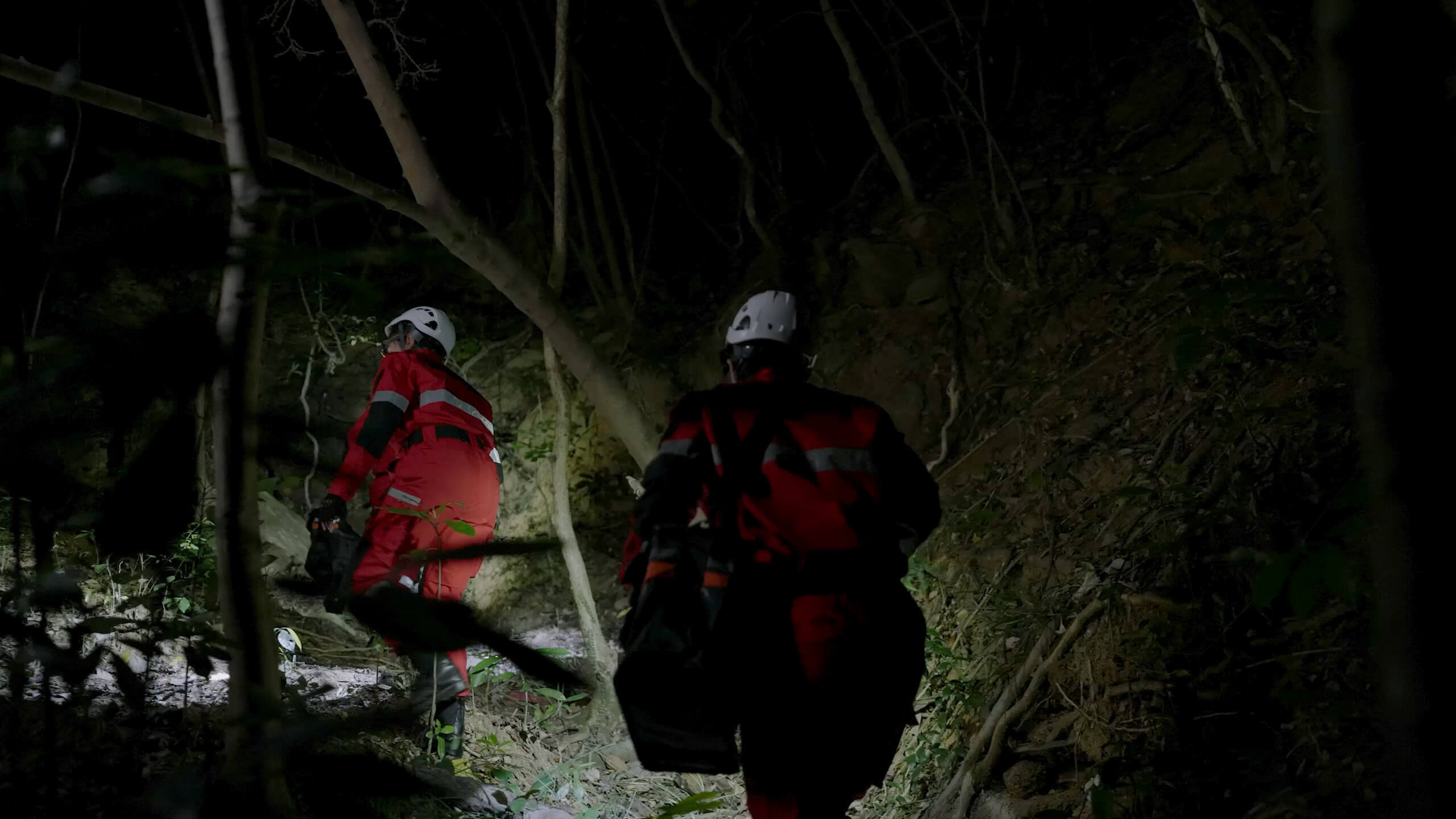
For H30T night inspection, use thermal to find heat contrast, Night Scene to recover visible context, and zoom IR/NIR only when it improves the view. Use the laser for location context and Pre-Recording to retain an event’s lead-in.
There is no single “best night mode.” Night Scene works on both visible cameras, but IR Light and NIR illumination are zoom-only. Electronic Dehazing cannot run with Night Scene. Thermal High-Res mode cannot measure temperature, and UHR infrared enhancement is a different feature with its own Night Scene restriction.
The useful question is what evidence you need next. A warm shape is not yet an identified person; a grayscale view is not a temperature image; a laser return does not establish which surface produced it. Each tool answers a different part of the inspection question.
This guide covers imaging choices and recording preparation, not flight authorization or a replacement for approved site procedures. For payload buying and upgrade decisions, use our H30T versus H20T comparison.
Which tool answers the question?
| Field question | Start with | Important limit |
|---|---|---|
| Can I see colour or surface detail in low light? | Visible Night Scene | Needs useful scene light; lower frame rates reduce motion smoothness. |
| Can I improve a very dark zoom view? | IR Light; test NIR illumination | Grayscale, zoom-only; illumination can worsen contrast. |
| Where is the heat contrast or possible hot component? | Thermal | A thermal pattern alone does not prove identity or temperature accuracy. |
| Where is the observed target? | Laser rangefinder / PinPoint | Return depends on the target, atmosphere and beam footprint. |
| Is daylight haze obscuring distant detail? | Electronic Dehazing | Zoom-only; cannot operate with Night Scene. |
| Could I miss the start of an event? | Pre-Recording | Must already be enabled and buffered; confirm saved channels. |
Sensor-selection suggestions by SpeedyDrone, based on DJI’s documented capabilities. They are not guaranteed identification distances or mission-specific operating standards.
Night Scene: choose motion handling before maximum sensitivity
Night Scene enhances low-light imaging on the wide-angle and zoom cameras. DJI lists Night Scene video at 1920 × 1080 with 25, 15 or 5fps on both cameras. Do not plan a night recording around the payload’s separate daytime 4K specifications.
Lower frame rates allow longer exposure and stronger low-light/noise-reduction performance, but movement looks less fluid. As an operating starting point, try 25fps for moving subjects or a changing view, 15fps as a compromise, and 5fps when a relatively static scene needs more low-light visibility. Compare the result on the actual subject rather than choosing the lowest number automatically.
At 5fps, five images represent each second. A brief movement may be harder to interpret even when an individual frame looks brighter. Aircraft motion and subject motion both matter, so a setting that works on a stationary structure may be unsuitable for following a person.
The maximum Night Scene ISO values—819,200 on zoom and 409,600 on wide—describe sensitivity settings, not a promise of readable markings or positive identification. Start with the available ambient light and decide whether retaining colour helps the task. Streetlights or industrial lighting may make a colour view more useful than an illuminated grayscale image.
IR Light changes the camera; NIR adds illumination
DJI’s naming can be confusing. IR Light removes the zoom camera’s infrared filter and changes its view to grayscale. The user manual refers to the related control as IR Cut Filter. This lets the camera use near-infrared information; it is not the thermal camera and is not, by itself, the active illuminator.
The NIR Auxiliary Light emits 850nm near-infrared illumination. The camera observes light reflected by the scene. Ambient near-infrared light can also contribute, so removing the filter does not mean the auxiliary light must always be on. Both IR Light and auxiliary NIR operation are limited to the zoom camera, not the wide-angle camera.
DJI permits the NIR auxiliary light to turn on after takeoff and turns it off after landing. Enabling it also enables the IR Light/IR Cut function. A ground check that cannot activate the illuminator is therefore not sufficient evidence of a fault; verify the documented operating conditions without bypassing normal flight preparation.

Why leaving NIR on can make the image worse
DJI says ordinary urban night scenes may already be clear enough with Night Scene. Adding NIR can whiten the image and reduce contrast. Compare the same subject with the illuminator off and on; keep the setting that preserves useful detail, not simply the brighter image.
The published illumination footprint is approximately 8m in diameter at 100m. That describes beam coverage at one distance, not a maximum range or a guaranteed recognition distance. The manual also notes that below 10× zoom, NIR illumination does not cover the camera’s entire field of view.
NIR is not a see-through-fog tool. DJI warns that long-distance dark scenes beyond 200m, or rain and fog, can produce particle backscatter and image whitening. Do not read “beyond 200m” as a guaranteed clear range below that distance. Weather, surfaces and ambient light still change the result.
Thermal finds a different kind of information
The H30T’s thermal camera detects long-wave infrared radiation in the 8–14μm band. Its native image is 1280 × 1024 at 30fps, with R-JPEG still-image support and up to 32× digital zoom. It does not require visible scene lighting, but atmospheric conditions, obstructions and weak thermal contrast can still limit what you learn.
Use thermal to notice a heat pattern, then use visible or NIR detail to understand the object and its surroundings. Thermal does not reliably substitute for reading a label, recognizing a surface finish or confirming that a warm shape is a particular person.
| Question | Zoom IR / NIR | H30T thermal |
|---|---|---|
| What forms the image? | Reflected light, including near infrared; the auxiliary lamp adds 850nm illumination. | Long-wave infrared radiation from the scene. |
| Is scene illumination needed? | Yes: useful ambient or auxiliary illumination. | No visible illumination is needed. |
| What is it useful for? | Grayscale structure and surface detail, where resolvable. | Heat contrast and, in supported modes, temperature measurement. |
| What can defeat the view? | Insufficient return, limited beam coverage or backscatter. | Obstructions, atmosphere, low thermal contrast and measurement limitations. |
High-Res and UHR are not the same setting
For temperature work without the optional infrared density filter, High Gain covers −20°C to 150°C and Low Gain covers 0°C to 600°C. Those ranges are not guarantees of accurate field readings. For emissivity, reflections, target size and uncertainty, see our thermal measurement accuracy guide.
High-Res mode is for observing small temperature differences and does not support temperature measurement. Do not choose it merely because the name sounds like the highest measurement-quality setting.
UHR infrared enhancement is separate. When enabled, automatic UHR operates at thermal zoom levels of 5× or higher; DJI’s manual says it is unavailable with Night Scene enabled. That restriction does not mean Night Scene disables the thermal camera, nor does it establish an undocumented High-Res incompatibility.
The laser helps locate a target—it does not identify it
After finding a subject, the rangefinder and PinPoint tools can add distance, altitude and coordinate context. Treat those readings as information to cross-check against the image and scene, not as proof that the return came from the small component you intended to measure.
DJI specifies a 3–3000m measurement range. The upper figure depends on defined test conditions, including visibility, incidence angle and a target larger than the laser footprint. Rain, fog, haze, snow, reflective surfaces and several objects within the beam can reduce performance. It is not a 3000m guarantee for every person, wire or insulator.
The beam is also not an infinitely small point. DJI lists a footprint of approximately 50 × 450mm at 100m and 450 × 4500mm at 1000m. At the longer distance, its long dimension is about 4.5m. A small target and its background may both lie inside that footprint, so a stable-looking number still needs interpretation.
Darkness and haze are different problems
Night Scene addresses low illumination. Electronic Dehazing reduces the visual effects of atmospheric haze on the zoom image, with Auto operation and Low/High settings described in DJI’s manual. It is not another lamp and does not create missing scene light.
Night Scene and Electronic Dehazing cannot be enabled together. For a hazy daylight view, dehazing may be the relevant tool. For a dark view, Night Scene is the relevant starting point. A dark, foggy scene does not unlock a combined setting, and neither this processing nor NIR should be treated as a guarantee of usable visibility.
Pre-Recording: keep the lead-in, not an endless archive
H30 Series Pre-Recording supports 10-, 15- and 30-second buffers on the wide, zoom and infrared thermal cameras. Once enabled and filled, the rolling buffer can retain footage from before the operator presses Record, alongside the subsequent recording. It cannot recover an earlier event if the feature was off or the required footage has already left the buffer.
This is useful when a person enters the scene or equipment behaves intermittently. Continuous observation does not have to become one continuous saved video, but the operator still needs to start recording while the relevant lead-in remains available. Support on all three cameras does not mean every channel is automatically saved: check the selected video storage channels.
As a SpeedyDrone planning suggestion, try 10 seconds for predictable events, 15 seconds when a moderate lead-in is enough, and 30 seconds when the beginning may be difficult to anticipate. These are workflow choices, not DJI task standards. A longer buffer does not replace a recording plan for extended events.
Rehearse the installed aircraft, payload and DJI Pilot 2 combination. Confirm Night Scene behaviour, selected channels, buffer duration and saved files together, especially after changing settings. DJI has documented version-specific Auto Night Scene/Pre-Recording interactions historically; an old issue list is not proof of a universal defect in current firmware. Use the current downloads and your own verification, not a launch-era assumption.
- Select the camera channels you need to retain and check available storage.
- Set the intended Night Scene frame rate and thermal observation or measurement mode.
- Enable Pre-Recording, select a duration and allow the buffer to fill.
- Record a short rehearsal event, then inspect the saved lead-in and channel files.
Two illustrative night-inspection workflows
Search observation: find contrast, then verify context
A thermal scan may reveal a warm shape near vegetation. Use a visible Night Scene view to examine its outline and surroundings; if detail remains inadequate, compare zoom IR Light with and without NIR illumination. Do not classify the target solely from warmth or from a brighter grayscale image.
Once the scene supports a useful interpretation, add range/PinPoint context and retain the relevant views. A previously configured buffer may preserve the discovery lead-in. Communicate uncertainty alongside location information when the object is not positively identified.
Utility follow-up: separate finding an anomaly from measuring it
Thermal contrast can suggest a component worth examining. Visible zoom helps establish which structure is in view; NIR is an optional aid when the reflected-light image remains too dark, not a mandatory step. Check that the laser return corresponds to the intended part of the scene rather than assuming the reticle isolates a small fitting.
If the report needs temperatures, use a measurement-capable thermal mode and the appropriate measurement procedure—not High-Res observation mode. Record intermittent behaviour with a prepared buffer where useful. For the wider programme, read our powerline and utility inspection guide. These examples are illustrative, not SpeedyDrone field-test results or utility safety procedures.
Mode restrictions to check before the mission
| Feature | Applicable channel | Restriction or setup dependency |
|---|---|---|
| Night Scene | Wide and zoom | 1080p at 25/15/5fps; not simultaneous with dehazing. |
| IR Light | Zoom | Grayscale infrared-filter operation, not thermal measurement. |
| NIR Auxiliary Light | Zoom | After takeoff; enables IR Light; can reduce contrast. |
| Electronic Dehazing | Zoom | Unavailable with Night Scene. |
| Thermal High-Res | Thermal | Temperature measurement unavailable. |
| Automatic UHR | Thermal | Enhancement at ≥5× when enabled; unavailable with Night Scene. |
| Pre-Recording | Wide, zoom and thermal | Select 10/15/30 seconds and saved channels; rehearse the installed configuration. |
| Laser rangefinder | Separate ranging module | Target and atmosphere determine usable returns. |

View the H30T at SpeedyDrone
Plan around the evidence you need
The H30T combines wide and zoom imaging, thermal imaging, laser ranging and NIR illumination. Its value is the ability to cross-check those views—not a promise that one setting solves every dark scene.
Before choosing a setup, identify the host aircraft, expected subject distance, available lighting and whether the deliverable is observation footage, positional context or temperature evidence. SpeedyDrone’s listing asks buyers to confirm availability before ordering.
Discuss your H30T inspection setup
Send SpeedyDrone your aircraft model, inspection task and expected night conditions to discuss the payload setup and confirm current availability.
Discuss an H30T night-inspection setupFrequently asked questions
Does Night Scene work on both H30T visible cameras?
Yes. DJI supports Night Scene on the wide-angle and zoom cameras. Night Scene video is 1920×1080 at 25, 15 or 5fps. IR Light and the NIR auxiliary illuminator are different: both are zoom-only. Do not infer that a shared Night Scene feature gives the wide camera the zoom camera’s near-infrared functions.
Is 5fps the best Night Scene setting?
Not automatically. Lower frame rates allow longer exposure and stronger low-light performance, but sacrifice motion smoothness. Five frames per second may suit a relatively static subject in very low light; it can make moving subjects or a moving view harder to interpret. Judge the information needed from the clip, not just the brightness of one frame.
Is H30T black-and-white night vision the same as thermal?
No. The zoom camera’s IR Light function removes its infrared filter and produces a grayscale reflected-light view. NIR illumination adds 850nm light to that scene. The separate thermal camera detects long-wave infrared radiation in the 8–14μm band. A black-and-white zoom view is therefore not a temperature map, even if it reveals details that were difficult to see in colour.
Should NIR always be enabled at night?
No. DJI notes that Night Scene may already be sufficient in urban night conditions. Extra NIR can whiten the view or reduce contrast, especially when particles scatter light back toward the camera. Compare the same scene with it off and on. Select the view that supports interpretation, and remember that the illuminator is available only after takeoff.
Does the 8m footprint at 100m specify NIR range?
No. It describes the approximate diameter of the illuminated area at a particular distance. It does not establish a maximum illumination range or guarantee object detection, recognition or identification at 100m. Target reflectivity, atmosphere, ambient light and zoom framing affect the usable result; below 10× zoom, the beam does not fill the entire camera view.
Can Night Scene and Electronic Dehazing run together?
No. DJI documents them as mutually exclusive. Night Scene addresses low light; Electronic Dehazing addresses haze effects in the zoom image. A night scene with fog may involve both problems, but it does not permit both features at once or make NIR a reliable fog-penetration solution.
Can thermal High-Res mode measure temperature?
No. High-Res mode is intended for observing small temperature differences, without temperature measurement. It is separate from automatic UHR enhancement, which operates at thermal zoom levels of 5× or higher when enabled and is unavailable with Night Scene. Choose the thermal mode according to whether the task requires observation or actual temperature evidence.
Does the H30T laser measure every target at 3000m?
No. 3000m is the upper end of DJI’s specified range under defined conditions. A small target, mixed surfaces within the laser footprint, unfavourable reflectivity or poor visibility can limit the return. Range and PinPoint information should be checked against the scene; the number alone does not prove which object was measured.
How much earlier footage does Pre-Recording retain?
The selectable buffers are 10, 15 and 30 seconds for supported wide, zoom and thermal recording. The feature must be enabled, the buffer must have had time to fill, and the wanted event must still be inside that rolling window when recording begins. Verify the selected saved channels and inspect a rehearsal clip; it is not automatic recovery of everything observed before Record.
Official references
Specifications and restrictions were checked against DJI’s current public documentation. Suggested workflows are SpeedyDrone’s interpretation, not a claim of field testing. Recheck the installed software and relevant release notes before relying on a configuration.
- DJI H30 Series specifications — frame rates, thermal specifications, NIR and laser figures.
- DJI H30 Series FAQ — IR/NIR operation, environmental limits and mode restrictions.
- DJI H30 Series overview — supported pre-recording channels and buffer durations.
- DJI H30 Series User Manual v1.0 — printed pages 8, 10, 12–14 and 20–21: ranging, thermal modes, recording and settings.
- DJI H30 Series downloads — current manuals and version-specific release information.


