


Compact camera or flagship system
A flagship should solve
a real shooting need.
Start with the finished photograph or video, then decide which camera system earns its place in your bag.
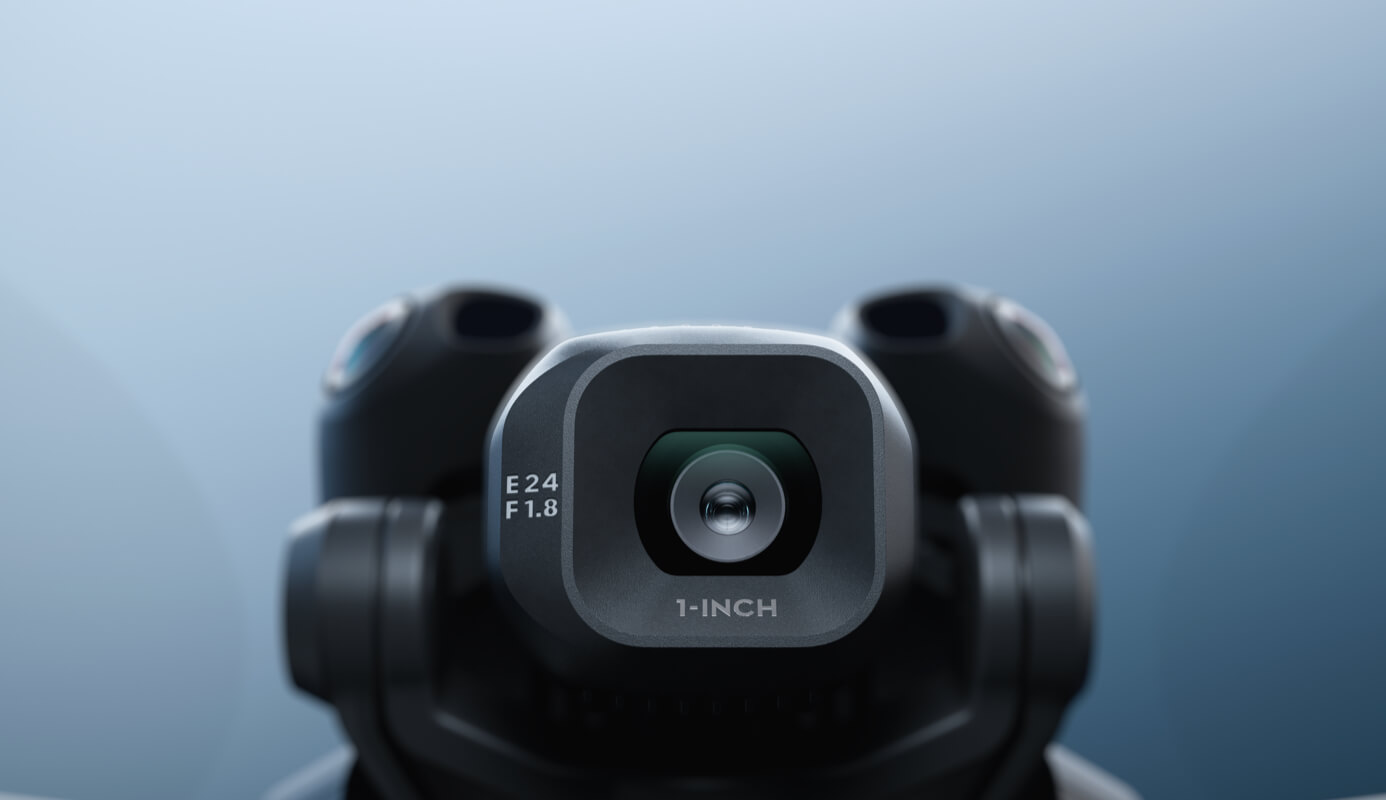
Specifications, Canadian listings and operating-weight guidance checked October 4, 2026. Photography: DJI and SpeedyDrone product galleries. This is a specification-based buying guide, not a side-by-side flight test.
Mini 5 Pro is enough when wide-angle 4K video, RAW photographs, true vertical capture and a small carrying kit cover your work. Mavic 4 Pro makes sense when a specific shot or delivery requirement needs its additional cameras, larger main sensor, 6K recording or gimbal flexibility.
The DJI Mini 5 Pro vs DJI Mavic 4 Pro decision is not “amateur versus professional.” Mini already has a 50MP, 1-inch camera and serious recording options. A paid shoot does not automatically need the flagship; an enthusiast with a recurring telephoto requirement may have a stronger reason to buy it. Both support true vertical shooting, so portrait-format content alone does not settle the choice.
Start with the last few projects you finished, or the next brief you must deliver. Was a wide establishing shot sufficient? Did you need a tighter view without moving closer? Was the limitation the camera, or the light, access, flight planning and edit? Those questions reveal whether extra hardware addresses a problem you actually have.
Here, the comparison is between complete Fly More packages with DJI RC 2 and three batteries. That avoids making Mini look artificially inexpensive by comparing its entry controller package with a fuller flagship kit. The price difference is substantial, but it belongs beside the carrying and operating consequences—not in place of them.
There is also a middle option. If your only missing tool is an independent 70mm camera, Air 3S deserves a look before you jump to Mavic. The flagship needs a reason beyond being the next step up the catalogue.
In this comparison
One capable camera system versus three physical lenses
Mini 5 Pro gives you a 24mm-equivalent wide camera and a 48mm Med-Tele mode from that same camera system. Mavic 4 Pro gives you separate 28mm, 70mm and 168mm-equivalent cameras. That is the first difference to evaluate, before megapixels or maximum flight time.
The two exact packages below both include RC 2. Their photographs come from the matching SpeedyDrone listings; the written contents, rather than every accessory pictured in promotional artwork, determine what is included.


| Capability | Mini 5 Pro | Mavic 4 Pro |
|---|---|---|
| Main camera | 1-inch CMOS, 50MP; 24mm equivalent; fixed f/1.8 | 4/3 Hasselblad CMOS, 100MP; 28mm equivalent; f/2–f/11 |
| Tighter framing | 48mm Med-Tele mode using the same camera | Independent 70mm camera: 1/1.3-inch, 48MP; independent 168mm camera: 1/1.5-inch, 50MP |
| Video headroom | 4K/60 HDR and 4K/120 slow motion | Main camera up to 6K/60 and 4K/120 slow motion; other cameras have their own limits |
| Vertical capture | True vertical shooting | True vertical shooting; main camera up to vertical 4K/60, tele cameras up to vertical 2.7K/60 |
Phone: swipe inside the table. Keyboard: focus the table region and use arrow keys. Resolutions and HDR support depend on the selected camera and recording mode.
For wide travel footage, Mini's single camera is not a reason to dismiss it. It can record a location, follow a planned flight path and produce files suitable for a considered edit. Mavic's 28mm main lens also starts slightly tighter than Mini's 24mm; the flagship is not automatically the wider tool for a constrained establishing view.
Will you use 70mm and 168mm in the finished edit?
Buy the extra cameras when they change your sequence, not because three sounds more complete than one. A dedicated longer lens can isolate details from a permitted stand-off position, reduce how much unrelated scenery fills the frame and give you a different framing option without relying solely on a crop from the wide camera.

Consider an illustrative tourism sequence: a wide view explains the location, a medium view emphasizes a lodge or vehicle, and a distant detail adds a final visual layer. If those tighter views are required repeatedly, Mavic's camera system has a clear job. If your edit only needs the first view, you are paying to carry options that may remain unused.
There is a useful photography distinction here. From the same position, a longer focal length narrows the field of view; it does not by itself change perspective. Moving the aircraft changes the viewpoint and the relationship between foreground and background. The compressed-looking compositions often associated with telephoto work involve the chosen viewpoint as well as the lens. A crop is not identical to a separate camera, but neither is changing lenses a substitute for composition.
The 168mm camera also makes small framing errors and movement more conspicuous. Allow time to aim, stabilize and check the shot. A longer view does not remove line-of-sight, site-access or safe-flight constraints. For lens-by-lens practice, use our Mavic 4 Pro 28mm, 70mm and 168mm lens guide; this comparison is about whether you need that system in the first place.
Does the larger camera or 6K solve your output requirement?
Mavic's main-camera upgrade is a combination: a 4/3 sensor, adjustable f/2–f/11 aperture, 100MP stills and up to 6K/60 video. It is not simply “100MP is twice as good as 50MP.” Light, exposure, lens performance, motion, processing and the final display all affect the useful result.
Both drones support DNG RAW photographs. For a stills brief, ask how the files will be used: a modest web image, a tightly cropped architectural detail or a large final print are different demands. Mavic's higher-resolution main-camera mode is relevant to demanding output, but the pixel count alone does not guarantee that a particular photograph will meet the brief. Check the required detail and process a representative file before committing to a difficult delivery.
Variable aperture gives Mavic another exposure control when you want to retain a chosen shutter setting. Mini's f/1.8 aperture is fixed. That does not make Mini unsuitable for controlled video; its Fly More kit includes ND filters. Nor does adjustable aperture make filters unnecessary in every bright scene. Choose exposure tools for the light and intended motion rather than assume the more expensive camera removes that work.
6K can provide additional framing latitude for a lower-resolution edit, or meet a brief that specifically requests more than 4K. It also creates another reason to check your ingest, storage, editing and export workflow. If you deliver wide-angle 4K with little reframing, Mini's 4K capability may already satisfy the requirement. Mavic's 6K headline applies to its main camera, not uniformly to all three lenses.
Vertical video does not automatically favour either drone
Mini is attractive for travel Reels, Shorts and mixed horizontal/vertical shooting because a capable camera fits in a small kit. But the correct comparison is not “Mini rotates, Mavic crops”: Mavic 4 Pro also supports true vertical shooting. Its main camera supports vertical 4K/60; the medium and tele cameras support vertical 2.7K/60.

Mini's gimbal has a 225° roll range. Mavic's Infinity Gimbal adds 360° roll capability and shooting upward to 70°. Those numbers describe different mechanical and creative capabilities, not a guarantee that every movement works in every recording mode. DJI notes movement constraints for Mavic's vertical shooting, including limitations that can affect abrupt starts and stops.
If a planned shot needs that roll or upward view, test the exact camera, mode and movement before the shoot. If your vertical footage consists of straightforward landscapes and subjects, gimbal range beyond the shot's needs may add little value. Likewise, Mini's ActiveTrack 360° can help a solo workflow, but tracking and obstacle sensing do not make it a pilot-free camera. Choose a controllable, lawful route and retain responsibility for the flight.
Do you actually carry the complete kit?
The smaller kit matters when it determines whether you take the drone at all. Mini's published standard-battery aircraft weight is 249.9g ±4g, versus approximately 1,063g for Mavic. Folded dimensions without propellers are 157×95×68mm and 257.6×124.8×103.4mm respectively. These are aircraft measurements, not complete shoulder-bag weights.

Both Fly More bags add RC 2, spare batteries, a charging hub, cables and other accessories. The standard Mini battery weighs approximately 71.2g; a Mavic battery approximately 332g. Spare-battery load therefore matters on a long walk even before you consider the aircraft. We have not weighed complete kits and do not present a fabricated all-in total.
For a hiking creator already carrying a camera, water and clothing, Mini may earn its place because it leaves room for the rest of the trip. For a drive-to-location production with a planned telephoto sequence, Mavic's greater carrying burden may be acceptable. The useful question is what you carry on your real route, not whether either aircraft technically folds.
If you already own Mini, keeping it can remain sensible after buying Mavic. One can serve lightweight outings while the other serves a defined shot list. That is an ownership choice, not an argument that everyone needs two drones.
Compare matching Fly More kits, not headline starting prices
On October 4, 2026, SpeedyDrone displayed C$1,429.00 for Mini 5 Pro Fly More Combo with RC 2 and C$3,898.99 for Mavic 4 Pro Fly More Combo with RC 2. The listed-price difference is C$2,469.99, before applicable taxes and delivery charges. Both purchase controls were enabled when checked; confirm current availability and fulfilment timing before a trip or deadline.
| Item | Mini 5 Pro Fly More | Mavic 4 Pro Fly More |
|---|---|---|
| Listed item price | C$1,429.00 | C$3,898.99 |
| Controller / batteries | DJI RC 2; three standard Intelligent Flight Batteries | DJI RC 2; three Intelligent Flight Batteries |
| Charging equipment | Two-Way Charging Hub; no wall adapter listed in the kit contents | Parallel Charging Hub and 100W USB-C Power Adapter |
| Other relevant contents | ND8/32/128 filters, shoulder bag, protective cover, spare propellers and cable | Shoulder bag, storage cover, spare propellers and cables |
Dated Canadian listings, not a price guarantee. Compare the complete included-controller packages; no optional controller-removal offer has been deducted.
The comparison is fairer with the same controller and three batteries, but the boxes are not identical. Check whether you already have an appropriate charging adapter for Mini. Conversely, do not assume Mavic's included hub performs three-battery parallel charging merely because “Parallel” appears in its name: DJI specifies sequential charging with the included 100W adapter.
Do not spend the difference only because it is available in your budget. Decide whether the missing capability is recurring, whether your final files benefit from it and whether the rest of the workflow is ready. For an occasional tighter shot, changing the plan or selecting the intermediate camera system may be sufficient. For repeatable flagship-specific output, buying the appropriate camera can be more practical than repeatedly working around its absence.
Longer endurance is useful, but it is not your shoot budget
DJI lists up to 36 minutes for Mini with its standard battery and up to 51 minutes for Mavic. These are manufacturer maximums measured in controlled, windless-equivalent Photo-mode tests until battery depletion, with different flight speeds. They are not an identical-condition comparison of recorded production flights.
Plan for reaching the subject, making corrections, recording useful takes and returning with reserve. Wind, temperature, movement, configuration and battery condition change the session. Three batteries provide separate flight cycles, not one continuous three-times-longer flight. A longer maximum can add headroom, but a poor return plan remains poor on either drone.

Neither size nor endurance establishes a wind winner: both publish a 12m/s maximum wind-resistance rating. That rating is not permission to operate at the limit, nor a guarantee of stable footage in gusts. Assess the actual conditions, available landing sites and your operating margin rather than substitute an aircraft category for judgement.
In Canada, weigh the aircraft you will actually fly
Transport Canada defines a microdrone as having an operating weight less than 250g, including anything attached or carried. Mini's 249.9g ±4g specification does not guarantee that every standard-battery unit is below that threshold. Weigh the flight-ready configuration; the RC 2 and shoulder bag are carrying-kit items, not attached aircraft weight.
The optional DJI Mini 5 Pro Intelligent Flight Battery Plus weighs approximately 117g versus 71.2g for the standard battery. Its up-to-52-minute DJI maximum is a different configuration, and it takes Mini beyond the microdrone threshold. It is not included in the standard Fly More price above.
Microdrone pilots do not need registration or a pilot certificate, but safety, restricted-airspace, privacy and other obligations remain. Mavic, and a Mini configuration at 250g or above, require registration and the appropriate certification and operating category. Consult TC's microdrone guidance and operation categories; this guide is not permission for a particular flight. Our Canadian drone safety overview provides wider context.
When should you stop at Air 3S instead?
If the independent 70mm camera is the only thing missing from Mini, do not skip Air without checking it. The DJI Air 3S Fly More Combo (DJI RC 2) combines a 1-inch, 24mm-equivalent main camera with a dedicated 70mm camera. It addresses the two-camera requirement without making every buyer pay for Mavic's third focal length and main-camera system.
Use the Air 3S vs Mini 5 Pro comparison for that upgrade question. If Air already covers your wide and medium shots, our Mavic 4 Pro vs Air 3S guide examines the additional flagship requirements. Those are adjacent decisions, not reasons to buy three aircraft.
Choose from the shot list, then the kit
The following situations are editorial examples, not client case studies or measured results. A travel creator making wide landscape clips and straightforward vertical posts may get more practical value from Mini's small kit. An everyday property-video brief may also be covered by Mini if its required framing and final files do not demand additional cameras.
A tourism, automotive or architectural brief requiring a wide-to-medium-to-distant-detail sequence can justify Mavic when the 168mm view and larger main camera genuinely contribute. If only medium framing is missing, evaluate Air first. None of those industry labels automatically determines the drone; the actual subject, access and delivery specification do.
Keep or buy Mini when your current limitations are not its camera system. Choose Mavic when you can name a repeated, flagship-specific requirement and accept the cost, carrying load and operating obligations. Compare configurations within the Mini 5 Pro collection or Mavic 4 Pro collection once that choice is clear. Our Mini 5 Pro Canadian buyer guide develops the compact-kit choice; the DJI consumer drone lineup guide provides broader positioning.
Frequently asked questions
Can Mini 5 Pro handle paid photography or video work?
Yes, when its capabilities meet the required deliverable and the operation is lawful. Payment does not itself create a need for three cameras, 6K or a 100MP main-camera mode. Check the client's resolution, framing, colour workflow and final use, then verify a representative file against the brief. Mini can be the appropriate tool for a wide-angle job; it is not the right substitute when a recurring shot specifically needs a dedicated longer lens or another capability it lacks. The brief matters more than a “professional” label.
Is Mini 5 Pro's 48mm mode a real second telephoto camera?
No. The 48mm-equivalent Med-Tele mode uses Mini's existing camera system; it is not a separate lens and sensor like Mavic's dedicated 70mm and 168mm cameras. It can be useful for tighter framing, but do not describe Mini as a dual-camera aircraft or infer that its mode reproduces every output characteristic of a physical telephoto camera.
Do all three Mavic 4 Pro cameras record 6K?
No. The up-to-6K/60 capability belongs to Mavic's Hasselblad main camera. The medium and tele cameras have their own recording limits, sensors and modes. If your delivery needs a particular resolution throughout a sequence, check every camera you plan to use rather than apply the headline specification to the entire system. A main-camera 6K establishing shot does not turn a later telephoto clip into 6K. Plan the edit and final export around the actual source files.
Does Mavic 4 Pro support true vertical shooting too?
Yes. It is incorrect to make true vertical capture an exclusive Mini advantage. Mavic's main camera supports vertical 4K/60, while the medium and tele cameras support vertical 2.7K/60. DJI also describes mechanical movement limitations in vertical shooting, so verify the chosen mode and planned movement before relying on an aggressive manoeuvre. Mini's practical appeal for social content is the combination of a capable camera and compact kit, not the absence of portrait recording on Mavic.
Does 100MP make Mavic's 4K video twice as sharp?
No. A still-photo pixel count is not a multiplier for the quality of a separately selected video mode. Mavic's larger main sensor, lens, aperture control and recording options should be assessed as a system. For video, choose the required frame size, frame rate and colour workflow; for stills, evaluate detail at the intended output size. Neither “100MP” nor “50MP” tells you whether the exposure, motion, lighting and final processing will satisfy a specific brief.
Can I use Battery Plus and keep Mini under 250g?
No. Mini 5 Pro's heavier Intelligent Flight Battery Plus takes the configuration above the microdrone threshold. Even with the standard battery, check actual flight-ready weight rather than assume that the nominal 249.9g figure guarantees every unit qualifies. The standard Fly More package compared here uses standard batteries; the Plus maximum flight-time figure should not be substituted for it.
What is the fair Canadian price difference between these kits?
The checked RC 2 Fly More listings were C$1,429.00 for Mini and C$3,898.99 for Mavic, a C$2,469.99 item-price difference on October 4, 2026. Each includes RC 2 and three batteries, but the accessory contents differ: Mini lists ND filters, while Mavic lists a 100W adapter. Do not compare one entry package against the other's fuller combo or deduct an optional controller-removal arrangement from only one side. Recheck prices, availability and checkout charges when you are ready to order.
Do wind or night flights automatically justify Mavic?
No automatic recommendation follows from aircraft size or a sensing headline. Both publish a 12m/s maximum wind-resistance rating, and both sensing systems have environmental and operating limits. Forward LiDAR does not make every obstacle detectable from every direction in darkness. Decide whether your intended camera output needs Mavic, then assess weather, visibility, site hazards and safe operating margins separately. Neither drone makes a marginal flight safe merely because its specification mentions wind resistance, night sensing or automated tracking.
If I already own Mini 5 Pro, should Mavic replace it or supplement it?
Upgrade only after identifying the limitation you need to remove. If your existing edits mainly use wide views and vertical clips, improve the planning or production workflow first rather than assume a new aircraft is necessary. If you repeatedly need 168mm framing, main-camera 6K, variable aperture or a particular gimbal movement, Mavic can fill that gap. Keeping Mini for lightweight outings can still make sense, provided the two roles are distinct enough to justify owning both. Do not assume batteries, charging accessories or other kit pieces become interchangeable simply because the aircraft share the DJI brand.
Bring the shot list, not just the bigger budget
Tell us your subjects, final video or photo format, planned flight locations and how you will carry the kit. We can help you narrow the package choice and confirm the current offer before you order.
Discuss the right drone kitSources and scope
Camera, weight and manufacturer-test figures: DJI's Mini 5 Pro specifications and FAQ; Mavic 4 Pro specifications and FAQ. The intermediate camera-system reference uses the Air 3S specifications. Retail prices and inclusions come from the exact SpeedyDrone listings above; Canadian operating guidance is linked in its relevant section. Scenarios and buyer-fit recommendations are editorial analysis, not measured flight, image-quality or commercial outcomes.


