


Buying guide
DJI Mavic 4 Pro vs Air 3S: When Is the Triple-Camera Flagship Actually Worth the Extra Money?
Air 3S already has a serious 70mm camera. Here is what the flagship premium adds to the shot list.

Mavic 4 Pro vs Air 3S: the quick answer
Choose Air 3S when 24mm and 70mm cover your work. Pay for Mavic 4 Pro when its extra camera and controls solve a shot you actually need.
The DJI Air 3S already combines a 1-inch main camera, a dedicated 70mm camera and 4K/120 slow motion. For travel, YouTube and many everyday property shoots, that is a capable kit. The DJI Mavic 4 Pro becomes worth the premium when its larger Hasselblad main camera, variable aperture, 168mm telephoto, 6K recording or Infinity Gimbal addresses a recurring creative or delivery requirement.
The most useful comparison is between the two Fly More packages with DJI RC 2 and three flight batteries. At SpeedyDrone’s checked prices, Mavic costs $1,839.99 CAD more. That buys meaningful imaging options, but their value depends on your footage. A paid job does not automatically require the flagship, and a demanding hobbyist can have a good reason to buy one.
Start with your last few edits: which shots were limited by the camera, and which were limited by light, location or planning? A larger sensor cannot fix a weak flight path. A third focal length matters when you know where it belongs in a sequence.
Current Canadian price difference
These are SpeedyDrone’s displayed item prices, checked September 7, 2026. Taxes, delivery charges and optional adjustments are outside the comparison; confirm the final quote and availability before ordering.
Swipe across the table to compare all columns.
| Package | DJI Air 3S | DJI Mavic 4 Pro | Mavic premium |
|---|---|---|---|
| Entry package | RC-N3: $1,439.00 | RC 2: $2,848.99 | $1,409.99 |
| Fly More + RC 2 | $2,059.00 | $3,898.99 | $1,839.99 |
The entry prices compare different controllers: RC-N3 uses a phone, while RC 2 has its own screen. Fly More aligns the controller and battery count, though the boxes still differ. Air 3S lists ND filters and a charging hub; Mavic lists a 100W power adapter and its Parallel Charging Hub. With that 100W adapter, DJI specifies sequential charging. Check accessories as well as the headline difference. The optional Air 3S controller-removal refund is not applied here.
The specifications that change the purchase
Swipe across the table to compare all columns.
| Feature | DJI Air 3S | DJI Mavic 4 Pro |
|---|---|---|
| Main camera | 1-inch CMOS, 50MP | 4/3 Hasselblad CMOS, 100MP |
| Main lens | 24mm; f/1.8 fixed | 28mm; f/2.0–f/11 variable |
| Main-camera video | 4K/60 HDR; 4K/120 slow motion | 6K/60 HDR; 4K/120 slow motion |
| Medium tele | 70mm; 1/1.3-inch; 48MP; f/2.8 | 70mm; 1/1.3-inch; 48MP; f/2.8 |
| Long tele | None | 168mm; 1/1.5-inch; 50MP; f/2.8 |
| Gimbal | 3-axis; up to 60° upward tilt | Infinity Gimbal; 360° rotation; up to 70° upward tilt |
| Maximum flight time | 45 minutes | 51 minutes |
| Takeoff weight | 724g | Approx. 1,063g |
| Wind-resistance rating | 12m/s | 12m/s |
| Night sensing | Omnidirectional vision + forward LiDAR; vision requires suitable texture and >1 lux | 0.1-lux nightscape system + forward LiDAR; suitable texture required |
| Transmission reference | O4; up to 20km FCC | O4+; up to 30km FCC |
| Internal storage | 42GB stated | Standard: 64GB nominal, approx. 42GB available. Creator: 512GB nominal, approx. 460GB available. |
Sources: DJI Air 3S specifications, DJI Mavic 4 Pro specifications and Mavic FAQ. Flight-time and transmission figures are manufacturer test maximums, not usable mission-time or legal-distance promises. Slow-motion modes are separate from HDR recording.
Air 3S already has the most useful telephoto focal length for many creators
Both 70mm cameras have a 1/1.3-inch sensor specification, 48MP resolution and an f/2.8 aperture. Both support 4K/120 slow motion. If your favourite aerial look is a vehicle framed against a landscape, or a building isolated within its surroundings, Air 3S already gives you that dedicated medium-tele perspective.
Matching headline specifications do not establish identical sensors, processing or image quality. Mavic adds full D-Log alongside D-Log M and HLG; Air 3S lists D-Log M and HLG. The 512GB Mavic aircraft also adds ALL-I recording. Those are workflow differences, but buying Mavic simply to acquire a real 70mm lens makes little sense when Air 3S already has one.
1-inch vs 4/3 Hasselblad: where the main camera matters
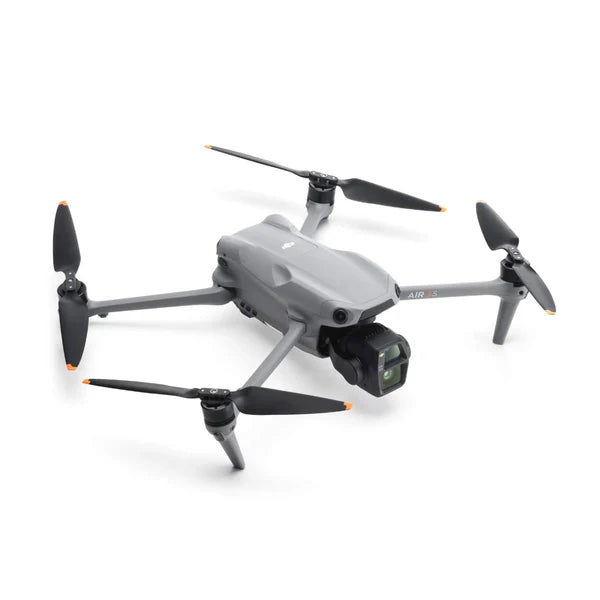
Mavic’s main camera changes more than resolution. It combines a larger 4/3 sensor, a 28mm lens, adjustable aperture and 6K/60 HDR recording. Air 3S starts wider at 24mm, with a 1-inch sensor, fixed f/1.8 aperture and 4K/60 HDR. Both offer serious capture options; the question is how much latitude your final delivery needs.
DJI advertises up to 14 stops of dynamic range for Air 3S and 15.5 stops for Mavic’s main-camera video. The latter is a controlled D-Log measurement excluding slow motion and cropped vertical video. These are manufacturer claims under stated conditions, not a side-by-side measurement from SpeedyDrone. They should not be treated as a guaranteed 1.5-stop gain in every scene. See DJI’s Air 3S overview and the Mavic FAQ and test footnotes.
The larger main-camera system is most relevant when you repeatedly balance bright skies against dark terrain, grade footage extensively or need demanding still-image output. For an ordinary online property tour or travel edit, Air 3S may already meet the brief. Good exposure and timing remain essential on either drone.
Does 100MP mean twice the image quality?
No. More pixels give you more options for detailed stills, large prints and cropping. They do not double lens quality, dynamic range or low-light performance. Light, movement, noise, processing and capture mode still decide how much useful detail survives.
Mavic’s 100MP setting is also a specific mode, rather than an all-purpose quality guarantee. DJI excludes full-resolution photos from its HDR and dual-native-ISO fusion support. Do not assume a 100MP still simultaneously receives the advertised 15.5-stop video performance. Choose the capture mode for the scene and output.
Why f/2.0–f/11 matters for video
Mavic’s variable aperture adds an exposure control that Air 3S lacks. If you want to keep shutter speed consistent while light changes, adjusting aperture gives you another option alongside ISO and ND filters. That can be useful during a continuous take or when matching footage to a production’s shutter settings.
It does not eliminate ND filters. Stopping down changes the image, and very small apertures can soften fine detail through diffraction. For casual travel, fixed aperture is often straightforward. For a controlled video workflow, being able to adjust it in flight can justify part of the premium.
The 168mm camera is the real triple-camera question
Mavic’s third camera supplies a perspective Air 3S cannot capture with a dedicated lens: 168mm equivalent, a 1/1.5-inch sensor, 50MP and f/2.8. It supports 4K/60 HDR and 4K/100 slow motion. This is a separate imaging system, rather than simply a longer digital-zoom setting.
Think of mountain layers behind a lodge, a skyline detail or a vehicle framed against a distant ridge. The longer lens lets you compose tightly from farther away. That more distant viewpoint can make background layers appear closer together. Technically, perspective compression comes from camera position: changing focal length while staying in exactly the same place changes framing, not perspective.
The best buyer already treats 28mm, 70mm and 168mm as three lenses with different jobs. For shot-planning examples, see our Mavic 4 Pro triple-camera lens guide.
When the third camera is not worth paying for
If most of your footage consists of wide establishing shots, property exteriors and travel scenes, with occasional 70mm details, the third lens may spend much of its life unused. Narrow framing also demands more deliberate subject placement; atmospheric haze or a poor viewpoint can still spoil a distant shot.
Before paying for 168mm, name a few shots you regularly cannot get with 24mm and 70mm. If none comes to mind, spend time with Air 3S first. A third camera does not automatically make a sequence more professional.
24mm vs 28mm: Air 3S starts wider
Air 3S has a useful advantage at the other end of the range. Its 24mm main lens captures a wider native view than Mavic’s 28mm main lens. That can help fit architecture, foreground and landscape into an establishing shot when your available position is constrained.
You can sometimes move Mavic farther back, but doing so changes the viewpoint and may be impractical within the site’s safe flying area. The lens sets offer different choices: Air 3S begins at 24mm and reaches 70mm; Mavic begins at 28mm and adds 168mm. More reach does not replace a wider starting view.
Infinity Gimbal can matter more than the third camera
Mavic’s Infinity Gimbal supports 360° rotation and upward shooting to 70°. Roll movements can change the horizon during a reveal, while the upward angle adds options for architecture and overhead subjects. For music videos, commercial sequences or creative social campaigns, this movement vocabulary may be the strongest reason to upgrade.
Air 3S can already tilt upward to 60°, so upward shooting itself is not exclusive to Mavic. The larger distinction is the rolling gimbal and its broader movement possibilities. “Infinity” also does not mean mechanically unlimited movement: DJI documents restrictions in vertical orientation, including narrower tilt travel and changes to aircraft movement. Plan the intended mode before building a shot around it.
6K60 vs 4K60: who actually needs 6K?
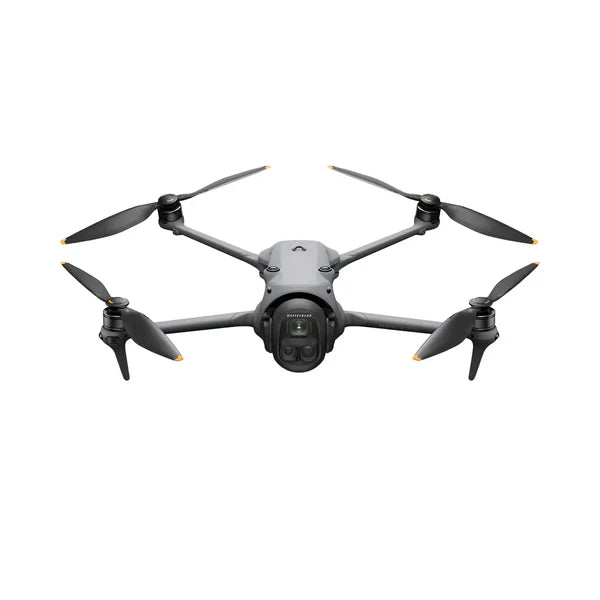
Mavic records up to 6K/60 HDR on the Hasselblad main camera. Extra source pixels give an editor room to reframe or stabilize a shot for a 4K timeline, or to meet a higher-resolution brief. This is valuable when a client needs several crops from the same carefully planned flight.
The tele cameras do not become 6K cameras. Nor does 6K alone make Mavic necessary for a 1080p social post or ordinary 4K YouTube delivery. Air 3S already records 4K/60 HDR and 4K/120 slow motion. If you seldom crop and your current delivery resolution is sufficient, more pixels may mainly increase the material you must store and process.
Creator Combo features are not standard Mavic features
The $3,898.99 Fly More comparison uses the standard Mavic aircraft. DJI specifies 64GB nominal storage with approximately 42GB available. Air 3S lists 42GB onboard, so the nominal “64GB” number should not be read as a large usable-storage advantage.
The Mavic 4 Pro 512GB aircraft in the Creator Combo has approximately 460GB available and supports H.264 ALL-I recording with 10-bit 4:2:2 sampling. Standard Mavic’s relevant H.265 modes use 10-bit 4:2:0. The Creator version also offers a faster transfer workflow and timed capture down to one second in supported modes; that interval is not universal across every resolution. These distinctions are documented in DJI’s Creator Combo comparison and the model specifications.
51 minutes vs 45 minutes: useful headroom, with limits
DJI’s six-minute maximum-flight-time difference can be useful for scouting, repeated takes and waiting for a subject to enter the composition. It is not a guaranteed six extra minutes of working footage. Both published figures come from controlled conditions and a battery-depletion test; a practical flight needs return and landing reserves.
Wind, temperature, manoeuvres and your chosen safety margin affect the time available. Both models also have the same published 12m/s wind-resistance rating. Mavic’s larger platform should not be sold as a higher rated wind limit, and endurance alone is a weak reason to spend another $1,840.
724g vs 1,063g: consider the whole carrying kit
Air 3S is 339g lighter at the aircraft level. The difference grows when you pack spare batteries: DJI lists approximately 247g per Air 3S battery and 332g per Mavic battery. With two additional batteries, the aircraft-and-three-battery difference is approximately 509g, before controllers, bags, chargers or filters.
That calculation matters on a hike or a trip where the drone shares a backpack with a ground camera. A vehicle-based production can absorb the larger kit more easily. Weigh the complete kit you intend to carry; the bag, charger and accessories will also affect the difference.
Canadian drone rules: both are above 250g
Air 3S is lighter, but it has no microdrone registration advantage over Mavic 4 Pro. Both fall within Transport Canada’s small-drone weight class. For the Canadian operations discussed here, registration, registration marking and the applicable pilot certificate are required. Information checked September 7, 2026.
The category depends on what, where and how you fly, including airspace, people nearby and aircraft safety requirements. Basic, Advanced and Level 1 Complex privileges are different. Sharing a weight class does not establish identical permissions for every operation. Consult Transport Canada’s registration requirements and operation categories for your plan.
Night sensing and transmission are supporting advantages
Air 3S combines omnidirectional vision with forward LiDAR. Mavic’s nightscape system is specified for lower-light vision conditions, with DJI highlighting 0.1 lux. That gives Mavic a stronger low-light sensing specification, but recognizable surface texture and the stated operating conditions still matter.
Obstacle sensing cannot guarantee collision avoidance. Thin wires, transparent or reflective surfaces and poorly textured obstacles remain reasons for careful site assessment and manual judgement. DJI’s Mavic 4 Pro manual (pages 51–53) details these limits. Better night sensing is not permission to fly closer to obstacles.
The 20km O4 and 30km O4+ transmission figures belong in the specification table, not the centre of the purchase decision. DJI measures them under unobstructed, interference-free FCC conditions for one-way, non-return communication. They are not Canadian legal flight distances. Basic operations require visual line of sight; other categories have their own conditions. Buying O4+ does not authorize a 30km flight.
Which buyer should pay the premium?
Air 3S is the sensible starting point when your deliverables are mainly wide and medium-tele 4K footage. It leaves more budget for the rest of the kit and the travel or planning that makes good footage possible. It can also be the right paid-work tool when it meets the client’s requirements.
Mavic is easier to justify when you can attach its extra capability to repeated work: a large still-image deliverable, demanding grading, planned 168mm compositions, aperture control during takes or a rotating-gimbal sequence. You do not need every feature, but you should know which one earns its place. Judge cost recovery against your own jobs rather than assuming a more expensive drone raises your rate.
Swipe across the table to compare all columns.
| Your main need | Better starting choice |
|---|---|
| Travel, hiking, backpack space | Air 3S |
| 24mm + 70mm, everyday 4K delivery | Air 3S |
| General property videos or YouTube | Air 3S, if it meets the brief |
| Best value for a dedicated 70mm camera | Air 3S |
| High-resolution stills, 6K or adjustable main-camera aperture | Mavic 4 Pro |
| Planned 168mm compositions or rolling-gimbal shots | Mavic 4 Pro |
| Production requires ALL-I / 10-bit 4:2:2 | Mavic 4 Pro 512GB Creator aircraft specifically |
| Simpler registration through lower weight | Neither: both exceed 250g |
Frequently asked questions
Is Air 3S good enough for paid real estate work?
It can be, when the brief calls for conventional wide and medium-tele footage at resolutions it supports. Start with the required shots, output and operating conditions. Mavic becomes relevant if the job needs its larger main camera, variable aperture, 6K, 168mm view or gimbal movement. Being paid is not itself a camera specification. Neither aircraft removes the need for the appropriate Canadian pilot certification and operating permissions.
Are the two 70mm cameras identical?
Their published focal length, sensor size, resolution and aperture match, and both offer 4K/120 slow motion. That does not prove identical hardware, processing or footage. Mavic includes full D-Log in addition to D-Log M and HLG, and its 512GB Creator aircraft adds ALL-I options. Air 3S remains a strong value when the dedicated 70mm view is the capability you actually want.
Can I crop Air 3S footage instead of buying the 168mm camera?
Cropping narrows framing but discards source pixels; it does not create the captured detail of a dedicated longer lens. It also does not change perspective if the aircraft stays in the same place. An occasional crop may be sufficient for your delivery. Repeated tight compositions and demanding outputs are a stronger reason to consider Mavic’s separate 168mm camera.
Does variable aperture mean I can stop using ND filters?
No. It gives Mavic another exposure control, which can help preserve a chosen shutter speed as light changes. You may still want an ND filter to hold your preferred aperture and shutter settings in bright conditions. Very small apertures can soften fine detail. Check the specific bundle: the compared Air 3S Fly More listing includes ND filters, while the Mavic Fly More list includes a 100W adapter instead.
Does every Mavic 4 Pro record 10-bit 4:2:2?
No. DJI reserves H.264 ALL-I recording and the associated 10-bit 4:2:2 sampling for the Mavic 4 Pro 512GB aircraft in the Creator Combo. The standard aircraft’s relevant H.265 modes are 10-bit 4:2:0. A controller upgrade does not change the aircraft version. If the recording format is mandatory, confirm the exact aircraft and test files in your editor before buying.
Does Air 3S avoid registration because it is lighter?
No. Air 3S weighs 724g and Mavic 4 Pro approximately 1,063g, so both are above 250g. Canadian registration and marking requirements apply to both, along with the pilot certificate and operating conditions relevant to the flight. The lighter aircraft is easier to carry; it does not gain microdrone status. The two models’ individual safety declarations and permissions still need checking for the intended operation.
Which price comparison should I use if I want three batteries?
Use the Fly More packages with DJI RC 2 as the closer starting comparison: $2,059.00 CAD for Air 3S and $3,898.99 CAD for Mavic 4 Pro at the September 7, 2026 check. The $1,839.99 difference aligns controller and battery count, but accessories differ. Availability messaging also needs confirmation. Recheck the exact listing and complete cost before relying on these dated prices for a purchase.
Sources and scope
This is a buying analysis based on DJI’s model-specific specifications and FAQ, the exact SpeedyDrone offer pages and Transport Canada guidance linked above. It is not a hands-on comparison or a measured image-quality test. Manufacturer maximums retain their stated conditions; price and availability reflect the check date and can change.
Choose the capability your next shoot needs
Air 3S makes the strongest value case when 24mm, 70mm and 4K cover your work. Mavic 4 Pro earns its premium when you will use its larger main camera, aperture control, 168mm view, 6K or gimbal movement often enough to justify the cost.
Tell SpeedyDrone what you shoot, your output requirements, preferred controller and deadline. Confirm the exact package and availability before planning around a listed price.
Confirm your kit and availability


