


Drone comparison
DJI Air 3S vs Mini 5 Pro: Is the 70mm Camera Worth the Extra Size & Weight?
One focal length or two? The buying decision goes beyond the shared 1-inch main-camera specification.
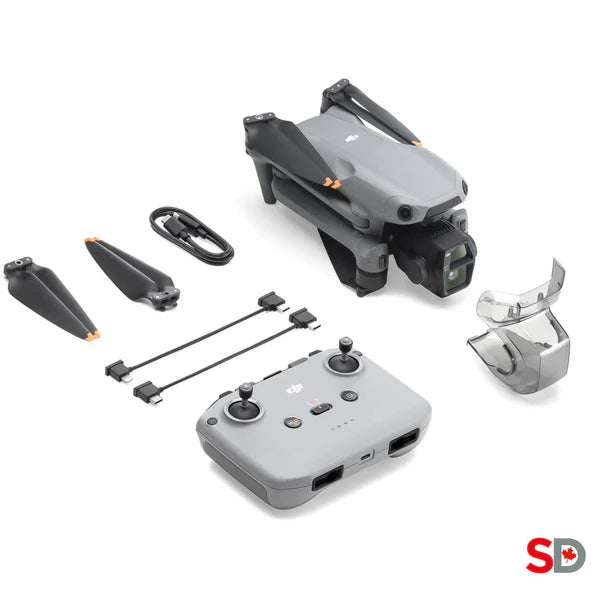
Choose DJI Air 3S if a dedicated 70mm camera will be a regular part of your filming. Choose Mini 5 Pro if you mainly want wide-angle travel footage, true vertical shooting and a smaller kit. Air 3S also offers a longer standard-battery maximum flight time, but both drones have the same published 12 m/s wind-resistance rating.
The DJI Air 3S vs Mini 5 Pro decision is unusually close at the main camera. Both have a 50MP, 1-inch CMOS sensor behind a 24mm-equivalent f/1.8 lens. Buying the larger aircraft therefore needs a more specific justification than expecting every wide-angle clip to look better. This is a specification-based buying comparison, not a report of side-by-side flight testing.
For Canadian buyers, there is another condition: Mini 5 Pro’s nominal weight sits very close to the microdrone threshold. Its actual flight-ready weight matters. A smaller bag, a second camera and the requirements for your intended flights should all enter the decision before you compare bundle prices.
Canadian price: compare matching RC-N3 packages
On September 7, 2026, SpeedyDrone’s public product pages displayed $1,059 CAD for Mini 5 Pro Standard Combo (RC-N3) and $1,439 CAD for Air 3S (DJI RC-N3). That is a listed-price difference of $380 CAD, before applicable taxes and delivery charges. These are the entry RC-N3 listings; an RC 2 or multi-battery package is a different comparison.
Both purchase areas displayed a backorder notice when checked. The Mini page also retained conflicting “in stock” text farther down its description, so immediate availability cannot be confirmed from that page. Check the current Mini 5 Pro RC-N3 listing and Air 3S RC-N3 listing, then confirm timing before buying for a trip or paid shoot. The expired August promotion on the Mini page is not included in this comparison.
The useful question is whether the additional camera will earn its place in your shooting routine. If you repeatedly crop distant details from wide shots, the upgrade addresses a specific limitation. If your footage is mostly broad views and portrait-format posts, the smaller aircraft may already deliver the output you need.
The specifications that change the decision
The table compares the aircraft with their standard batteries unless stated otherwise. Focal lengths are full-frame equivalents. Flight durations are DJI test maximums, not guaranteed recording time or safe return-flight budgets.
| Buying factor |
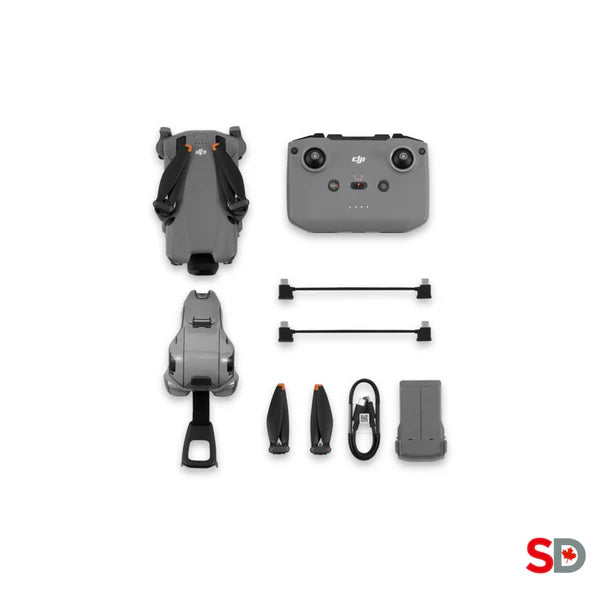 DJI Mini 5 ProStandard Combo (RC-N3)Shop at SpeedyDrone.ca DJI Mini 5 ProStandard Combo (RC-N3)Shop at SpeedyDrone.ca
|
DJI Air 3SDJI RC-N3 packageShop at SpeedyDrone.ca
|
|---|---|---|
| Wide camera | 1-inch CMOS, 50MP 24mm equivalent, f/1.8 |
1-inch CMOS, 50MP 24mm equivalent, f/1.8 |
| Tighter framing | 48mm Med-Tele mode, 2× zoom on the same camera | Separate 1/1.3-inch, 48MP camera 70mm equivalent, f/2.8 |
| Video highlights | 4K/60 HDR; 4K/120 slow motion | 4K/60 HDR; 4K/120 slow motion |
| Colour workflow | 10-bit D-Log M / HLG | 10-bit D-Log M / HLG on both cameras |
| Portrait-format capture | True vertical shooting | 2.7K vertical mode, up to 60fps |
| Creative gimbal roll | 225° flexible rotation | No equivalent 225° creative roll feature |
| Maximum flight time | 36 minutes; 52 with Battery Plus | 45 minutes |
| Published takeoff weight | Approx. 249.9 g ±4 g | 724 g |
| Maximum wind resistance | 12 m/s | 12 m/s |
| Internal storage | 42GB | 42GB |
| Obstacle sensing | Omnidirectional vision and forward LiDAR; conditions apply | Omnidirectional vision and forward LiDAR; conditions apply |
Sources: DJI Mini 5 Pro specifications, Mini 5 Pro FAQ, DJI Air 3S specifications and Air 3S overview.
Several headline features are shared. Air 3S’s strongest camera distinction is the additional optical focal length; Mini 5 Pro’s strongest workflow distinctions are its size and rotating camera. Similar specifications do not prove identical image quality, but they also do not establish a decisive wide-camera advantage for Air 3S.
What the dedicated 70mm camera actually adds
Air 3S lets you switch from a broad establishing view to a tighter subject composition using a separate camera. That is useful when a landscape film needs both the whole valley and an isolated ridge, or an architectural sequence needs a building in context followed by a selected façade detail. The narrower field of view gives you another way to organize the frame without relying entirely on enlarging the wide-camera image.
It also helps when a more distant camera position is appropriate for the shot. You can keep a subject prominent while including a smaller portion of the surroundings. That does not create permission to fly near people, roads or buildings; the aircraft position still needs to suit the operation. A longer focal length is a composition tool, not an exemption from separation or airspace requirements.
There is a technical distinction behind the often-used word “compression.” Camera position determines perspective; focal length determines framing from that position. Switching lenses while remaining in the same place does not physically move the background closer. Moving farther from a subject, then using a longer focal length to maintain its size in the frame, changes the relative appearance of foreground and background. A cropped wide image from the same position retains that perspective, although its detail and processing may differ.
This is why simply flying a wide-angle camera closer is not always a substitute for the desired telephoto composition: you have changed the viewpoint. The Air 3S advantage is a dedicated camera for tighter framing from your chosen position. See Tamron’s explanation of compression and shooting distance for the underlying photography principle.
Mini 5 Pro’s 48mm mode is useful, with different limits
DJI describes Mini 5 Pro’s 48mm Med-Tele mode as 2× zoom. It uses the same imaging system as its wide view, while Air 3S’s 70mm view comes from a second sensor and lens. “48mm” therefore does not mean the Mini contains a hidden second telephoto camera. Conversely, calling it merely a useless digital zoom would dismiss a practical framing option without evidence.
For an occasional closer view destined for a phone screen, the Mini’s result may be sufficient. For a sequence built around repeated tighter shots, Air 3S offers the more direct dual-camera workflow. This is a recommendation based on camera architecture and intended output; it is not a measured claim that every Air 3S telephoto frame beats every Mini crop.
Mode limitations matter as well. DJI’s Mini 5 Pro FAQ says its advertised maximum HDR dynamic range does not apply to 48mm Med-Tele mode or slow motion. The portrait-optimization feature discussed alongside Med-Tele is also limited to Normal colour mode. Do not assume every wide-camera processing benefit carries unchanged into every zoom or colour setting. The Mini 5 Pro Canada buyer guide covers the broader model and package decision.
Low light: two similar main-camera specifications
The Air 3S tele camera has a smaller sensor and a narrower maximum aperture than its own wide camera. Its value is the additional framing choice, not a second 1-inch camera. For a difficult low-light shot, deciding whether you need that framing is more useful than assuming the tele camera must match the wide camera’s noise, shadow detail or grading latitude.
Our practical starting recommendation is to use the 1-inch wide camera when light is limited and the wider composition works. Check exposure and noise before committing the sequence to telephoto. This is an optical and workflow inference, not a quantified noise comparison. Actual results depend on light, motion, settings and processing. Between the two drones’ wide cameras, the shared sensor-size and lens specifications alone cannot settle a low-light winner.
Battery life: longer standard flights, equal wind ratings
DJI quotes 45 minutes maximum for Air 3S and 36 minutes for Mini 5 Pro with its standard battery. That nine-minute difference is useful context for someone planning repeated compositions between battery changes. However, the tests use different forward speeds and continue until battery depletion forces landing. Neither figure tells you how long you can safely film while preserving the energy needed to return.
DJI also publishes a separate Mini 5 Pro “typical flight time” scenario: 21 minutes with the standard battery and 33 with Battery Plus. That scenario includes travel, 4K/60 recording, manoeuvring and return-to-home. It illustrates how much the mission changes endurance. There is no equivalent Air 3S scenario established in this comparison, so comparing the Mini’s 21 minutes directly against Air 3S’s 45-minute maximum would be misleading.
Both models list 12 m/s maximum wind resistance. Air 3S’s heavier body does not justify awarding it a better published wind specification. Gusts, return direction and remaining battery still matter, and a maximum rating should not become your target operating condition. For Canadian travel, assess the forecast and landing options rather than choosing by aircraft weight alone.
What changes with Battery Plus?
Mini 5 Pro’s compatible Intelligent Flight Battery Plus raises DJI’s maximum figure to 52 minutes. That means Air 3S does not have the longest published duration across every possible configuration. The Plus battery also adds weight; it should not be presented as a way to obtain that endurance while retaining the standard battery’s near-250 g configuration.
Compare the cost of the actual batteries, charger and carrying arrangement you intend to use. For a walking trip, a compact aircraft and several planned stops may be preferable. For a shoot organized around longer uninterrupted flight segments, the larger standard battery may be more convenient. These are workflow choices, not promised flight durations.
In Canada, actual operating weight decides the category
Transport Canada defines microdrones as aircraft with an operating weight below 250 g. Anything attached or carried counts toward that weight; the handheld remote controller does not. Microdrone pilots do not ordinarily need drone registration or a drone pilot certificate. Aircraft at or above 250 g enter the registration and applicable pilot-certificate framework. See Transport Canada’s operating categories.
Air 3S’s 724 g specification puts it clearly above the threshold. Mini 5 Pro requires more care: DJI specifies approximately 249.9 g ±4 g, so the model name and nominal weight do not guarantee that your individual aircraft qualifies as a microdrone. Confirm its flight-ready weight with the installed battery and accessories. Do not round a measurement down to make it fit the category. Transport Canada’s May 2026 operating-weight reminder specifically places that responsibility on pilots.
A Plus-battery setup must be assessed at its heavier operating weight. If staying below 250 g is your main reason for choosing the Mini, verify the intended configuration before purchasing. Registration and a certificate also do not automatically authorize any location: the applicable category depends on the aircraft, people nearby and airspace, with further requirements where relevant.
A qualifying microdrone is still subject to rules. Reckless or negligent operation is prohibited, restricted airspace requires permission, and privacy and trespass laws still apply. Transport Canada also identifies advertised events as requiring an SFOC even for microdrones. Its microdrone guidance distinguishes requirements from recommended practices. Regulatory information checked September 7, 2026; assess your particular operation before flight.
Vertical video and obstacle sensing
Mini 5 Pro’s true vertical shooting changes the camera orientation for portrait-format capture. Its flexible roll control also offers creative rotation. For someone delivering Reels, Shorts or vertical advertisements frequently, those tools influence composition at capture and can reduce dependence on a horizontal crop. DJI describes these functions in its Mini 5 Pro overview.
Air 3S still supports vertical output: DJI lists a 2.7K vertical mode. It can be appropriate for social delivery, particularly when a telephoto shot is the priority. The deciding question is whether you want frequent native vertical composition or occasional vertical exports from a workflow centred on horizontal footage.
Both aircraft combine omnidirectional vision with forward-facing LiDAR. Neither should be described as lacking advanced sensing, and neither system is a guarantee against collision. DJI specifies lighting and surface conditions for visual sensing; forward LiDAR is directional and does not turn darkness into all-direction protection. Keep the flight path observable and treat sensing as assistance. These shared features give little basis for choosing Air 3S solely because it is the larger aircraft.
Which drone fits your work?
Choose Mini 5 Pro when the drone needs to accompany you more often than it needs to provide another lens. A travel diary, walking holiday or frequent vertical content workflow can benefit from carrying less. If the shots you keep are mostly wide views, paying for a second camera you rarely select is unlikely to solve your main limitation.
Choose Air 3S when you can identify recurring shots that call for its dedicated tele camera: isolated landscape features, architectural details or carefully planned vehicle footage. A repeatable need for both wide and tighter views gives the larger kit a concrete role. The longer standard-battery maximum is an additional consideration, with the test limitations explained above.
Keep your current Mini 5 Pro if you cannot yet name the shots it prevents you from making. Review a recent edit: did the limitation come from focal length, or from light, location, planning and camera movement? If telephoto framing repeatedly appears on your missing-shot list, Air 3S becomes easier to justify. If not, its larger body alone is not a reason to replace a capable wide-camera drone.
Frequently asked questions
Is Air 3S worth the extra money over Mini 5 Pro?
It is easier to justify when you regularly need the dedicated 70mm camera for tighter landscape, architecture or planned vehicle shots. Mini 5 Pro is the stronger fit when portability and true vertical capture dominate your work. The RC-N3 listings differed by $380 CAD when checked on September 7, 2026, but that is a dated public-price comparison, not a quote or confirmation of immediate stock.
Does Mini 5 Pro have an optical telephoto camera?
No separate telephoto camera is listed. Its 48mm Med-Tele mode is 2× zoom using its single-camera system. Air 3S has a separate sensor and lens for the 70mm-equivalent view. The Mini mode can still be useful; the distinction is how the tighter image is captured, not a claim that every cropped image is unusable.
Is Air 3S better in wind?
DJI publishes the same 12 m/s maximum wind-resistance figure for both models. This comparison therefore does not award Air 3S a higher wind rating or claim measured stability superiority. Wind direction, gusts, the route home and battery reserve matter for either aircraft.
Can I fly Mini 5 Pro without registration in Canada?
Only rely on the microdrone registration exemption when your actual operating weight is below 250 g. DJI’s approximately 249.9 g ±4 g specification does not guarantee that for every unit. Include the battery and attached accessories when checking weight. At or above 250 g, registration and the applicable pilot certificate are required; other operational rules still apply.
Does Battery Plus make Mini 5 Pro a better endurance choice?
It gives Mini 5 Pro a higher published maximum than Air 3S: 52 minutes versus 45. That comparison uses different DJI test configurations and is not a guarantee of recording time. Battery Plus adds weight and changes the configuration being compared. Consider the operating-weight category, total package cost and your return reserve before treating it as the better choice.
Can Air 3S shoot vertical video for Reels?
Yes. DJI lists a 2.7K vertical mode, while Mini 5 Pro offers true vertical shooting through camera rotation. Air 3S can still serve a social-video workflow, especially when its telephoto view matters. Mini 5 Pro is the more direct recommendation for creators who routinely compose for a portrait frame.
Will Air 3S automatically improve my wide-angle footage?
No such improvement is established by the specifications alone. Both wide cameras use a 50MP 1-inch sensor specification and a 24mm-equivalent f/1.8 lens. Processing and image characteristics may differ, so identical output should not be assumed either. Choose Air 3S for a demonstrated need in your workflow, especially the second camera, rather than aircraft size alone.
Sources and scope
Product capabilities and manufacturer test conditions: DJI specification, overview and FAQ pages linked above. Public Canadian offers: the exact SpeedyDrone RC-N3 listings. Operating rules: Transport Canada. Lens explanation: Tamron. Prices and public availability wording were checked September 7, 2026. Recommendations are editorial analysis; no independent image-quality, wind-stability or endurance test is claimed.
Confirm the right kit for your next shoot
Tell SpeedyDrone Canada what you film, whether you deliver vertical video, which controller you prefer and when you need the aircraft. Ask for current availability and a matching package comparison before committing to a time-sensitive shoot.
Ask about configuration and availability


