


DJI Mavic 4 Pro Triple-Camera Lens Guide
The Mavic 4 Pro is not one camera with two zoom shortcuts. Each physical camera changes perspective, subject distance, background compression and the way a shot feels. This guide explains which focal length to use for real estate, automotive work, tourism, commercial video and social content.

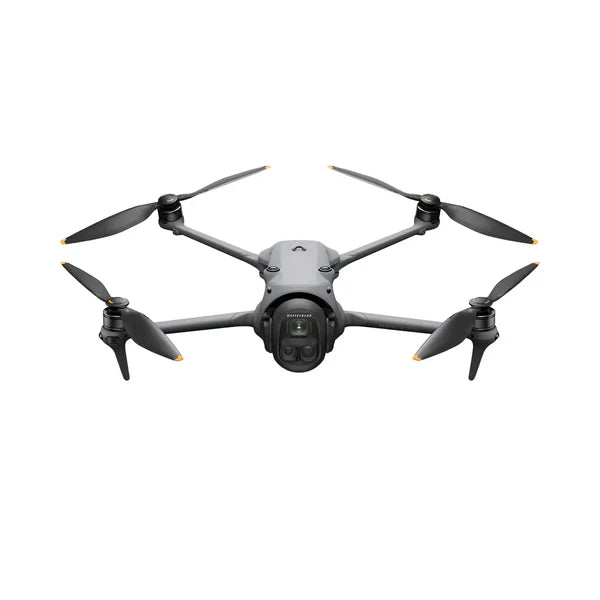
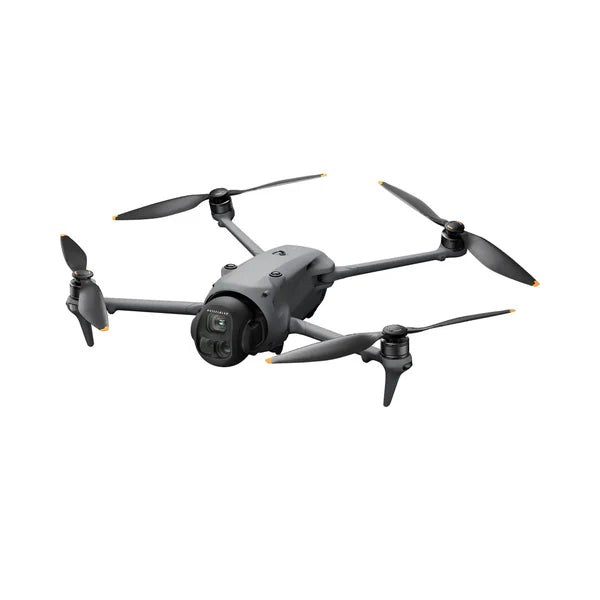
4/3 CMOS Hasselblad main camera, 1/1.3-inch medium tele camera, 1/1.5-inch tele camera and Infinity Gimbal.
Start wide, move telephoto only when perspective improves the story.
Use 28 mm to explain where the subject is. Use 70 mm to make the subject feel more important. Use 168 mm to isolate distant details and compress space. A professional sequence often uses all three rather than declaring one lens the winner.
Establish the place.
- 4/3 CMOS and 100 MP stills.
- Variable f/2.0-f/11 aperture.
- 6K/60fps HDR and 4K/120fps.
- Best for landscapes, architecture, overheads and low light.
- Most flexible exposure control of the three cameras.
Feature the subject.
- 1/1.3-inch CMOS and 48 MP stills.
- Fixed f/2.8 aperture.
- 4K/60fps HDR and 4K/120fps.
- Best for cars, estates, people, resorts and layered scenery.
- Balanced compression without the sensitivity of 168 mm.
Isolate the detail.
- 1/1.5-inch CMOS and 50 MP stills.
- Fixed f/2.8 aperture.
- 4K/60fps HDR and 4K/100fps.
- Best for distant architecture, mountain layers and compressed automotive shots.
- Requires steadier flight and more disciplined subject distance.
Three sensors, three lenses and three different operating styles.
The 28 mm camera is the flagship image-quality tool. The 70 mm camera is the practical storytelling telephoto. The 168 mm camera is the specialist perspective.
| Specification | 28 mm Hasselblad | 70 mm Medium Tele | 168 mm Tele |
|---|---|---|---|
| Sensor | 4/3 CMOS | 1/1.3-inch CMOS | 1/1.5-inch CMOS |
| Maximum still resolution | 100 MP Highest resolution | 48 MP | 50 MP |
| Field of view | 72 degrees | 35 degrees | 15 degrees |
| Aperture | f/2.0-f/11 Exposure control | f/2.8 fixed | f/2.8 fixed |
| Minimum focus distance | 2 m | 3 m | 3 m |
| Maximum standard video | 6K/60fps HDR | 4K/60fps HDR | 4K/60fps HDR |
| Maximum slow motion | 4K/120fps | 4K/120fps | 4K/100fps |
| Manufacturer dynamic-range reference | Up to 15.5 stops in DJI's stated D-Log test conditions | Use controlled comparison; not identical to main-camera claim | Use controlled comparison; not identical to main-camera claim |
| Best default use | Establishing shots and low-light hero images | Subject-focused commercial compositions | Distant details and strong compression |
Move the drone instead of treating zoom as a crop button.
Changing focal length without changing aircraft position narrows the field of view. Changing focal length and repositioning the aircraft changes the perspective, scale relationship and visual depth of the scene.
Show the environment around the subject.
Use foreground, leading lines and visible location context. This is usually the safest lens for establishing geography and building a coherent sequence.
Reduce background clutter and strengthen the subject.
Reposition farther away and use the narrower view to create a more premium, controlled commercial composition.
Stack distant layers into one dramatic frame.
The telephoto view can make mountains, buildings, roads or vehicles appear visually closer together. Small yaw and gimbal movements become more obvious.
Build a wide, medium and detail progression.
Start with 28 mm context, move to a 70 mm hero shot, then use 168 mm for a memorable detail or transition.
Choose the lens from the client deliverable.
The strongest focal length changes with the subject, the legal stand-off distance, the desired pace and the amount of location context the final edit requires.
Context, architecture and premium compression.
Use 28 mm for the property and neighbourhood, 70 mm for facade and amenity hero shots, and 168 mm for distant details only when the flight path remains safe and legal.
28 mm + 70 mmMake the vehicle dominate the frame.
DJI specifically positions 70 mm for car shots. Use 168 mm for compressed road, track or landscape layers from a controlled stand-off distance.
70 mm firstEstablish the destination before isolating its icons.
Use 28 mm for landscapes and resort context, 70 mm for architecture and guests, and 168 mm for distant landmarks or mountain layers.
All threeMatch focal length to visual hierarchy.
Use 28 mm for scale, 70 mm for the hero product or facility, and 168 mm for abstract details that can become transitions or campaign cutaways.
Planned sequenceShow both location and experience.
28 mm explains the grounds. 70 mm creates a more intimate pool, restaurant or balcony shot. 168 mm can isolate a distant guest experience without approaching closely.
28 mm + 70 mmCommunicate progress without claiming survey accuracy.
Use 28 mm for site context, 70 mm for facade progress and 168 mm for distant visual details. Use an enterprise mapping system for measured inspection deliverables.
Marketing onlyFrame the location without treating the crowd as a flight path.
Use distant 70 mm or 168 mm framing to create compressed venue shots from a legal location. Advertised-event flights require special permission in Canada.
70 mm / 168 mmUse focal length to control scale.
28 mm emphasizes foreground and openness. 70 mm simplifies the scene. 168 mm stacks hills, roads, weather and light into graphic layers.
All threePlan movement for the final crop.
Use Infinity Gimbal rotation or cropped-vertical modes when appropriate, but confirm which HDR and frame-rate features remain available in the selected mode.
Infinity GimbalThe gimbal creates shots that focal length alone cannot.
Mavic 4 Pro can shoot 70 degrees upward and rotate through 360 degrees of roll. Use these movements sparingly so the motion supports the subject rather than becoming the entire video.
Reveal height from below.
- High-rise facades and towers.
- Bridges and architectural overhangs.
- Forest canopy and cliff reveals.
- Low approaches that transition upward.
- Subject framing without pointing the aircraft nose upward.
Create transitions and social-first movement.
- Full-roll transitions between scenes.
- Rotating building or vehicle hero shots.
- Vertical and diagonal framing changes.
- Abstract brand sequences.
- Use with slow aircraft movement to avoid visual overload.

Show geometry above the aircraft.
This can be especially useful for towers, roofs, trees and transitions from lower foreground to upper structure.

Design movement for the edit.
Record a clean beginning and ending frame, maintain safe aircraft separation and use the roll as a motivated transition rather than a random effect.
Plan the sequence before changing cameras in the air.
A repeatable lens plan saves battery, protects continuity and reduces unnecessary movement around the subject.
Define the deliverable.
Horizontal film, vertical social edit, real-estate listing, automotive reel or commercial campaign.
Choose the hero focal length.
Decide whether context, subject importance or distant detail is the main visual objective.
Match exposure and colour.
Lock white balance, monitor shutter and understand that only the 28 mm camera has variable aperture.
Reposition for perspective.
Do not only switch cameras from the same point. Move safely to create the intended subject-background relationship.
Stabilize telephoto movement.
Use slower yaw, smoother gimbal input and more distance because long focal lengths magnify motion.
Capture clean handles.
Hold before and after each move so the editor has usable transition points.
Review before leaving.
Check focus, exposure, motion, flare, horizon, compression and missing coverage on the controller.
Organize by camera.
Separate wide, medium-tele and tele clips so colour matching and sequence construction are faster.
Telephoto does not replace safe stand-off planning.
Mavic 4 Pro weighs 1,063 g and is a small drone in Canada. Registration and a pilot certificate are required. The operating category depends on airspace, people and the planned flight.
| Operational factor | What Mavic 4 Pro offers | What the pilot must still do |
|---|---|---|
| Flight time | Up to 51 minutes in DJI's controlled test | Reserve enough battery for wind, repositioning, return and landing |
| Speed | Up to 25 m/s or 90 km/h in stated conditions | Use a speed appropriate to visibility, subject and stopping distance |
| Night sensing | 0.1-lux omnidirectional obstacle sensing under stated texture conditions | Survey the area and understand that sensing cannot detect every wire or obstacle |
| Transmission | Up to 30 km FCC 10-bit HDR transmission reference | Maintain the visual-line-of-sight and airspace permissions required in Canada |
| Basic operation | Possible when every Basic condition is met | Remain in uncontrolled airspace, more than 30 m from uninvolved people and away from airport and heliport limits |
| Advanced operation | Possible with the right certificate, drone assurance and permissions | Obtain controlled-airspace permission and follow the applicable people-distance rules |
Choose the package around field time and post-production.
Prices below are public SpeedyDrone references checked July 21, 2026. Stock, promotions and package condition can change.
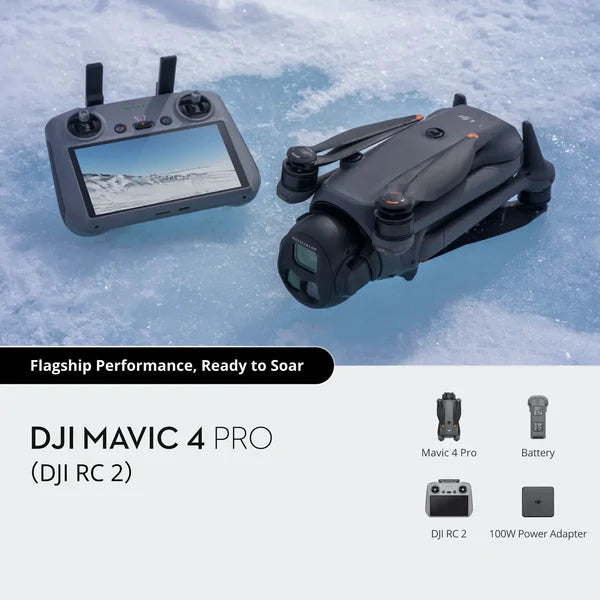
Core flagship system.
- Mavic 4 Pro aircraft.
- DJI RC 2.
- One Intelligent Flight Battery.
- 100W USB-C power adapter.
- Best for occasional creators or buyers adding accessories individually.
Best all-around field package.
- DJI RC 2.
- Three Intelligent Flight Batteries.
- Parallel Charging Hub.
- Shoulder bag.
- Best for real-estate, travel and active creator work.
Best professional post-production package.
- 512GB Mavic 4 Pro aircraft.
- DJI RC Pro 2 with 7-inch Mini-LED display.
- ALL-I and 10-bit 4:2:2 recording support.
- Three batteries and 240W charging setup.
- Best for commercial production and advanced colour workflows.
Buy Mavic 4 Pro when the lens choice will be used, not admired.
Mavic 4 Pro makes the most sense for creators who regularly need wide context, commercial compression and distant detail from one aircraft.
Professional multi-scene creators
Real-estate, travel, automotive, resort, tourism and brand creators who can build sequences from all three cameras.
Buy Mavic 4 ProCreators who only need a wide camera
If nearly every finished shot uses the main wide camera, compare Air 3S or a smaller platform before paying for two tele cameras.
Compare alternativesSurvey or thermal inspection buyers
Choose an enterprise platform when RTK, thermal imaging, measurement accuracy or managed inspection data is required.
Choose enterpriseTriple-camera questions answered.
Which Mavic 4 Pro lens should I use most often?
Use the 28 mm Hasselblad camera as the default for establishing shots, landscapes, architecture, overheads and low-light work. Move to 70 mm when you want stronger subject separation and compressed perspective. Use 168 mm when distant details, layered backgrounds or a safer stand-off distance are central to the shot.
Is the 70 mm camera better than cropping the 28 mm camera?
A physical 70 mm camera changes perspective and framing before the image is recorded. Cropping the 28 mm image narrows the frame but does not fully reproduce the same subject-to-background relationship. The 70 mm camera also provides its own 1/1.3-inch sensor and 48 MP stills.
When should I use the 168 mm telephoto camera?
Use 168 mm for distant architectural details, mountain layering, automotive compression, venue exteriors and subjects that should not be approached closely. It requires more careful piloting because small aircraft movements appear larger at long focal lengths.
Which camera has the best video quality?
The 28 mm 4/3 Hasselblad camera is the flagship option. DJI specifies 6K/60fps HDR, 4K/120fps slow motion and up to 15.5 stops of video dynamic range in its stated D-Log test conditions.
Can all three Mavic 4 Pro cameras record slow motion?
Yes. The 28 mm and 70 mm cameras support up to 4K/120fps. The 168 mm camera supports up to 4K/100fps. Slow-motion modes may not support the same HDR and Dual Native ISO Fusion features as normal recording modes.
What is the Infinity Gimbal useful for?
The Infinity Gimbal supports 70-degree upward shooting and full 360-degree roll rotation. It can create upward architectural reveals, vertical roll transitions, rotating product shots and dynamic social-media moves that are difficult with a conventional drone gimbal.
Is Mavic 4 Pro good for real estate?
Yes for high-end marketing, estate overviews, neighbourhood context, roof and exterior visuals, provided the pilot follows Canadian rules and avoids presenting marketing footage as survey-grade inspection data. The 28 mm and 70 mm cameras are usually the most useful.
Is Mavic 4 Pro good for automotive video?
Yes. DJI specifically positions the 70 mm camera for car shots, and the 168 mm camera can create strong background compression from a distance. Filming near roads, vehicles and uninvolved people requires careful location control and legal separation.
Can Mavic 4 Pro replace an enterprise inspection drone?
No. It can capture high-quality visual marketing and contextual footage, but it does not provide the RTK, thermal, mission-management or measurement workflow expected from purpose-built enterprise platforms.
Does the 30 km transmission specification mean I can fly 30 km away in Canada?
No. DJI's 30 km figure is a controlled FCC transmission maximum. Canadian operating rules, visual-line-of-sight requirements, airspace permission, interference, terrain and battery reserve determine the legal and safe flight.
What licence is required for Mavic 4 Pro in Canada?
Mavic 4 Pro weighs 1,063 g, so it is a small drone. It must be registered and the pilot needs at least a Basic Pilot Certificate. Advanced privileges are required for operations that do not meet every Basic condition, such as controlled airspace or closer operations around people.
Which Mavic 4 Pro package should a professional creator buy?
The standard RC 2 package is best for buyers who need one battery and the core aircraft. Fly More adds three batteries, a charging hub and a shoulder bag. The 512GB Creator Combo adds RC Pro 2, ALL-I and 10-bit 4:2:2 recording, 512GB storage and a 240W charging workflow.
How much does Mavic 4 Pro cost in Canada?
When checked on July 21, 2026, SpeedyDrone listed the RC 2 package at CAD 2,848.99, Fly More Combo at CAD 3,898.99 and 512GB Creator Combo at CAD 4,809. Prices, stock and promotions can change.
Verify the exact mode and package before the shoot.
Tell us the subject. We will recommend the lens and package.
Send your main work type, normal delivery resolution, expected shooting time, controller preference, need for 4:2:2 or ALL-I recording, and whether you need purchase, rental, training or a Toronto demonstration.
