


DJI Agras T25P vs T50 vs T100: Cost-per-Acre and Farm-Size Decision Guide
The right Agras platform is not chosen from farm acres alone. It depends on annual treated acres, spray volume, refill distance, weather window, crew structure, power and mixing logistics, transport, Canadian aircraft category and the value of finishing the work on time.
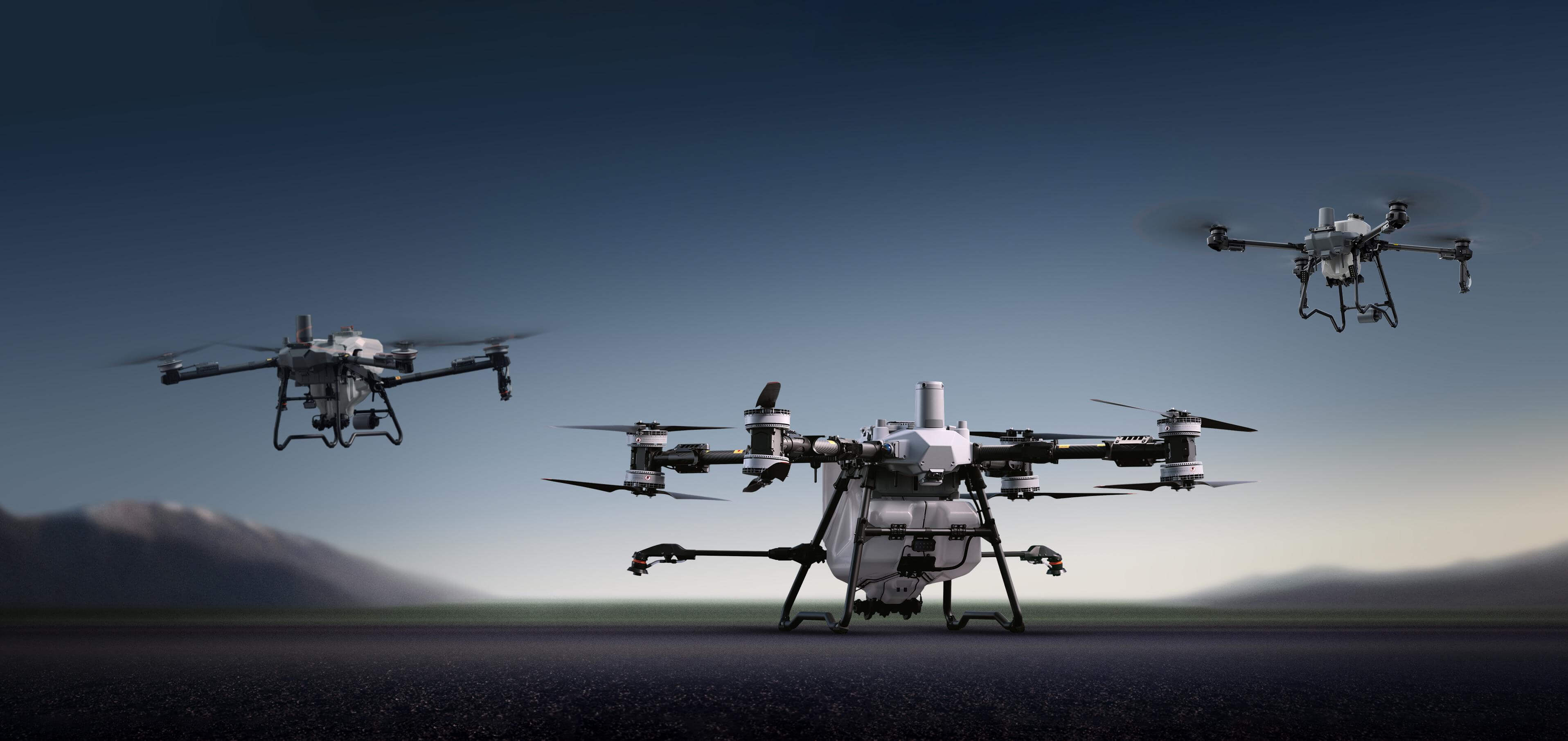
Official DJI lineup image. The compact T25P appears at right. This comparison evaluates T25P, T50 and T100 for Canadian farm and custom-application workflows.
Use peak treated acres and refill workload to choose the platform.
T25P fits targeted and compact operations. T50 is the balanced commercial choice. T100 is the capacity platform for large farms and custom applicators that can support its transport, crew, power and special-operation requirements.
Compact fields, targeted work and lower transport burden.
- Planning starting point: about 100-500 physical acres.
- Best where fields are fragmented or access is tight.
- Strong fit for specialty crops, orchards and spot work.
- 20 L spraying and 25 kg spreading payload.
- More refill cycles at moderate or high spray volumes.
- Price and Canadian package must be quoted.
The balanced platform for routine commercial operations.
- Planning starting point: about 500-2,000 physical acres.
- Strong fit for repeated spray and spread passes.
- 40 L spray tank and 50 kg spreading payload.
- Same 16 or 24 L/min architecture as T25P.
- Lower refill burden without T100 scale.
- Current three-battery package is CAD 29,999.
Large blocks, custom application and narrow weather windows.
- Planning starting point: 2,000+ physical acres or high custom acres.
- 100 L spraying and 100 kg spreading payload.
- 30 L/min standard or 40 L/min optional flow.
- Substantially fewer refill cycles.
- Requires a large-drone and SFOC operating plan above 150 kg.
- Current three-battery package is CAD 48,505.
Compare payload, refill, flow, spreading and Canadian operating weight.
Maximum capacity, width, discharge and charging figures are manufacturer test references. Actual loading recommendations change with altitude, temperature, aircraft status, material and task.
| Specification | DJI Agras T25P | DJI Agras T50 | DJI Agras T100 |
|---|---|---|---|
| Primary fit | Compact and targeted agriculture | Balanced routine commercial work | High-capacity and custom application |
| Spray tank | 20 L Compact | 40 L Balanced | 100 L High capacity |
| Spray payload | 20 kg | 40 kg | 100 kg |
| Standard spray flow | 16 L/min with 2 nozzles | 16 L/min with 2 nozzles | 30 L/min with 2 nozzles |
| Optional spray flow | 24 L/min with 4 nozzles | 24 L/min with 4 nozzles | 40 L/min with 4 nozzles |
| Droplet size | 50-500 micrometres | 50-500 micrometres | 50-500 micrometres |
| Published spray width | 4-7 m at 3 m crop height | 4-11 m at 3 m crop height | 5-13 m; actual width depends on the scene |
| Spread tank | 30 L | 75 L | 150 L |
| Spread payload | 25 kg | 50 kg | 100 kg |
| Maximum spread discharge | 190 kg/min | Application-specific; public DJI page emphasizes 50 kg and 8 m | 400 kg/min with compound fertilizer |
| Spread width | 3-8 m | 8 m | 3-10 m |
| Weight with spray battery | 33 kg | 52 kg | 75 kg standard spray configuration before liquid |
| Maximum spray takeoff weight | 53 kg | 92 kg | 175 kg standard or 177 kg optional 4-nozzle |
| Canadian category at operating weight | Medium drone | Medium drone | Large drone when over 150 kg SFOC |
| RTK hover reference | +/-10 cm horizontal and vertical | +/-10 cm horizontal and vertical | +/-10 cm horizontal and vertical |
| Wind reference | Less than 6 m/s | 6 m/s maximum | Less than 6 m/s |
| Battery | DB800, 15,500 mAh | DB1560, 30 Ah | DB2160, 41,000 mAh |
| Fast-charge reference | About 9-12 minutes under qualifying conditions | About 9 minutes under qualifying conditions | About 8-9 minutes from 30% to 95% under qualifying conditions |
| Public SpeedyDrone package | Request quote | CAD 29,999 three-battery package | CAD 48,505 three-battery package |
Compare the complete field system, not only the airframe.
Agriculture drone ownership includes aircraft, tank or spreader, batteries, charger or generator, cooling, controller, relay, transport, water handling, PPE, training and support.
DJI Agras T25P
T25P appears at right in the official DJI lineup image. SpeedyDrone positions it as the flexible entry platform for smaller-scale and targeted agriculture workflows.
DJI Agras T50
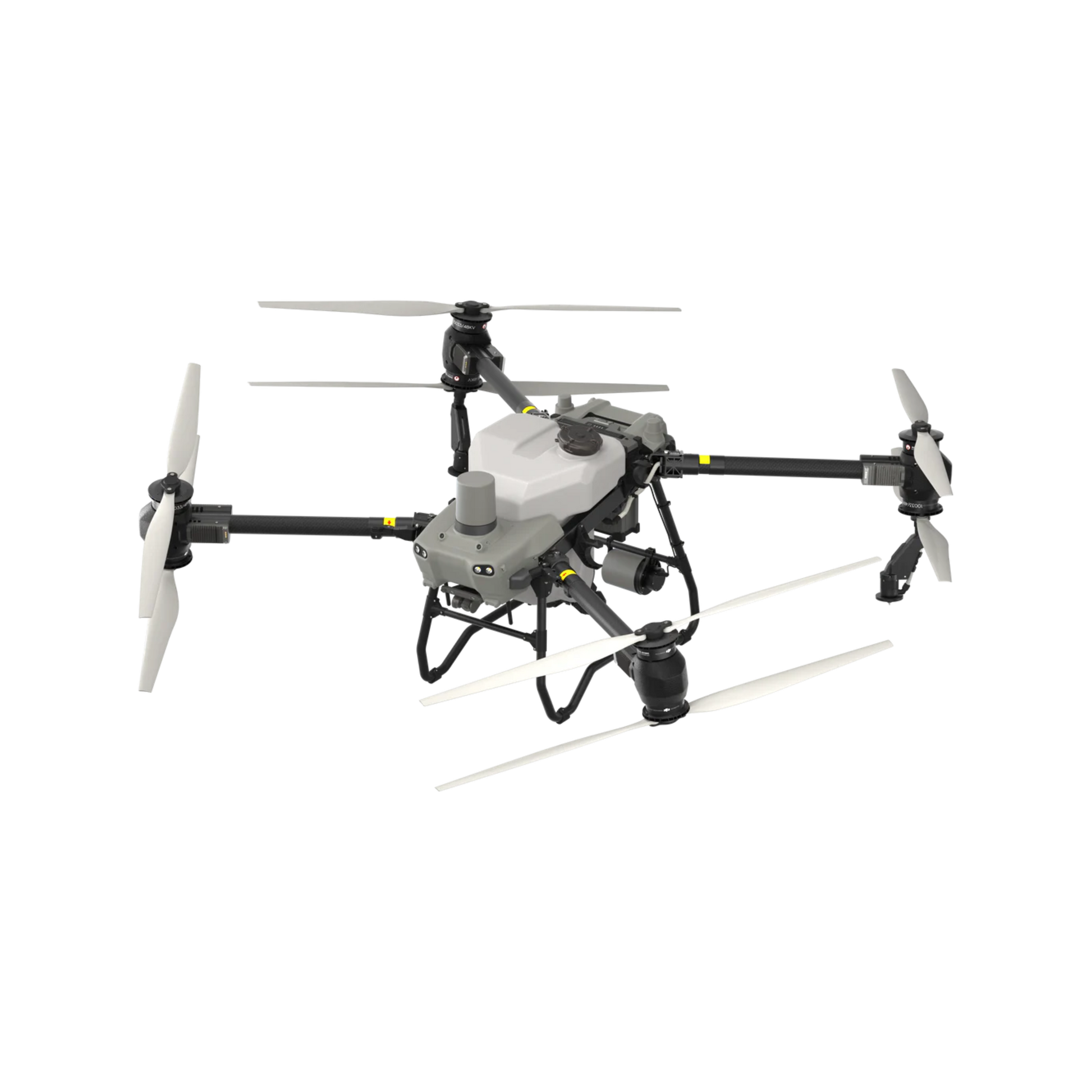
The current SpeedyDrone CAD 29,999 package includes a brand-new aircraft and controller, a pre-owned Grade AAA+ battery station and three pre-owned Grade AAA+ DB1560 batteries.
DJI Agras T100
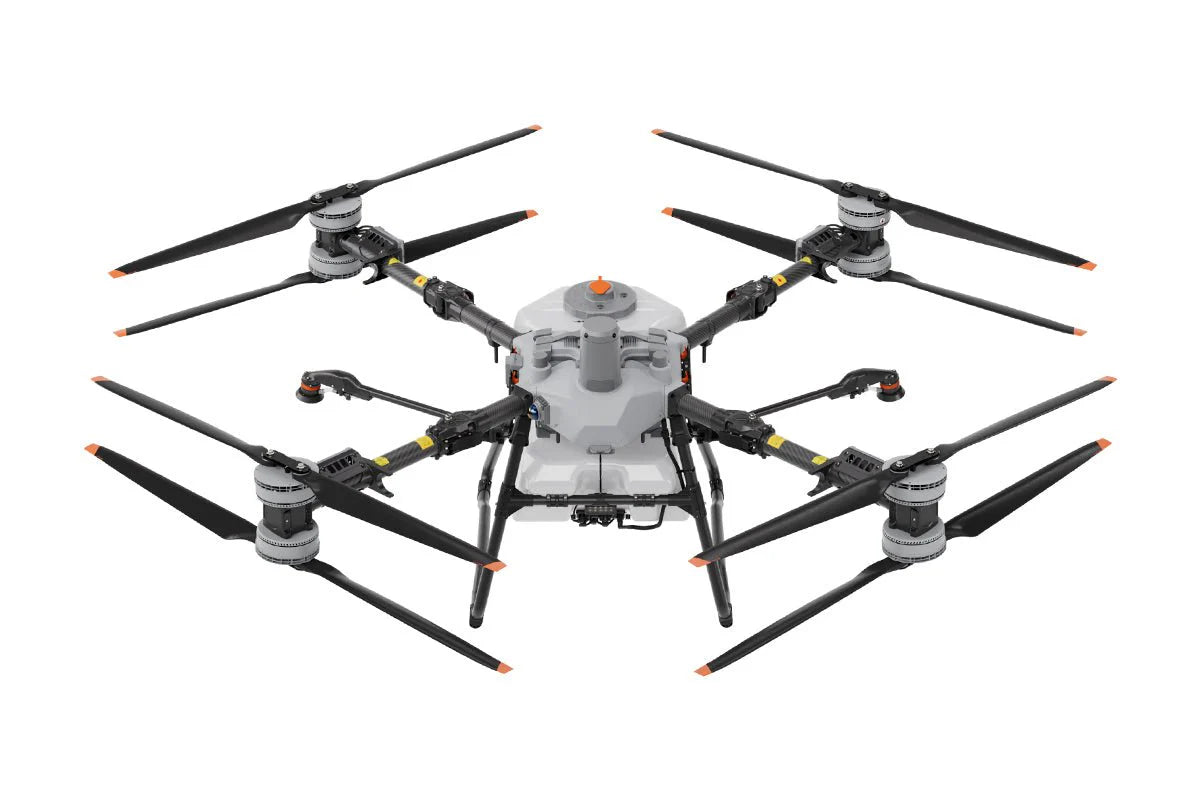
The current CAD 48,505 package lists the T100 airframe, spraying system with air-cooled heat sink, three DB2160 batteries and a C12000 intelligent power supply. Confirm availability before ordering.
Annualize capital, add operating cost and divide by every treated pass.
The worked example uses a five-year capital-recovery period and an 8% annual financing or opportunity-cost assumption. It compares current T50 and T100 package prices before tax. T25P uses the same formula after a written quote is received.
Keep pesticide or fertilizer material cost separate. The chemical label determines application rate, minimum aerial spray volume and other conditions.
Use the exact written package price.
- Capital recovery factor in this model: 0.250456.
- Annualized capital = package price x 0.250456.
- Add batteries, charger, transport, training and support.
- Best evaluated from a water-only time study.
Annualized capital: CAD 7,513.
- Five-year, 8% capital-recovery assumption.
- Current package includes mixed new and pre-owned equipment.
- Condition and battery cycle history should be reviewed.
- Excludes tax and operating expenses.
Annualized capital: CAD 12,148.
- Five-year, 8% capital-recovery assumption.
- Package includes three batteries and C12000 supply.
- Availability should be confirmed before ordering.
- Excludes SFOC, transport and operating expenses.
| Annual treated acres | T50 capital per acre | T100 capital per acre | T100 capital premium per acre |
|---|---|---|---|
| 500 | CAD 15.03 | CAD 24.30 | CAD 9.27 |
| 1,000 | CAD 7.51 | CAD 12.15 | CAD 4.63 |
| 2,000 | CAD 3.76 | CAD 6.07 | CAD 2.32 |
| 4,000 | CAD 1.88 | CAD 3.04 | CAD 1.16 |
| 8,000 | CAD 0.94 | CAD 1.52 | CAD 0.58 |
T100 must save time or protect a crop window to justify its annual capital premium.
The annualized T100 package premium over the current T50 package is approximately CAD 4,635. At an illustrative loaded crew cost of CAD 45/hour, the larger platform needs to save about 103 crew or logistics hours per year before considering other cost differences.
| Annual treated volume | Average time saving required to offset annualized capital premium |
|---|---|
| 1,000 treated acres/year | 6.18 minutes saved per acre |
| 2,000 treated acres/year | 3.09 minutes saved per acre |
| 4,000 treated acres/year | 1.54 minutes saved per acre |
| 8,000 treated acres/year | 0.77 minutes saved per acre |
Spray volume per acre changes the machine decision faster than farm size.
At low aerial spray volumes, all three tanks cover more ground. At higher label volumes, the refill advantage of T100 becomes much larger. The label minimum cannot be reduced to fit the aircraft.
| Application volume | T25P 20 L tank | T50 40 L tank | T100 100 L tank |
|---|---|---|---|
| 5 L/acre | 4.00 acres / 25.0 loads per 100 acres | 8.00 acres / 12.5 loads per 100 acres | 20.00 acres / 5.0 loads per 100 acres |
| 10 L/acre | 2.00 acres / 50.0 loads per 100 acres | 4.00 acres / 25.0 loads per 100 acres | 10.00 acres / 10.0 loads per 100 acres |
| 15 L/acre | 1.33 acres / 75.0 loads per 100 acres | 2.67 acres / 37.5 loads per 100 acres | 6.67 acres / 15.0 loads per 100 acres |
Pump flow shows whether the requested rate is physically possible - not how many acres the crew will actually finish.
The theoretical flow ceiling equals maximum litres per minute multiplied by 60 and divided by litres per acre. Turns, acceleration, overlap, buffers, refill, battery swaps, ferry distance, wind, terrain and mixing reduce real field capacity.
| Configuration | Maximum flow | Theoretical ceiling at 5 L/acre | Theoretical ceiling at 10 L/acre | Theoretical ceiling at 15 L/acre |
|---|---|---|---|---|
| T25P standard | 16 L/min | 192 acres/hour | 96 acres/hour | 64 acres/hour |
| T25P optional 4-nozzle | 24 L/min | 288 acres/hour | 144 acres/hour | 96 acres/hour |
| T50 standard | 16 L/min | 192 acres/hour | 96 acres/hour | 64 acres/hour |
| T50 optional 4-nozzle | 24 L/min | 288 acres/hour | 144 acres/hour | 96 acres/hour |
| T100 standard | 30 L/min | 360 acres/hour | 180 acres/hour | 120 acres/hour |
| T100 optional 4-nozzle | 40 L/min | 480 acres/hour | 240 acres/hour | 160 acres/hour |
The best platform is the smallest system that reliably completes the peak workload.
Avoid buying only for the annual average. Model the busiest weather window, the most demanding label volume and the fields farthest from refill and charging support.
T25P is the compact starting point.
- One to three annual treatment passes.
- Fragmented, specialty or targeted applications.
- Solo or small-crew transport is important.
- 20 L refills remain manageable.
- Quote and Canadian eligibility must be verified.
T50 balances capacity and deployment.
- Routine row-crop spraying and spreading.
- Repeated passes increase treated-acre utilization.
- 40 L tank reduces T25P refill burden.
- 50 kg spreading supports broader seasonal use.
- Suitable medium-drone operating plan is required.
T100 is a production-system decision.
- Large contiguous blocks and high annual treated acres.
- High-volume labels or short weather windows.
- Nurse rig, transport and trained crew are ready.
- Refill savings create measurable time value.
- Large-drone SFOC and operating plan are funded.
Larger payloads shift the bottleneck from the aircraft to the support system.
T100 reduces tank cycles, but the operation must mix and transfer more material, move a larger aircraft, cool and charge larger batteries and maintain legal separation between pilot and mixer or loader.
| Workflow layer | T25P planning | T50 planning | T100 planning |
|---|---|---|---|
| Transport | Compact vehicle or trailer solution | Dedicated trailer or farm vehicle commonly practical | Heavy trailer, loading method and larger site footprint |
| Mixing and refill | Frequent smaller batches | Balanced tank and batch size | High-throughput nurse system required to avoid idle time |
| Battery rotation | DB800 and 9-12 minute charge reference | DB1560 and 9-minute charge reference | DB2160 and 8-9 minute 30-95% charge reference |
| Crew | Pilot plus separate mixer or loader; observer as required | Pilot, mixer or loader and observer for efficient commercial work | Formal crew, lift and refill safety, SFOC responsibilities and logistics lead |
| Field access | Strong for fragmented or constrained sites | Good balance of access and capacity | Best where larger setup area and contiguous work are available |
| Peak-window strength | Targeted jobs and smaller blocks | Routine commercial farm program | High-volume and high-consequence completion windows |
Build the field workflow before choosing the tank size.
A good farm fit-check starts with labels, treated acres, water volume, refill distance, crew, power, aviation category and peak timing.
Count treated acres
Multiply physical acres by expected annual spray and spread passes. Include custom acres and realistic weather-window demand.
Read every product label
Confirm aerial use, minimum spray volume, rate, droplet classification, buffer zones, PPE, timing and provincial restrictions.
Measure refill distance
Map field access, nurse-truck locations, mixing and refill time, ferry distance, terrain and turning constraints.
Define the crew
Separate pilot and mixer or loader roles, assign visual observers where required and calculate loaded hourly labour.
Choose tank and flow
Match 20, 40 or 100 L capacity and 16, 24, 30 or 40 L/min flow to the label volume and peak workload.
Design power rotation
Select battery count, charger, generator or grid power, cooling and fuel logistics for the actual shift length.
Verify aviation category
Confirm medium or large classification, certificate, aircraft declaration, VLOS or BVLOS method, airspace and SFOC needs.
Confirm pesticide licensing
Complete provincial or territorial applicator certification, permits, storage, transport and recordkeeping requirements.
Run a water-only demonstration
Measure actual swath, refill time, battery rotation, ferry, turns, coverage and crew communication without pesticide exposure.
Build the cost model
Annualize capital, add fixed and variable operating cost, and divide by treated acres rather than physical farm size.
Test the peak weather window
Model the busiest week, not the annual average. Confirm the system can complete the critical crop-protection work on time.
Document and improve
Record rate, route, weather, crew, battery, maintenance, material, acres and variance after each operation.
Health Canada now permits selected RPAS pesticide use - but the aerial label remains the operating rule.
SPN2026-02 took effect June 30, 2026. It allows drones to apply products already registered for conventional aerial application. It does not turn every pesticide into a drone-approved product.
| Requirement | What the farm or applicator must do |
|---|---|
| Aerial use on the label | Use RPAS only when the end-use product label permits aerial application |
| Prohibited label | If the label says "DO NOT apply by air" or provides no aerial use, drone application is prohibited |
| Application rate | Follow the labelled rate, number of applications and retreatment interval |
| Spray volume | Do not reduce below the label's minimum aerial spray volume |
| Droplet size and swath | Calibrate the rotary atomizers and establish the actual swath for the operational settings |
| Buffer zones | Use the labelled rotary-aircraft aerial buffer zones unless the label provides another applicable instruction |
| Crew position | Do not place the pilot, observer or crew downwind of the spraying drone |
| Mixing and loading | The mixer or loader must not be the pilot; pilot loading is limited to the approved premixed closed-system situation |
| PPE | Follow label PPE and safety measures for mixing, loading, flying, battery changes, cleanup and repair |
| Visual observer | Health Canada states that visual observers must hold at least a Basic RPA pilot certificate |
| Provincial rules | Obtain required pesticide licences, education, permits, storage and application records |
| Restricted uses | Forest, woodland, residential and aquatic aerial uses require label permission and applicable provincial or territorial permits |
T25P and T50 are medium drones. T100 can enter the large-drone special-operation category.
Transport Canada classifies operating weight, including anything carried by the aircraft. The exact loaded configuration determines the category.
| Aircraft | Published operating-weight context | Canadian planning implication |
|---|---|---|
| T25P | 33 kg with spray battery; 53 kg maximum spraying takeoff weight | Medium drone: Advanced operations or higher, registration and eligible Safety Assurance Declaration |
| T50 | 52 kg with battery; 92 kg maximum spraying takeoff weight | Medium drone: Advanced operations or higher, registration and eligible Safety Assurance Declaration |
| T100 | 75 kg aircraft in standard spray configuration; 175 kg maximum spraying takeoff weight | Operating above 150 kg is a large-drone special operation requiring SFOC-RPAS |
Map and analyze before applying - but keep agronomy and compliance in the loop.
Matrice 3M can collect RGB and multispectral data. Agras performs spraying or spreading. The useful workflow is Observe, Map, Analyze, Decide, Apply, Verify, Record and Improve.
| Stage | Practical action | Important limitation |
|---|---|---|
| Observe | Scout crop condition, weed pressure, drainage, lodging and access | One image date does not establish cause |
| Map | Collect calibrated RGB and multispectral data where appropriate | Resolution, lighting, calibration and ground truth affect the map |
| Analyze | Identify zones and compare with crop, soil and field records | Vegetation indices are not automatic prescriptions |
| Decide | Agronomist or responsible farm manager defines material, rate and timing | Label, economics and crop stage remain controlling inputs |
| Apply | Load the compatible route or prescription and calibrate the Agras system | File and route compatibility must be verified |
| Verify | Check coverage, swath, droplet, weather and application record | Software completion does not prove biological outcome |
| Record | Store product, rate, acres, operator, route, weather and equipment data | Retention and regulatory requirements vary by province |
| Improve | Compare outcome, logistics, cost and timing to revise the next operation | Do not change label requirements from internal analysis |
Complete this checklist before requesting a final quote.
The quote should include the aircraft, spray or spread system, batteries, charger, transport, training, compliance and local support.
Ownership makes sense when treated-acre utilization and timing value are proven.
A farm can begin with demonstrations or contractor service, then buy when recurring acres, crew and compliance support ownership. Financing can preserve working capital, but total borrowing cost still belongs in the cost-per-acre model.
Best for uncertain or seasonal demand.
- Few annual treated acres.
- No trained crew or pesticide licence.
- Need to validate crop and field fit.
- One high-consequence application window.
- Capital approval is not ready.
Best for a proven balanced workload.
- Repeated annual spray and spread use.
- Medium-drone operation is established.
- 40 L tank meets the peak window.
- The current package condition is acceptable.
- Farm support and training are available.
Best when capacity creates measurable value.
- Large annual treated acres or custom work.
- High refill and flow savings.
- Nurse, transport and crew systems are ready.
- SFOC and large-drone compliance are funded.
- The crop-window value offsets the premium.
T25P, T50, T100 and Canadian application questions answered.
Which DJI Agras model is best for a smaller Canadian farm?
T25P is the most compact option in this comparison and is the logical starting point when the farm has fragmented fields, specialty crops, targeted spraying, limited transport capacity or a small crew. Its 20 L spray tank and 25 kg spreading payload reduce transport burden, but increase refill frequency. The final decision should use annual treated acres, application rate and peak-window workload rather than land area alone.
Is T50 the best all-around choice?
T50 is the most balanced platform for many growing farm and custom-application workflows. It doubles T25P spray volume to 40 L, carries 50 kg for spreading and keeps the same 16 L/min standard or 24 L/min optional spray-flow architecture. It usually makes sense when a farm needs meaningful refill reduction without committing to T100 transport, crew and large-drone compliance.
When does T100 make financial sense?
T100 makes sense when its 100 L spray tank, 100 kg spreading payload, higher 30 or 40 L/min spray flow and reduced refill frequency save enough labour and weather-window time to offset the larger capital, transport and regulatory burden. In the worked capital-only model, its annualized package premium over the current T50 package is about CAD 4,635 per year.
What is the difference between physical acres and treated acres?
Physical acres describe the land base. Treated acres count every pass. A 1,000-acre farm treated three times represents 3,000 annual treated acres. Cost-per-acre calculations should normally use treated acres because every pass consumes labour, battery cycles, fuel or power, mixing time and maintenance.
How is cost per treated acre calculated?
Annualize the capital cost, add annual fixed costs, then divide by annual treated acres. Add variable labour, energy, transport, maintenance and battery costs per acre. Keep pesticide and fertilizer material cost separate because label application rates are not reduced merely because a drone is used.
How many acres does one tank cover?
Tank coverage equals tank volume divided by spray volume per acre. At 10 L per acre, T25P covers 2 acres per 20 L tank, T50 covers 4 acres per 40 L tank and T100 covers 10 acres per 100 L tank. These are mathematical tank equivalents and do not include unused residue, partial fills or field-specific loading practice.
Does a larger tank always reduce cost per acre?
No. A larger tank reduces refill frequency, but can increase purchase price, transport requirements, site setup, crew needs, battery and charging infrastructure, insurance and regulatory complexity. A larger aircraft lowers cost per acre only when the workload uses that capacity.
Can T100 be flown under normal Advanced operations in Canada?
T100 has a published maximum takeoff weight of 175 kg or 177 kg depending on spray configuration. Canadian large drones weigh more than 150 kg and operate as special operations requiring an SFOC-RPAS. A lower operating load does not automatically establish eligibility; verify the exact aircraft configuration, declarations and proposed operation with Transport Canada.
What certificates are needed for T25P and T50?
Their operating weights place them in Canada's medium-drone category when above 25 kg and not more than 150 kg. Medium-drone VLOS operations require an Advanced certificate or higher and an eligible Safety Assurance Declaration for the intended operation. Operators must also register the aircraft and follow airspace, people-distance and operational requirements.
Can Canadian farmers now apply pesticides by drone?
Health Canada's June 30, 2026 policy allows RPAS application of products already registered for conventional aerial application. The label must permit aerial application. If the label says not to apply by air or has no aerial use, drone application remains prohibited. All aerial label rates, spray volumes, droplet sizes, buffer zones and other conditions still apply.
Can the drone pilot mix and load pesticide?
Health Canada's policy separates roles. The person who mixes and loads pesticide must not be the RPA pilot. A pilot may load premixed chemical only when the label permits a closed system, another person performed the mixing and the approved closed-transfer method is used.
Does the current T50 package use new batteries?
The current CAD 29,999 SpeedyDrone T50 package lists a brand-new aircraft and controller with a pre-owned Grade AAA+ C10000 battery station and three pre-owned Grade AAA+ DB1560 batteries with approximately 100 to 150 cycles. Buyers should review the written package condition and battery records before purchase.
What does T25P cost in Canada?
SpeedyDrone currently presents T25P as a request-quote agriculture solution rather than publishing a standard package price. Cost-per-acre should be calculated using the final written quote, package contents, battery condition, charger, training and support.
Can Matrice 3M data automatically create a T50 or T100 prescription?
No. Matrice 3M can collect RGB and multispectral data, but drone imagery is not automatically an agronomic prescription. The workflow still requires analysis, agronomic decisions, compatible files, route verification, equipment calibration and compliance with the pesticide or fertilizer application rules.
Verify the package, pesticide label and aircraft eligibility before operating.
Request a farm fit-check based on crop, acres, rate and weather window.
Send the province, crop, physical acres, annual spray and spread passes, label volume, material, field shape, refill distance, crew, transport, power source, current licences, peak application window and financing preference. SpeedyDrone can prepare a T25P, T50 or T100 comparison, written package quote, on-farm demonstration discussion, training pathway and Canadian compliance checklist.


