


Orchard and Vineyard Spraying with DJI Agras
Orchards and vineyards are three-dimensional spray targets. Rows, canopy depth, slopes, headlands, trellis wire, wind and sensitive neighbours all affect the route. DJI Agras can automate the flight, but only calibration and label-compliant field testing can show whether the crop receives the required coverage.
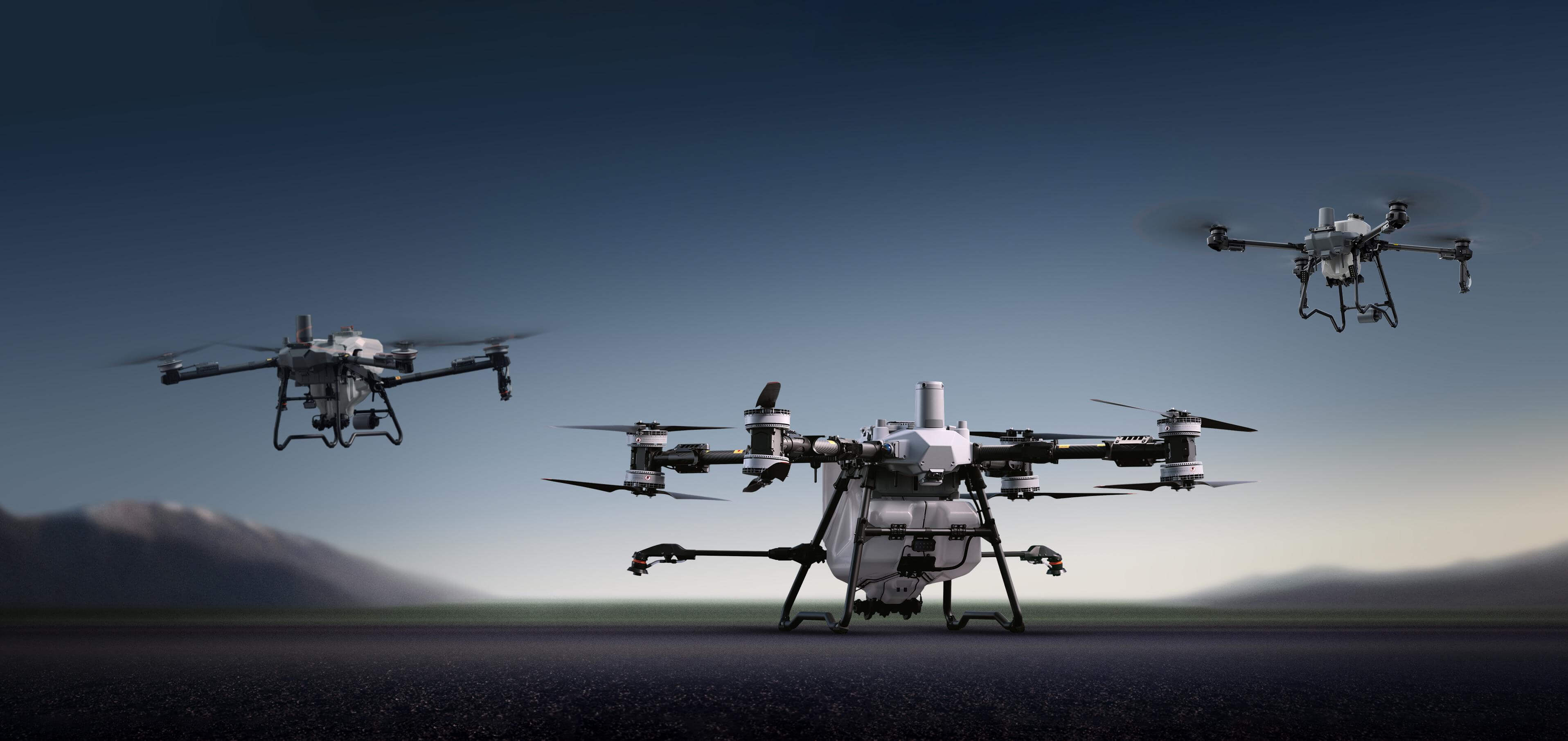
Official DJI Agriculture lineup image. T25P is the compact orchard platform in this guide; T50 and T100 add progressively more tank, flow and support-system demand.
Route planning creates repeatability. Water-sensitive paper proves coverage.
Choose T25P for compact blocks and access, T50 for balanced commercial orchard work, and T100 for large contiguous operations with high refill demand. Then validate the actual swath and canopy deposition before chemical application.
Compact rows and fragmented specialty-crop blocks.
- 20 L spray tank and 16 L/min standard flow.
- Optional four-nozzle flow up to 24 L/min.
- Orchard Mode 4.0 and row planning.
- Waypoint position and height editing.
- Single-side spraying for boundaries and obstacles.
- Request-quote Canadian package.
The balanced orchard and vineyard platform.
- 40 L tank reduces T25P refill frequency.
- 16 L/min standard or 24 L/min optional flow.
- Orchard surveying and 3D route generation.
- Spray while turning in supported Standard orchard routes.
- Empty-tank point estimation supports refill planning.
- Current three-battery package: CAD 29,999.
High-volume blocks and professional custom application.
- 100 L tank and 30 L/min standard flow.
- Optional four-nozzle flow up to 40 L/min.
- LiDAR, radar and penta-vision safety architecture.
- Fruit-tree mapping tutorials and mist-nozzle option.
- Large-drone SFOC planning above 150 kg.
- Current three-battery package: CAD 48,505.
Tank capacity affects logistics. Route and spray settings affect the crop.
Manufacturer spray widths and maximum flow rates are controlled references rather than field guarantees. Orchard swath must be established for the canopy, route and label being used.
| Category | T25P | T50 | T100 |
|---|---|---|---|
| Spray tank | 20 L | 40 L | 100 L |
| Standard maximum flow | 16 L/min | 16 L/min | 30 L/min |
| Optional maximum flow | 24 L/min with four nozzles | 24 L/min with four nozzles | 40 L/min with four nozzles |
| Droplet range | 50-500 micrometres | 50-500 micrometres | 50-500 micrometres |
| Published spray width | 4-7 m at 3 m above crop | 4-11 m at 3 m above crop | 5-13 m, scene dependent |
| Orchard route capability | Orchard Mode 4.0, row planning and 3D waypoint editing | 3D orchard routes, row planning and compatible route sharing | Fruit-tree mapping workflow and current safety system |
| Terrain and slope | Terrain following; orchard mapping speed reduces on steeper slopes | Surveys slopes up to 20 degrees; terrain follow supports steeper work under stated conditions | LiDAR, radar and penta-vision terrain and obstacle system |
| Boundary control | Single-side spraying | Single-side spraying and supported turn spraying | Single-side spraying |
| Maximum spray takeoff weight | 53 kg | 92 kg | 175 or 177 kg depending on nozzle configuration |
| Canadian category | Medium drone | Medium drone | Large drone when operated above 150 kg |
| Current Canadian price | Request quote | CAD 29,999 package | CAD 48,505 package |
Compare the deployable system, not only the spray tank.
The package must include compatible power, cooling, controller, batteries, route support, transport and service. Confirm battery condition and final contents in writing.
DJI Agras T25P
Compact and foldable for solo mobility, targeted orchard work and Orchard Mode 4.0.
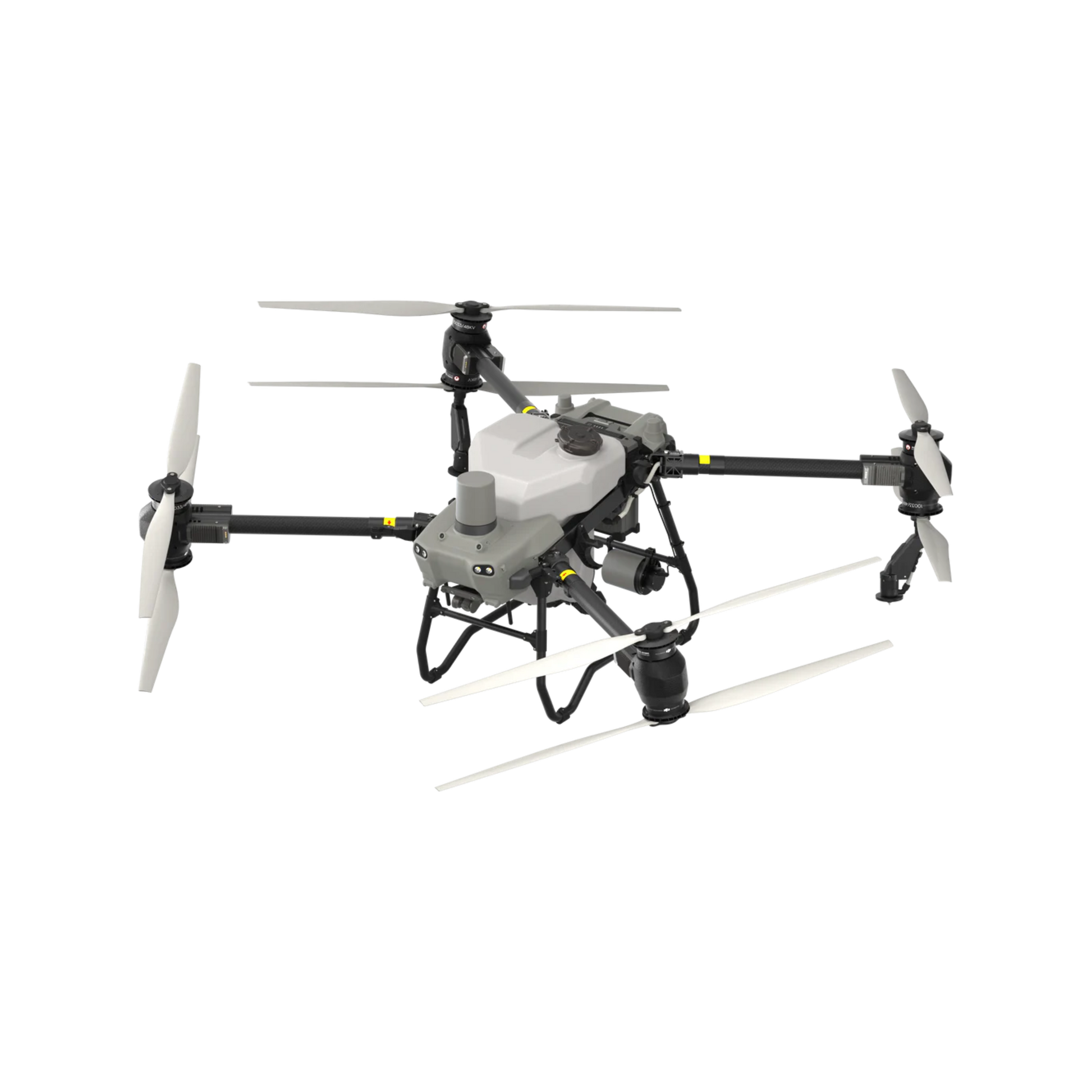
DJI Agras T50
Balanced 40 L platform. The current package combines a new aircraft and controller with pre-owned charging equipment and batteries.
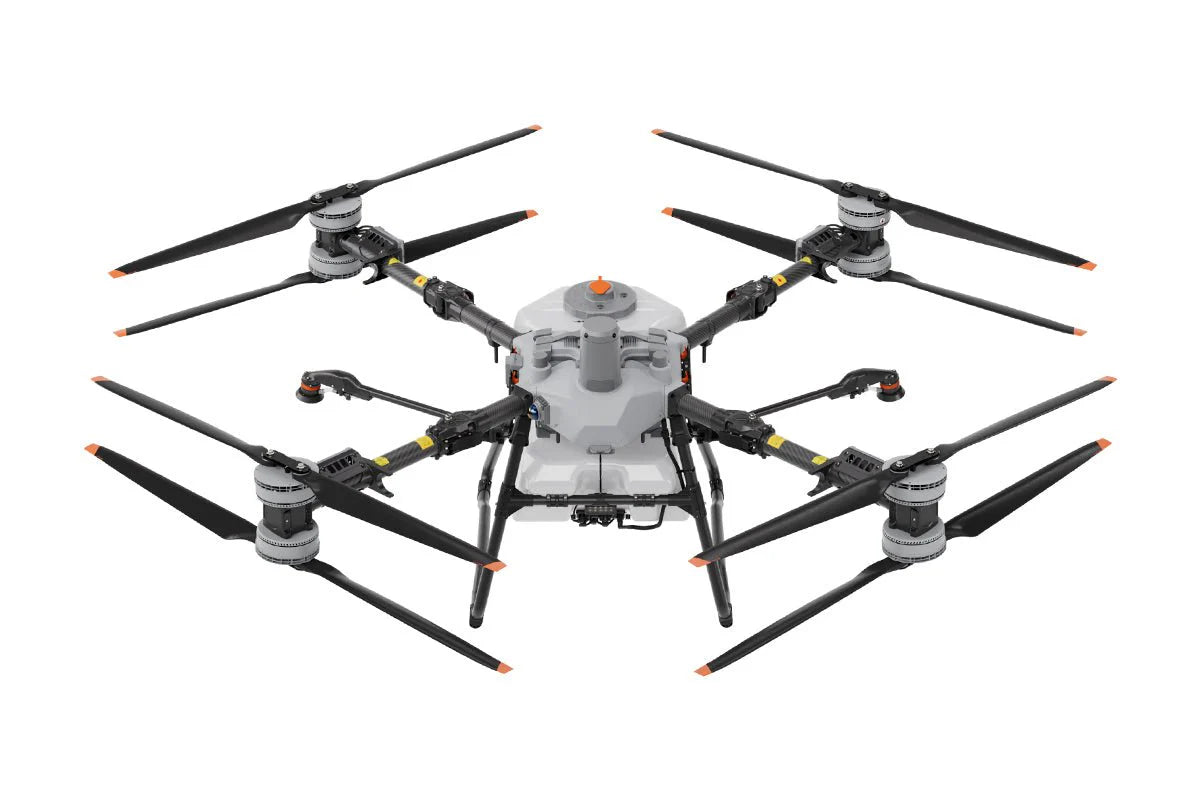
DJI Agras T100
High-capacity 100 L platform requiring a larger transport, power, crew and Canadian authorization plan.
A twelve-step process from label review to recorded application.
Build the route from the crop and hazards, then build the spray settings from the label and deposition test. Do not reverse that order.
Confirm the legal use
Read the current product label and confirm aerial application is allowed for the crop, pest and timing. Check provincial applicator requirements.
Map the block
Record boundaries, row ends, canopy height, elevation, headlands, access, residences, water, roads, workers and sensitive habitat.
Classify the route
Choose row planning for regular vines or tree rows and 3D orchard routes for irregular terrain, variable canopy or hillside blocks.
Mark hazards
Map trellis wire, utility lines, poles, irrigation equipment, dead trees, netting, wind machines and structures manually.
Set route geometry
Choose route spacing, flight height, direction, headland turns, margins and refill points from the crop and calibration plan.
Configure the spray system
Set two or four sprinklers, droplet size, flow, gain or terrain scenario, single-side spraying and turn behaviour.
Run a water-only test
Use the intended route and speed with clean water to verify swath, canopy deposition, underleaf coverage and drift.
Adjust from evidence
Change route spacing, height, speed, nozzle count or droplet size only after reviewing coverage and label requirements.
Prepare crew and PPE
Separate pilot from mixer or loader, position the crew upwind and brief battery, refill, contamination and emergency procedures.
Verify weather
Record wind speed and direction, gusts, temperature, humidity, inversion risk, canopy wetness and forecast changes.
Execute by block
Use repeatable routes, monitor empty-tank prediction, pause when conditions change and keep treatment records by block.
Inspect and record
Review missed areas, edge coverage, drift observations, water-sensitive paper, remaining material, battery cycles and route files.
Use row planning for regular blocks and editable 3D routes for complex terrain.
DJI supports row-tree route planning, 3D route waypoint editing and height or position changes on the controller. The route remains the operator's responsibility.
| Route element | Orchard or vineyard decision | Field control |
|---|---|---|
| Boundary | Include the true crop block and exclude sensitive habitat, water and neighbouring property | Use mapped exclusions and label buffer zones |
| Row direction | Align with trellis or tree-row geometry where the block is regular | Verify turns, gaps and end-row spray behaviour |
| 3D elevation | Follow changing canopy and terrain rather than one flat ground height | Edit waypoint height where mapping or safety review requires it |
| Route spacing | Start from canopy width and calibration rather than maximum published spray width | Measure deposition across adjacent rows |
| Headland turn | Provide room for the aircraft and avoid spraying outside the intended crop | Use turn spraying only after edge testing |
| Single-side spraying | Use near boundaries or obstacles where supported | Does not replace required buffer zones |
| Refill point | Position upwind with safe access, clean equipment and spill response | Use empty-tank prediction only as a planning aid |
| Obstacle route | Manually map poles, wires, wind machines, irrigation and netting | Maintain conservative separation; sensors are not a wire guarantee |
A route is complete only when the target surfaces receive the intended deposition.
Orchards and vineyards can require coverage on outer leaves, interior canopy, fruit zones or other pest-specific targets. Use water-only testing to show what the route actually reaches.
Control drift with the label, actual swath, weather and route - not one droplet setting.
Health Canada currently requires the labelled conventional rotary-aircraft aerial buffer zones for RPAS. Actual swath and droplet performance must be established for the aircraft and operating settings.
| Drift control | Required practice | Failure risk |
|---|---|---|
| Label eligibility | Use only products and crop uses that permit aerial application | Illegal pesticide use |
| Minimum spray volume | Meet or exceed the labelled aerial minimum | Coverage failure and non-compliance |
| Droplet size | Set the atomizers to the label-required classification and verify output | Off-target movement or weak deposition |
| Buffer zones | Apply the labelled rotary-aircraft aerial buffer zones | Risk to sensitive habitat and enforcement action |
| Wind direction | Keep pilot, observer and crew upwind of the spraying drone | Worker exposure |
| Wind speed and gusts | Stop when conditions exceed the label or the validated operating envelope | Variable swath and off-target movement |
| Flight height | Use the lowest safe and effective height supported by the route and test | Excess drift or poor canopy distribution |
| Route edge | Use margins, one-sided spray or shutoff without crossing required buffers | Boundary overspray |
| Temperature and inversion | Avoid unstable or inversion conditions that undermine deposition control | Unexpected transport and poor coverage |
| Canopy condition | Revalidate after major growth, pruning or row geometry changes | Missed interior or excessive outside deposition |
Trellis rows create a precise route and a demanding obstacle environment.
Vineyards often have regular row geometry, but posts, support wire, end anchors, wind machines, slopes and narrow headlands require conservative planning.
Use row-oriented routes and verify both sides.
- Map row ends and anchor systems.
- Compare windward and leeward deposition.
- Check fruit-zone and leaf-surface targets.
- Keep turns outside people and equipment.
Use 3D routes where ground and canopy height change.
- Survey terrain and canopy.
- Edit waypoint height and position.
- Reduce speed where slope or obstacle complexity increases.
- Recheck signal and relay placement.
Capacity helps only when refill and turn logistics keep pace.
- Stage nurse equipment near safe access.
- Confirm headland room for the larger aircraft.
- Model 100 L mixing and closed-transfer workflow.
- Fund the large-drone authorization path.
The route may be technically valid and still be legally prohibited.
Health Canada regulates the pesticide use. Transport Canada regulates the aircraft operation. Provinces and territories regulate applicator licensing, permits, storage and records. All layers must be satisfied.
| Rule layer | Orchard and vineyard requirement |
|---|---|
| Health Canada label | The crop and use must permit aerial application; follow rate, volume, droplet, buffer and safety directions |
| Health Canada crew roles | The mixer or loader must not be the pilot except the narrow premixed closed-system situation |
| PPE | Everyone handling contaminated aircraft, batteries or components follows the applicable label PPE |
| Visual observer | Health Canada states observers must hold at least a Basic RPA certificate |
| T25P and T50 aviation | Medium-drone VLOS work requires Advanced privileges or higher and the applicable Safety Assurance Declaration |
| T100 aviation | Operations above 150 kg are large-drone special operations requiring SFOC-RPAS |
| Airspace | Registration, pilot certificate, airspace authorization, people separation and current operational rules still apply |
| Provincial licensing | Complete pesticide applicator certification, aerial or RPAS endorsements, permits and application records where required |
Budget the route, power, transport, crew and compliance with the aircraft.
Public SpeedyDrone prices were checked July 21, 2026. Tax, availability, battery condition, training, PPE, transport, generator and licensing are additional.
Request-quote compact system.
- Confirm aircraft, spraying kit, batteries and charger.
- Include RTK, route support and Orchard Mode training.
- Best evaluated through a water-only farm demonstration.
CAD 29,999 three-battery package.
- New aircraft and controller.
- Pre-owned Grade AAA+ C10000 station.
- Three pre-owned Grade AAA+ batteries listed at 100-150 cycles.
- Confirm written condition and cycle records.
CAD 48,505 three-battery package.
- Aircraft and spraying system.
- Three DB2160 batteries.
- C12000 intelligent power supply.
- Confirm availability and SFOC deployment cost.
Route, coverage, drift, platform and Canadian-rule questions answered.
Can DJI Agras drones spray Canadian orchards and vineyards?
The aircraft can technically support orchard and vineyard route planning, terrain following and atomized spraying. Pesticide use is permitted only when the end-use product label allows conventional aerial application and the crop, pest, rate, spray volume, droplet size, buffer zones and other label directions are followed. Provincial licensing and permits may also apply.
Which Agras model is best for orchards and vineyards?
T25P is the compact choice for fragmented blocks, tight access and smaller crews. T50 is the balanced current choice for many commercial orchard and vineyard programs because it combines a 40 L tank with Orchard Mode 4.0 and optional four-nozzle 24 L/min flow. T100 is the high-capacity choice for large contiguous blocks and high-volume work when transport, refill, charging and large-drone compliance are ready.
What does Orchard Mode 4.0 do?
Orchard Mode 4.0 supports 3D routes, row planning and waypoint editing. Operators can adjust waypoint position and height and add or delete waypoints to improve the route around terrain and mapped obstacles. Route and aircraft compatibility, firmware and field conditions must be checked before use.
Can I use one universal route spacing for every vineyard?
No. Route spacing must be validated for row width, canopy width, flight height, droplet size, wind, nozzle configuration, operating speed and the required coverage. DJI's Romanian T50 vineyard case study used 3 to 5 m spacing and 2 to 2.5 m above the crop, but those are case-study settings, not Canadian defaults.
How should orchard spray coverage be verified?
Use water-only calibration with water-sensitive paper or another accepted method at the canopy top, interior, lower canopy and leaf surfaces relevant to the target. Repeat when route spacing, height, speed, droplet size, nozzle count, crop stage or wind changes.
Does a four-nozzle kit improve canopy penetration?
T25P and T50 can increase maximum system flow from 16 to 24 L/min with four sprinklers. DJI positions the configuration for higher-flow tasks such as orchard spraying. Coverage still depends on route, canopy, downwash, droplet size, speed and label volume, so the benefit should be validated rather than assumed.
Does single-side spraying replace buffer zones?
No. Single-side spraying can improve control near mapped boundaries or obstacles, but it does not override the pesticide label, required rotary-aircraft aerial buffer zones, provincial restrictions or the need to stop spraying when drift control is inadequate.
Can the pilot mix and load pesticide?
Health Canada separates key roles. The mixer or loader must not be the RPA pilot. A pilot may load premixed chemical only when another person mixed it, the label permits pilot loading with a closed system and the approved closed-transfer method is used.
Can the pilot or observer stand downwind of the drone?
No. Health Canada states that the pilot, visual observer and crew must not be positioned downwind of the spraying drone. Everyone handling the aircraft, battery or contaminated components must follow the label PPE requirements.
Can obstacle avoidance detect vineyard trellis wire?
Thin wires, cables, branches and low-contrast obstacles can be difficult for any sensing system. Map trellis ends, utility lines, irrigation hardware and support wires manually, maintain a conservative route and do not use obstacle avoidance as the primary control.
Can T100 be used without an SFOC in Canada?
T100 has a published maximum spraying takeoff weight of 175 or 177 kg. Operations above 150 kg are large-drone special operations requiring an SFOC-RPAS. A partially loaded configuration does not automatically establish eligibility; the exact operating configuration and authorization must be verified with Transport Canada.
How much do the orchard-capable Agras systems cost?
SpeedyDrone currently lists the T50 three-battery package at CAD 29,999 and the T100 three-battery package at CAD 48,505. T25P is request-quote. Prices, battery condition, package contents and availability must be confirmed in writing.
Verify the current label, route software, aircraft declaration and package.
Request an orchard or vineyard farm fit-check.
Send the province, crop, block acres, row spacing, canopy height, terrain, label spray volume, target pest, trellis or wire hazards, wind exposure, refill distance, crew, existing licences, annual treatment passes and preferred budget. SpeedyDrone can prepare a T25P, T50 or T100 recommendation, written package quote, demonstration discussion, training pathway, financing review and Canadian compliance checklist.


