


Canadian end-of-season field guide
Close the season clean. Open it ready.
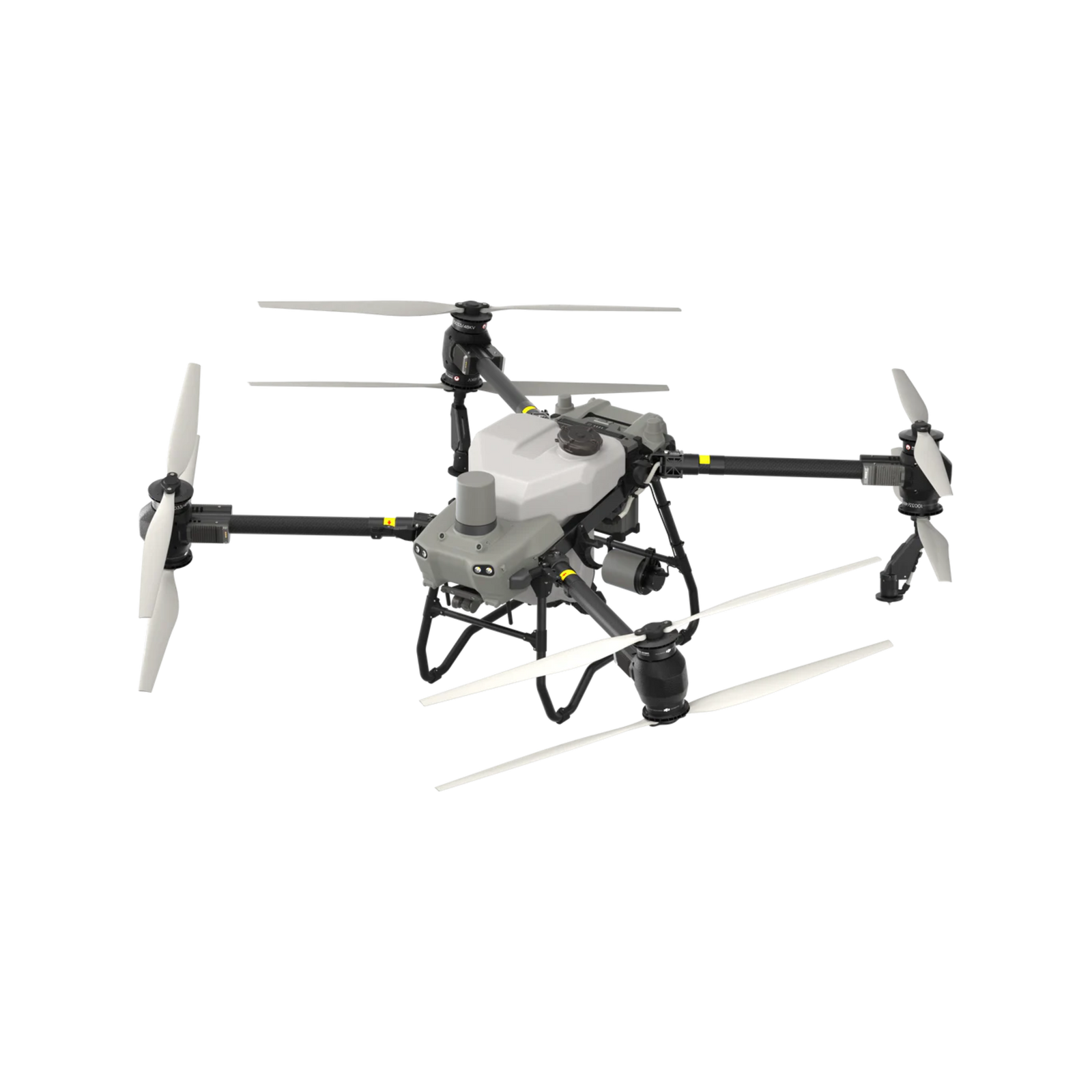
A practical winter-storage sequence for the T50 aircraft, spray and spreading payloads, DB1560 batteries, RC Plus and ground power equipment.
Quick answer: how should you prepare a T50 for winter storage?
Finish the last application under the product label and site procedure, then clean, flush, drain, inspect and dry the DJI Agras T50 before temperatures fall below freezing. Remove the DB1560 batteries, separate any battery with damage or an unresolved warning, prepare the RC Plus and power equipment under their own manuals, and record repairs that must be completed before spring.
Winterizing is a system task. An empty tank does not prove that the flow meter, pumps, hoses, filters and sprinklers are empty; a suitable aircraft storage temperature does not automatically make the same garage suitable for charging batteries or storing a generator.
This guide owns the season-closing workflow. When it is time to return the aircraft to field service, use the separate DJI Agras T50 Pre-Season Maintenance Checklist. For current aircraft package details, see the exact DJI Agras T50 Drone Only listing; batteries, charging equipment and the spreading system are separate.
Why end-of-season storage is different from daily maintenance
Daily cleaning assumes the aircraft may work again soon. End-of-season storage leaves residue or moisture undisturbed for months, allowing deposits to harden, connectors to corrode, granules to absorb moisture and residual liquid to freeze.
DJI's T50/T25 manual already sets a strong daily baseline. After the aircraft returns to normal temperature, it directs operators to fill the spray tank with clean water or soapy water, discharge through the sprinklers until empty, repeat twice, remove and clean the strainer and sprinklers, and store the cleaned aircraft dry. Winter preparation starts with that approved sequence and adds a deliberate drain, dry, inspection and records pass.
Do not confuse an operator inspection with an authorized repair. This article does not reproduce DJI's 100-flight or 20-hour inspection; it uses the quiet season to identify work that should be completed before the next one.
Step 1: finish the final application and decontaminate safely
The last field job should end under the current pesticide label, safety data sheet, farm procedure and provincial requirements. In Canada, the pesticide label is a legal document. Follow its PPE, rinsate, spill, storage and disposal directions; never treat a drone article as permission to pour leftover mix or cleaning liquid onto the ground or into a drain.
Choose a lawful cleaning location, keep the required PPE on, secure access, and account for remaining product. A label- or farm-specific decontamination sequence comes before a generic equipment checklist.
Important boundary: DJI's reference to clean or soapy water describes equipment care. It does not override the applied product's label or determine how pesticide mixture, rinsate, contaminated PPE or a spill must be handled.
Start only after the aircraft returns to normal temperature
DJI says not to clean the aircraft immediately after operations. Let motors, pumps and heat-dissipation components return to normal temperature, remove the flight battery, and keep the machine stable and powered down while you prepare the cleaning area.
Step 2: flush and clean the spraying system
The goal is to clean the entire liquid path, not merely the visible tank. The T50 route includes the tank, strainer, flow components, pumps, hoses and dual atomizing sprinklers. A clean-looking tank can still leave liquid in a low point or residue inside a filter housing.
- Follow the current T50 manual and the product label to choose the permitted cleaning liquid and location.
- Run the DJI cleaning sequence through the sprinklers rather than washing only the tank interior.
- Remove the spray-tank strainer and sprinklers as directed, clear blockage, and inspect the accessible seals and connection points.
- Look for residue at hose joints, filter housings, pump areas, cable interfaces and low sections of the plumbing.
- Do not reinstall wet components simply because the rinse water appears clear.
Do not add automotive antifreeze, windshield fluid or another improvised chemical unless current DJI instructions and the applied-product requirements explicitly allow it. Freeze resistance does not prove compatibility with seals, pumps, label rules or waste handling.
Step 3: drain and dry before the first hard freeze
DJI's aircraft-storage range of -20°C to 40°C is conditional: the manual states that the tank, flow meter, pumps and hoses must be empty. It also directs operators to keep the aircraft and parts clean and dry, remove or empty the tank when it is not in use, and remove the battery for storage.
That condition is not permission to leave residual water in the aircraft at -20°C. Check the tank, strainer cavity, hose low points, pumps, sprinklers, recesses and battery interface. Wipe exterior moisture and let the system drain and dry in a protected space.
Visible dry is not system dry
Inspect low points and removed components; do not judge only by the tank wall.
Protect connectors
Battery and payload interfaces should be clean, dry and free of residue before caps or covers are secured.
Keep vents clear
Do not wrap equipment in a way that traps moisture against the airframe or cooling path.
Record uncertainty
If a pump, hose or fitting cannot be confirmed empty, put it on the service list instead of guessing.
Step 4: clean and dry the spreading system separately
The optional spreading payload has a different contamination problem. Fertilizer, seed and other granules can remain around the hopper, gate and spinner; moisture can make residue cake during storage.
DJI's T50/T25 Spreading System guide says to clean residue from the spread tank and spreader immediately after spreading and dry the system afterward. It also identifies the spinner disk as a consumable part and directs users to replace it when obvious wear is present.
Empty the hopper, clean the gate and accessible interior under the current guide, inspect the spinner disk and mounting interfaces, and confirm the payload is dry before storage. Do not use liquid, powder or material outside the stated 0.5–5 mm dry-granule range during operation.


Step 5: prepare every DB1560 battery individually
Remove the battery from the aircraft, power it off, and inspect the case, handle, clamp, rubber caps, ports and terminals in good light. A swollen, leaking, dropped or otherwise damaged battery is a stop condition under DJI's battery guide. Isolate it from healthy batteries and conductive objects, do not charge it to “see if it recovers,” and contact qualified DJI support for the next step.
Keep batteries dry, flat, and away from heat, moisture, hazardous material and loose metal. For storage longer than three months, DJI recommends a battery safety bag and a -20°C to 40°C environment; use that more specific long-storage condition for winter.
Do not invent a universal “winter percentage”
DJI's current documents are not perfectly aligned. The DB1560 guide says a critically low battery should be charged to 25% and explains that a fully charged battery automatically discharges to 60% after seven days. A separate storage passage in the T50/T25 flight manual says to bring a critically low battery to 40–60%. Because the official documents differ, do not treat a generic 40–65% internet rule as the final T50 instruction.
Use the latest document for the exact battery, firmware and region, record the level, and ask DJI or SpeedyDrone when the manuals conflict. Do not store the battery fully depleted or charge to 100% solely for a multi-month lay-up.
Long-storage maintenance: DJI instructs users to complete a full charge and discharge at least once every three months. It also states that a battery left without a charge or discharge for five months or more is no longer covered by the battery warranty. Schedule the maintenance event; do not rely on memory.
Step 6: store the RC Plus by its own limits
The RC Plus does not share one universal winter number with the aircraft or DB1560. DJI lists an operating range of -20°C to 50°C, but its storage limits vary with duration: -30°C to 45°C for less than one month, -30°C to 35°C for one to three months, and -30°C to 30°C for six months to one year. Its charging range is narrower at 5°C to 40°C.
A controller can be within its storage range yet still be too cold to charge. Inspect its screen, sticks, antennas, ports and charging connection; keep it dry; back up field data; and allow it to acclimate before charging or powering it.
Manage condensation, not only air temperature
Moving cold equipment into warm, humid air can produce condensation on exterior surfaces and inside recesses. Keep covers closed during the initial move when appropriate, allow the equipment to warm gradually, then inspect ports and battery interfaces. Do not power or charge visibly cold, wet or fogged equipment.
Step 7: winterize the power and cooling equipment
Inspect the C10000 enclosure, cables, connectors, ventilation openings and dustproof cover. DJI says to disconnect AC and the battery when not in use, store the unit securely, and keep it away from sun, rain, heat, pressure, water, flammable gases and corrosives.
Clean the dustproof cover as the guide describes; do not open or improvise electrical repairs. Inspect the air-cooled heat sink and fan path, and do not rinse that cooling accessory with water.
The DJI C10000 Intelligent Power Supply is listed by SpeedyDrone as a special-order item. Its guide directly lists DB1560 compatibility, but the exact regional cable, site power and complete charging configuration still need confirmation.

D12000iEP generator: follow the 30-day storage procedure
If your T50 workflow uses the D12000iEP Multifunctional Inverter Generator, use its exact manual rather than a generic small-engine checklist. DJI's guide gives a specific procedure when the generator will not be used for more than 30 days: warm the unit for five to ten minutes, stop it, drain the engine oil, extract fuel from the tank, drain fuel from the high-pressure oil pipe and fuel pump, close the fuel valve, and place the generator in a cool, dry, clean location.
Fuel and hot oil make this higher-risk work. Use the complete manual and approved containers; contact an authorized dealer when needed. Do not substitute a stabilizer, oil grade, carburetor routine or disposal method from another generator.
Can you store a T50 in an unheated Canadian garage?
Sometimes, but only after you assess every component and the actual garage. A space that meets the aircraft's -20°C to 40°C condition may still be too damp, too cold for charging, unsuitable for batteries or inappropriate for fuel equipment.
| Check | What to verify | Decision |
|---|---|---|
| Minimum temperature | Measure the real overnight low at the storage position, not the weather-app forecast. | Compare each component with its own current manual. |
| Moisture & condensation | Check humidity, roof/door leaks, floor dampness and cold-to-warm transitions. | Relocate equipment if it cannot stay clean and dry. |
| Spray path | Confirm tank, flow meter, pumps, hoses, filters and sprinklers are empty and dry. | Do not rely on temperature range until this condition is met. |
| DB1560 batteries | Dry location, flat stable surface, safe separation, no damage or warning. | Use the battery-specific storage plan and maintenance calendar. |
| RC Plus | Storage duration and temperature are acceptable; charging occurs only at 5–40°C. | Warm and inspect before powering or charging. |
| Power equipment | C10000 stays dry and stable; generator fuel/oil storage procedure is complete. | Keep electrical and fuel equipment in suitable dedicated areas. |
| Contamination & pests | No pesticide residue, fertilizer dust, rodents, nesting material or conductive debris. | Use protected storage that remains inspectable and ventilated. |
Build the winter repair and parts list now
Do not let the spring crew rediscover every problem under deadline. Give each aircraft, battery and accessory a clear identifier; photograph the issue; record the date and operating context; and assign an action and owner. Keep an abnormal battery physically separated from the normal battery group.
| Component | Condition recorded | Action before spring |
|---|---|---|
| Propeller U2 | Nick on leading edge | Replace with the correct approved part; verify installation. |
| Left hose | Abrasion near clamp | Inspect and replace if required before pressure/flow checks. |
| Sprinkler | Uneven wear or poor atomization | Clean under the manual; replace worn centrifugal disk if directed. |
| DB1560 #3 | Unresolved warning | Isolate and arrange qualified diagnosis; do not charge or deploy. |
| Tank strainer | Persistent contamination | Clean or replace before the return-to-service flow check. |
| RC Plus cable | Jacket damaged | Replace with the correct cable before charging. |
This is a record format, not a diagnosis or repair instruction. DJI states that damaged aircraft parts and dealer-only maintenance should be handled through DJI Support or an authorized DJI Agriculture dealer.
What not to do during T50 winterization
- Do not store a “mostly empty” spray system: confirm that the tank, flow meter, pumps and hoses satisfy DJI's empty-and-dry condition.
- Do not improvise antifreeze: never add automotive or unapproved chemicals to the spray circuit without explicit compatible instructions.
- Do not rinse the DB1560 or air-cooled heat sink: DJI tells users to keep the battery dry and not rinse the cooling accessory with water.
- Do not charge a cold or damp controller: RC Plus has a 5–40°C charging range even though its storage range can be wider.
- Do not leave a damaged battery with the normal fleet: isolate swollen, leaking, dropped, damaged or abnormally behaving batteries.
- Do not copy another generator's winter routine: the D12000iEP has a DJI-specific storage sequence for more than 30 days.
- Do not hide repair findings in a notebook with no owner: turn each issue into a dated, assigned service action.
When should you schedule service?
Schedule service before storage or early enough that parts and technical support do not become a spring bottleneck. Check whether the aircraft has reached a current DJI maintenance interval, and escalate any airframe distortion, damaged propulsion part, leak, wiring damage, unresolved app warning or battery abnormality. Use the SpeedyDrone agriculture solutions hub to review the complete aircraft-and-power workflow, then contact the team with the aircraft serial, component ID, photographs and fault history.
DJI Agras T50 winter storage FAQ
What is the recommended T50 aircraft storage temperature?
DJI lists -20°C to 40°C for aircraft storage when the tank, flow meter, pumps and hoses are empty. The empty-system condition is essential: the number should not be read as approval to leave water or rinsate in the spray path. Keep the aircraft and parts clean and dry, remove or empty the tank when it is not in use, and remove the DB1560 from the aircraft. Batteries, the RC Plus, C10000 and generator each have their own conditions.
Should a DB1560 battery be stored fully charged for winter?
No. DJI's DB1560 guide says a fully charged battery automatically discharges to 97% after one day and to 60% after seven days. It also warns against extended storage when fully depleted. The current T50 documents contain different instructions for a critically low battery—25% in the battery guide and 40–60% in one flight-manual passage—so use the latest exact manual and ask DJI or SpeedyDrone when the documents conflict rather than applying a generic percentage.
How often does a stored DB1560 need maintenance?
DJI directs users to fully charge and discharge the battery at least once every three months to maintain performance. It also states that a battery left without being charged or discharged for five months or more is no longer covered by the battery warranty. Create a dated maintenance calendar for each battery ID, inspect it before every maintenance cycle, and stop if the battery is swollen, leaking, damaged, unusually hot or showing an unresolved warning.
Can I put antifreeze in the T50 spray system?
Do not add automotive antifreeze, windshield fluid or another improvised chemical unless current DJI instructions and the applied product's requirements explicitly permit it. The reviewed T50 manual describes cleaning with clean water or soapy water and storing the aircraft dry with the tank, flow meter, pumps and hoses empty. An unapproved freeze-resistant liquid may create material-compatibility, contamination, disposal or label-compliance problems.
Can the T50, batteries and RC Plus stay in the same unheated garage?
Only if the actual environment satisfies every component's separate conditions. Measure the real minimum temperature, control moisture and condensation, keep the aircraft spray path empty, and verify battery, controller and power-equipment rules independently. RC Plus can be stored at lower temperatures for some durations but can only be charged from 5°C to 40°C. Fuel equipment and high-power charging equipment also need suitable, separated storage arrangements.
How do I prevent condensation when bringing equipment indoors?
Move cold equipment into the warmer space in a controlled way and allow time for it to acclimate. Inspect the exterior, ports, battery interfaces, cable ends and recessed areas for moisture before opening covers, powering equipment or starting a charge. If the screen, housing or connectors are visibly cold, wet or fogged, keep the hardware powered down until it is fully dry and within its charging or operating range.
What should I do with an abnormal DB1560 battery?
Power it off, disconnect it, isolate it from healthy batteries and conductive objects, and record the battery ID and observed warning or damage. DJI says not to use swollen, leaking, dropped or damaged batteries. Do not charge it as a test and do not place it into ordinary waste. Contact DJI, an authorized agriculture dealer or a qualified battery-recycling provider for the correct inspection, transport and disposal process.
How should the T50 Spreading System be stored?
Remove remaining granules, clean residue from the tank and spreader immediately after use, and dry the system. Inspect the hopper, gate, spinner disk, cable and mounting points; DJI identifies the spinner disk as a consumable part that should be replaced when obvious wear is present. Keep the system dry and free of fertilizer dust or seed that can absorb moisture, cake or obstruct moving parts during storage.
What should happen before the first spring application?
Reopen the winter repair log, complete assigned service and replacement work, and use the dedicated T50 pre-season checklist. Inspect the airframe, propulsion, spraying or spreading payload, DB1560 batteries, charging and cooling equipment, RC Plus, firmware and field kit before mixing material. Complete applicable calibration and operational checks under the latest DJI manuals and product label; do not let the first paid field job become the first test after storage.
Sources and current-document check
- DJI Agras T50 downloads — current hub for the T50/T25 flight manual and component guides.
- DJI Agras T50 specifications — aircraft, RC Plus, DB1560, C10000 and generator parameters.
- DB1560/DB800 Intelligent Flight Battery User Guide v1.0 — battery use, storage and maintenance.
- D12000iEP Multifunctional Inverter Generator User Guide — storage for periods longer than 30 days.
- Health Canada pesticide FAQ and the Pesticide Product Information Database — current label and handling context.
Information checked September 14, 2026. Manuals, firmware, product labels, store status and regional requirements can change; verify the current exact documents before work.
Plan the service list before spring makes it urgent.
Send SpeedyDrone the T50 serial, DB1560 battery IDs, photos, warning history and the parts or power-system questions recorded during winterization. The team can help confirm current product availability, compatible equipment and the right next service conversation.
Contact SpeedyDrone Agriculture SupportEquipment guidance does not replace DJI manuals, pesticide labels, applicable law or qualified electrical, engine and battery service.


