


AI is moving out of the screen and into the physical world.
Canada's new national AI strategy names Manufacturing and Robotics as one of five priority sectors. Here is what that signal means - and what it does not mean - for Canadian organizations evaluating humanoid and quadruped robots.
For businesses, universities and public-sector teams, the useful takeaway is practical: define a task, measure the baseline, run a controlled pilot and verify safety, data, integration and operational acceptance before expanding.
What Canada's 2026 AI strategy actually says
The Government of Canada launched Canada's National Artificial Intelligence Strategy: AI for All in June 2026. The strategy organizes its direction around six pillars covering trust and protection, Canadian participation, adoption and shared prosperity, sovereign AI capacity, Canadian champions and international partnerships.
Inside that broader strategy, the federal government identifies five priority sectors where it intends to concentrate attention: health and life sciences; energy and natural resources; transportation; agriculture; and manufacturing and robotics.
Robotics is named directly
Manufacturing and Robotics appears as a priority sector, not merely a supporting technology buried in a software discussion.
Autonomous systems matter
Transportation highlights intelligent logistics, autonomous systems and predictive infrastructure maintenance.
Applied AI matters
Agriculture points to AI-powered precision farming, reinforcing the strategy's focus on real-world operations.
The robotics section connects industrial AI and robotics with persistent labour shortages, reshoring pressure, advanced manufacturing and defence production. It also ties investment choices to Canada's broader goals around protection, sovereignty and security.
What are Physical AI and Embodied AI?
Physical AI is a useful industry term for AI systems that perceive, decide and act through a physical machine. Embodied AI typically emphasizes how an intelligent agent learns and operates through a body interacting with an environment. These terms overlap, but they are not a single legal category or certification under the Canadian strategy.
Perceive
Cameras, depth sensors, LiDAR, force sensing or other inputs turn the environment into machine-readable data.
Decide
Planning, control software and AI models interpret conditions and select an action within defined limits.
Act
Motors, joints, wheels, legs or manipulators affect the real world, where errors can create physical consequences.
That last step changes the risk profile. A language model can generate a wrong sentence; a mobile robot can enter a restricted space, lose balance, contact equipment or collect sensitive environmental data. Physical AI therefore needs operational controls in addition to model evaluation.
Where robotics could create measurable value
The strategy provides national direction. The use cases below are practical business interpretations, not promises that every project will receive government support.
Humanoid vs quadruped robots
| Decision area | Humanoid robot | Quadruped robot |
|---|---|---|
| Best starting question | Does the research or workflow benefit from a human-like body, reach, interaction or tool environment? | Does the task require mobile sensing across stairs, uneven surfaces or hard-to-reach areas? |
| Common fit | Embodied AI research, manipulation, locomotion, education and controlled demonstrations. | Inspection, mapping, remote observation, payload integration and difficult-terrain mobility. |
| Main complexity | Balance, falls, manipulation safety, dexterity, development access and human proximity. | Communications, navigation, payload integration, terrain limits and autonomy supervision. |
| Acceptance focus | Stability, stopping, repeatable motion, workspace controls and task success. | Route completion, obstacle handling, sensing quality, runtime and recovery procedures. |
Neither body type is automatically more advanced or more profitable. The right platform is the one that can complete a defined task safely and repeatedly with an acceptable total cost of ownership.
Where Unitree platforms may fit
Unitree G1 / G1 EDU
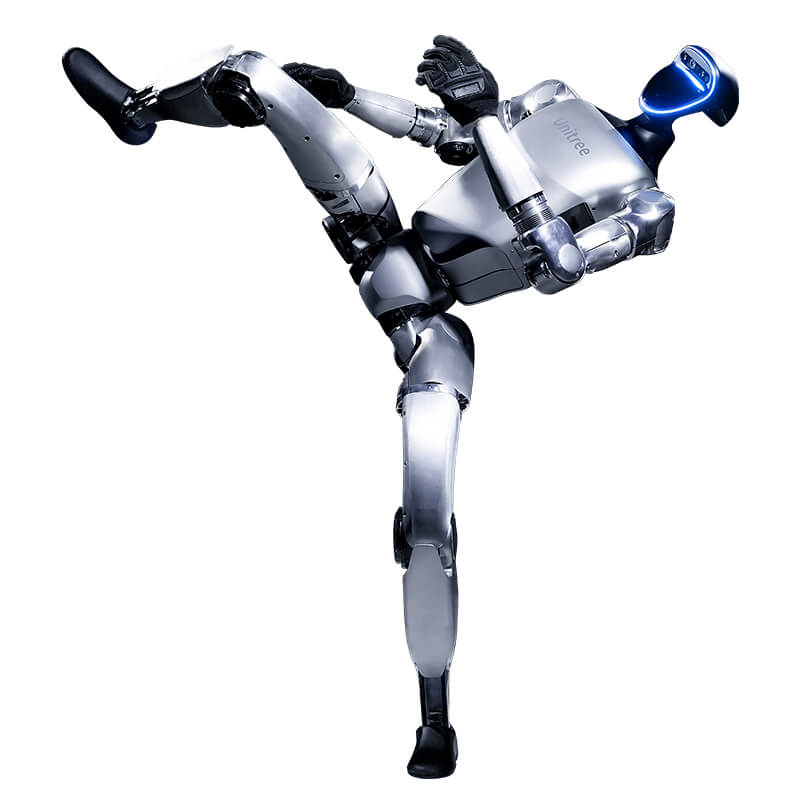
A compact humanoid family to evaluate for controlled research, education, perception, locomotion and embodied-AI development. Development access and hardware differ by configuration.
Unitree R1 / R1 EDU
A humanoid family with distinct basic and development-oriented configurations. Buyers should verify SDK access, compute, hands, sensors and supported workflows before selecting a version.
Unitree A2 / B2
Industrial quadruped platforms to assess for inspection and mobile sensing. Payloads, autonomy, environmental limits and integration requirements must be matched to the site.
For broader institutional planning, read SpeedyDrone's Canadian humanoid robotics lab guide. For G1-specific planning, use the Unitree G1 university and AI lab deployment guide.
What to decide before purchasing a robot
- Task: Write one observable job with a start, finish and failure condition.
- Environment: Document floors, stairs, lighting, dust, weather, people, restricted zones and communications.
- Operating mode: Separate remote control, supervised autonomy and unsupervised claims.
- Configuration: Confirm the exact model, compute, sensors, hands, payloads, SDK access and included equipment.
- Safety: Define authorized users, barriers, stop procedures, recovery, charging, maintenance and incident response.
- Data and security: Map video, audio, telemetry, model, network, cloud and retention requirements.
- Integration: Identify APIs, ROS or simulation needs, facility systems and the engineering owner.
- Economics: Include integration, training, spares, batteries, support, downtime and personnel - not only purchase price.
Canadian organizations should involve the appropriate internal safety, privacy, cybersecurity, IT, legal, procurement and operations stakeholders. Requirements vary by workplace, province, sector and intended use.
Pilot project → acceptance testing → deployment
Controlled pilot
Start with one site, one task, trained operators and a limited operating envelope. Record human interventions and failures, not only successful demonstrations.
Acceptance testing
Test repeatability, stop behaviour, communications loss, recovery, runtime, data handling, environmental limits and task-specific pass criteria.
Managed deployment
Expand only after owners approve procedures, training, maintenance, change control, incident reporting and ongoing performance review.
A strong pilot answers a narrow business question. “Can this configured robot complete this route and capture usable inspection data under our conditions?” is testable. “Can humanoid robots transform our company?” is not.
What the strategy means for Canadian businesses
The policy signal is significant because it places robotics inside Canada's national AI and industrial agenda. It may strengthen the case for organizations to build internal capability, evaluate applied research partnerships and prepare measurable projects in manufacturing, logistics, inspection and autonomous systems.
But strategy alignment is not an ROI model. Commercial value still depends on task frequency, labour and safety impact, integration effort, reliability and the cost of operating the complete system. The best near-term opportunity is usually a constrained workflow where a robot can collect better data, reduce exposure or increase repeatability under human oversight.
Canada AI strategy and robotics FAQ
Does Canada's 2026 AI strategy identify robotics as a priority?
Yes. The strategy lists Manufacturing and Robotics as one of five priority sectors and also discusses autonomous systems, intelligent logistics, predictive maintenance and precision agriculture in other priority sectors.
Does the strategy provide a subsidy for buying a Unitree robot?
No automatic subsidy is created by the strategy itself. A specific organization would need to identify a separate, active program and verify its applicant, project, cost, timing and approval requirements.
Is Unitree approved or certified by the Government of Canada?
The national strategy does not approve, certify or endorse Unitree or any specific robot model. Buyers must evaluate the exact configuration and applicable workplace, privacy, cybersecurity, procurement and safety requirements.
What is physical AI?
Physical AI is an industry term for AI that perceives and acts through a physical system such as a robot, vehicle or industrial machine. It is not a single Canadian legal classification.
When is a humanoid robot a better fit than a quadruped?
A humanoid may fit research involving human-scale movement, interaction, locomotion or manipulation. A quadruped may fit mobile sensing and inspection across stairs or uneven terrain. The task and operating environment should determine the platform.
Are G1 and R1 suitable for university research?
They can be evaluated for university and AI-lab work, but versions differ. Confirm development access, compute, sensors, hands, software support and safety needs for the exact project before purchase.
Can A2 or B2 be used for industrial inspection?
They can be evaluated as mobile platforms for industrial inspection and sensing. A complete solution depends on the selected payload, communications, autonomy, environment, integration, procedures and acceptance tests.
What should a robotics acceptance test include?
It should include task success, repeatability, emergency stopping, communications loss, recovery, runtime, sensing quality, data handling, environmental limits and documented pass or fail criteria.
How should a Canadian business start a robotics project?
Start with one measurable problem and a controlled pilot. Establish a baseline, select the configuration, complete risk and data reviews, train operators and expand only after acceptance criteria are met.
Can SpeedyDrone help with a Unitree demo or consultation?
Yes. Canadian organizations can contact SpeedyDrone to discuss the task, environment, platform options, configuration questions and a possible robotics demonstration or consultation.
Primary sources and further reading
- Innovation, Science and Economic Development Canada - Canada's National Artificial Intelligence Strategy: AI for All
- Government of Canada - National AI strategy announcement
- Government of Canada - AI for All strategy document and priority sectors
- ISED - Strategy overview
Editorial note: Information was checked on August 11, 2026. Policies, programs, product configurations and applicable requirements can change. This article is general business information, not legal, safety, cybersecurity, procurement or funding advice.
Book a Robotics Consultation or Unitree Demo
Tell SpeedyDrone about your organization, task, environment and research or inspection goals. We can help you frame the platform questions and next steps for a controlled evaluation.
Book a Robotics ConsultationReal Unitree G1 image sourced from SpeedyDrone Canada's current Unitree G1 collection page.


