


Prime Air is no longer a pilot story.It is becoming a network question.
Amazon's new expansion target is much larger than another single-city pilot. The real test is whether aircraft, fulfilment, airspace, local sites, software and community acceptance can work as one repeatable logistics system.
Amazon's plan is a serious move toward routine drone delivery, but it is not proof that Prime Air already serves 500 complete cities â or that drones are about to replace delivery vans. The important change is the operating model: drone delivery is being tied to Amazon's existing fulfilment network and planned across many communities. Coverage, customer eligibility and actual delivery volume still have to be earned site by site.
A national expansion target is not the same thing as a completed footprint.
Amazon says Prime Air is moving beyond a small collection of operating locations and toward suburban coverage in nearly 500 U.S. cities and towns by the end of 2026.
Amazon CEO Andy Jassy described lessons from 11 sites across seven U.S. states.
The August 19 expansion plan is intended to reach hundreds of additional communities.
The MK30 is built around lightweight consumer deliveries, not general freight.
Amazon describes delivery as fast as 30 minutes; actual eligibility and timing vary.
The story is the network, not only the aircraft.
For years, delivery-drone news was dominated by one-off routes, demonstrations and carefully bounded pilots. A plan that spans hundreds of communities asks a harder question: can the service behave like ordinary logistics?
A service-area map shows possible reach. It does not guarantee that every home has a safe delivery zone.
The correct item, package weight, address, weather and aircraft capacity must align at order time.
Aircraft inspections, batteries, loading, maintenance and remote oversight have to repeat all day.
Fast delivery still has to work after facilities, staff, certification, maintenance and failed attempts are counted.
Noise, privacy expectations, routes and local land-use questions become more visible as flight frequency rises.
Eight coordinated decisions happen before the customer sees a drone.
The visible part is an aircraft arriving over a yard. The infrastructure is the chain of decisions that must work before, during and after that flight.
Customer order
A shopper chooses an item and requests the fast delivery option.
Eligibility check
Weight, item, address and delivery-zone suitability are confirmed.
Weather and route
The operating window and planned path must remain acceptable.
Aircraft assignment
An available MK30, battery and maintenance state are matched to the mission.
Autonomous flight
The aircraft follows the planned mission under operational supervision.
Detect and avoid
The system must account for other aircraft and unexpected obstacles.
Delivery verification
The drop area is checked before the package is released.
Fleet record
The flight, aircraft health, exception and maintenance data return to the system.
Purpose-built for small, urgent consumer orders.
The MK30 can carry packages up to five pounds. Amazon says it has improved range over earlier designs, can operate in light rain and uses onboard sensing to support obstacle detection and avoidance.
Those capabilities fit a specific job: fast residential delivery of eligible lightweight items from nearby Amazon facilities. They do not turn the MK30 into a general-purpose cargo aircraft.
Official Amazon image. Real MK30 aircraft at a Prime Air facility; no aircraft imagery has been generated or reconstructed.
A national plan is delivered one site at a time.
Aviation authority is central, but local reality decides whether a site can operate repeatedly without losing community support.
Facility and land use: Where will aircraft be loaded, launched, recovered, charged and maintained?
Airspace and route design: Can routine paths work around airports, obstacles and other traffic?
Delivery-zone quality: Do enough customer properties have a usable, obstacle-free drop area?
Noise and privacy: How will frequent flights be explained, measured and managed?
Weather resilience: What happens when wind, rain, heat or visibility narrow the operating window?
Community acceptance: Are residents given clear information, realistic expectations and a way to raise concerns?
Prime Air and FlyCart 30 both move cargo by air. That is where the similarity ends.
Prime Air is an Amazon-operated last-mile consumer network. DJI FlyCart 30 is an enterprise cargo platform that an organization can plan around a defined industrial, worksite or remote-logistics mission.
Consumer last-mile network
Lightweight consumer last-mile delivery
Amazon aircraft inside an Amazon fulfilment and delivery network
Packages up to 5 lb
Nearby Amazon facility to an eligible customer address
A delivery service when the order and address qualify
Enterprise cargo mission platform
Industrial, worksite and remote-site cargo movement
Enterprise mission platform configured by the owner or operator
Up to 30 kg dual-battery or 40 kg single-battery under specified conditions
Cargo Case or optional Winch configuration
An aircraft platform that still requires an approved concept of operations, crew, site, procedures and support
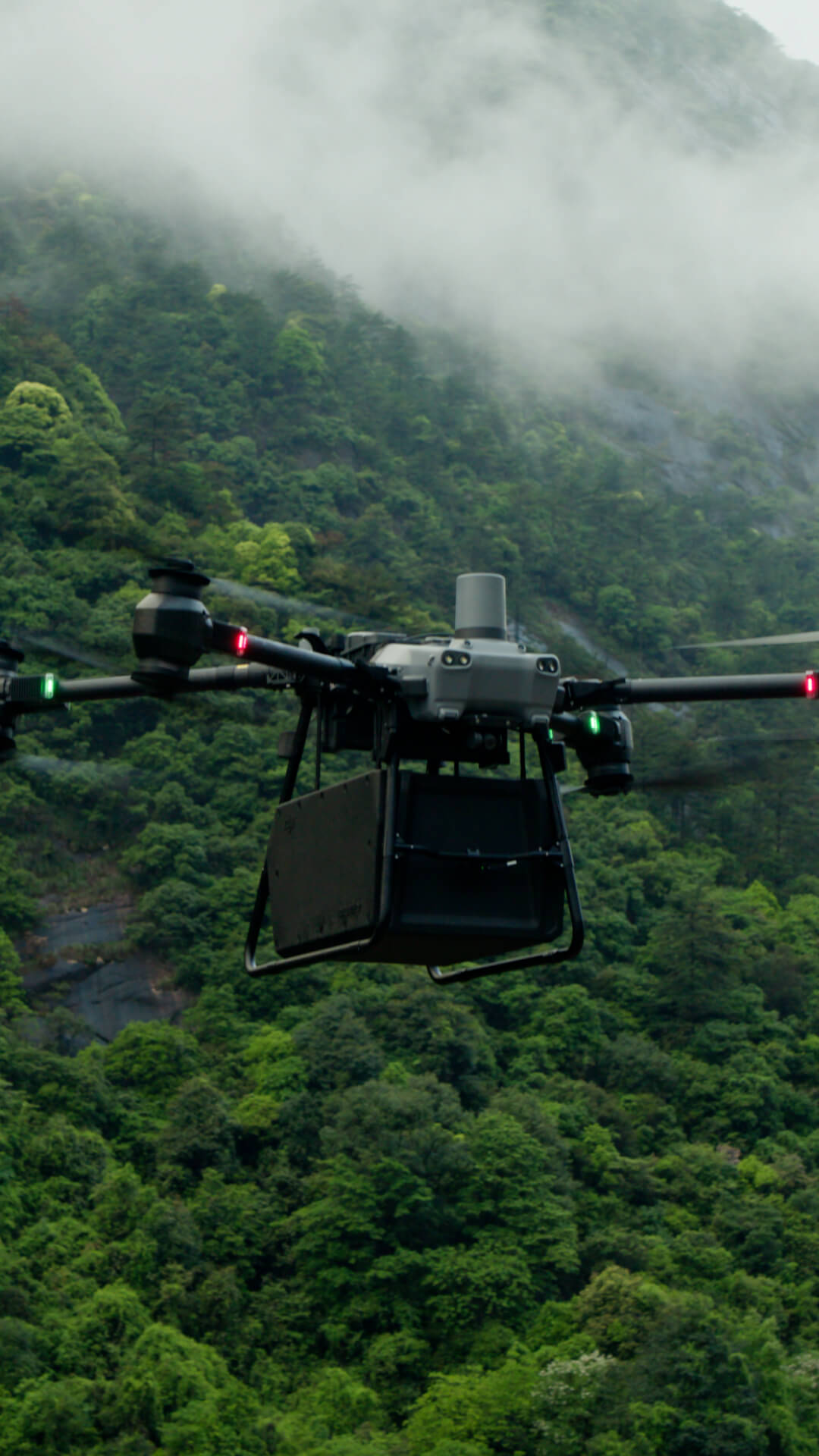
Start with the Canadian mission, not the Amazon headline.
A mine, utility, construction site or remote community may have a genuine cargo problem without needing a residential e-commerce network. For those projects, the useful questions are payload, route, terrain, handoff method, weather, communications, approvals and operating frequency.
DJI's figures come from controlled conditions and require configuration-specific planning. The optional FlyCart 30 Winch Kit changes the handoff workflow; it does not remove the need to validate the route, load, people, site and authority.
Technically imaginable is not the same as announced or authorized.
Amazon's August expansion plan is U.S.-focused. It does not announce a Prime Air launch date, service area, price or operating approval for Canada.
Exact operation category
Canada's lower-risk BVLOS pathway has defined limits. A residential delivery concept must be assessed against the actual aircraft, route, population exposure and operating model.
System requirements
Aircraft and supporting systems need the declarations, evidence and technical capabilities required for the proposed operation.
Route integration
Urban and suburban service must account for aerodromes, controlled airspace, traffic, obstacles and route constraints.
Other aircraft
Transport Canada states that short-range obstacle avoidance is not automatically a detect-and-avoid system for BVLOS operations.
Site and public acceptance
Noise, privacy, local land use, flight frequency and delivery-zone expectations shape whether routine service is workable.
Winter and economics
Wind, precipitation, icing risk, daylight, staffing, maintenance and demand density affect the real Canadian service window.
Define the logistics outcome before choosing the aircraft.
Amazon's expansion is useful because it exposes the full stack required for routine delivery. Canadian buyers can apply that discipline even when the mission, platform and scale are completely different.
Document the cargo, dimensions, weight, centre of gravity, handling risk and delivery method.
Measure origin, destination, distance, elevation, obstacles, airspace and alternate landing options.
Model missions per day, turnaround time, charging, loading, maintenance and seasonal downtime.
Assign pilot, operator, loader, supervisor, maintenance and emergency responsibilities.
Decide how orders, route planning, aircraft status, proof of delivery and records will connect.
Map the exact concept of operations to current Transport Canada requirements before promising service.
Amazon drone-delivery expansion questions
Does Amazon Prime Air already serve 500 U.S. cities?
No. Amazon announced a plan to reach nearly 500 U.S. cities and towns by the end of 2026. It is an expansion target, not a statement that all those communities or every address inside them already have active service.
How fast is Amazon drone delivery?
Amazon says eligible customers could receive deliveries in as fast as 30 minutes. Actual timing depends on item eligibility, address, delivery-zone suitability, weather, aircraft availability and local operations.
How much can the Amazon MK30 carry?
Amazon states that the MK30 can carry packages weighing up to five pounds. That payload limit is one reason Prime Air is best understood as a fast option for selected lightweight orders, not a replacement for general parcel delivery.
Will Amazon drones replace delivery vans?
The expansion does not prove that drones will replace vans. Amazon continues to invest in its fulfilment centres, trucks and other delivery methods. Drones are a specialized option inside a much larger logistics network.
Why does "500 cities" not mean universal coverage?
One launch site may serve parts of several communities, while service still depends on range, airspace, eligible addresses, suitable drop zones, item weight, weather and available operating capacity.
Is Amazon Prime Air coming to Canada?
Amazon's August 19 announcement focuses on U.S. expansion. It does not provide a Canadian launch date, service area, price or regulatory authorization, so none should be inferred from the U.S. plan.
Is DJI FlyCart 30 an alternative to Amazon Prime Air?
Not as a like-for-like consumer service. FlyCart 30 is an enterprise cargo platform for defined logistics missions, while Prime Air is an Amazon-operated last-mile network. The correct choice depends on the mission and operating model.
What should a Canadian cargo-drone project define first?
Start with cargo type, dimensions and weight; origin and destination; route distance and terrain; delivery frequency; site access; weather; communications; handoff method; crew; and the applicable Canadian operating authority.
Sources checked
- Associated Press: Amazon set to expand drone delivery of lightweight packages to 500 U.S. cities, August 19, 2026
- Amazon: Andy Jassy's 2025 Letter to Shareholders, Prime Air scale and timing targets
- Amazon: official Prime Air fulfilment, flight and delivery workflow
- Amazon: MK30 certification, BVLOS approval and onboard detect-and-avoid
- U.S. FAA: public involvement and environmental review for drone operations
- DJI: FlyCart 30 payload, Cargo Case, Winch and controlled-condition specifications
- Transport Canada: 2025 summary of lower-risk BVLOS and medium-RPAS rules
- Transport Canada Drone Zone: obstacle avoidance versus detect-and-avoid
Checked August 19, 2026. "Nearly 500 cities and towns," year-end timing, delivery speed, current-site count and delivery totals are announcement-era figures or targets and may change. "Infrastructure" is an editorial frame, not a formal Amazon product designation. This article does not claim Canadian Prime Air availability or authorization. DJI specifications are manufacturer maximums measured under stated conditions; project performance and legal authority depend on the exact configuration and operation.
Planning a drone cargo or remote logistics project in Canada?
Bring SpeedyDrone the cargo type, dimensions and weight, origin and destination, distance, frequency, terrain, site access, pilot and operating capability, communications and planned timeline. We can help frame the aircraft, Winch, battery, workflow and support discussion around the real mission.


