


DJI Enterprise Integration Reference
MQTT, EventAPI, OpenAPI, file synchronization and livestream forwarding—what each connection is for and how to choose.
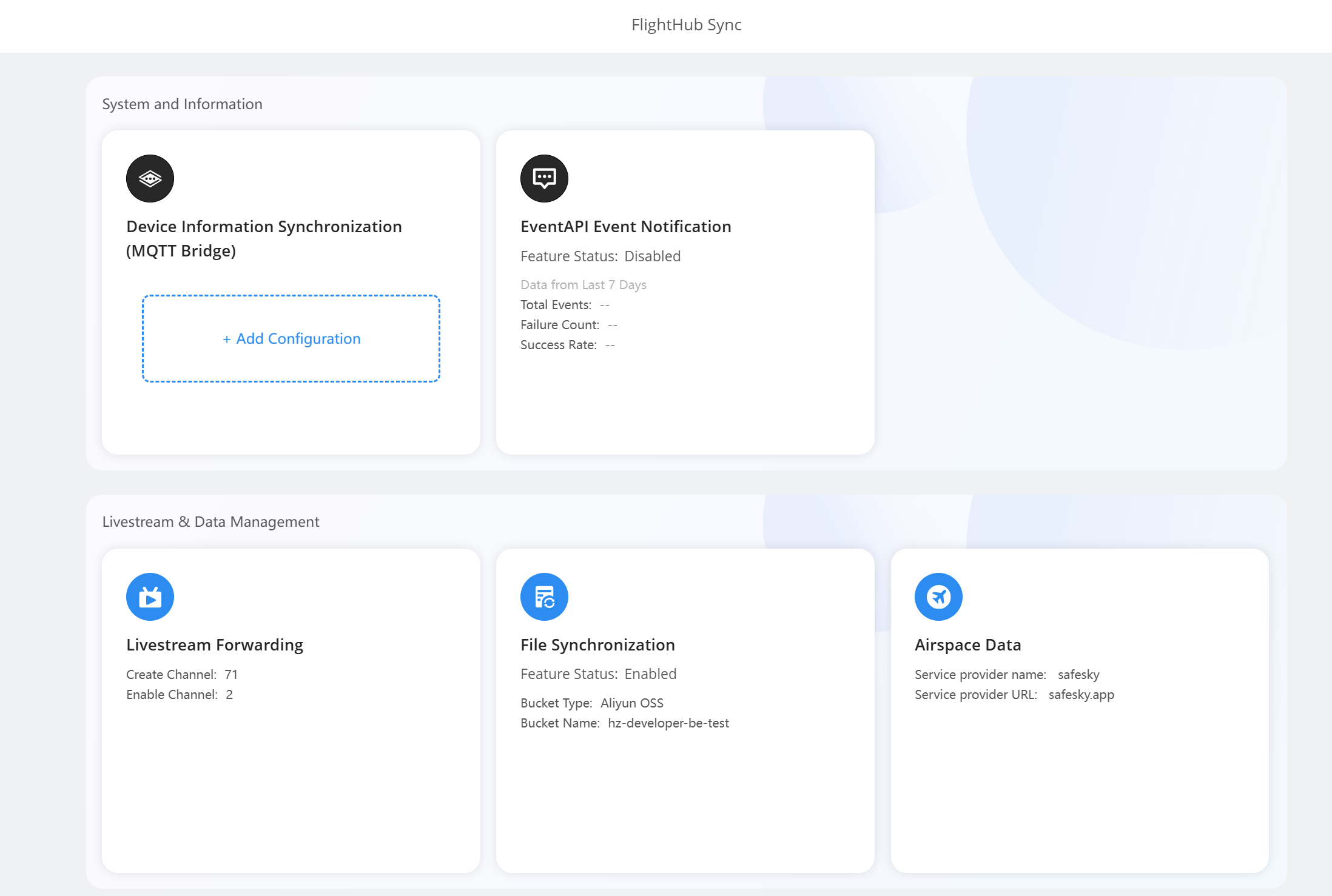
DJI FlightHub Sync is the integration layer between FlightHub 2 and a third-party cloud, operations platform or storage environment. It is not one API. It groups several connection patterns that move different kinds of information: MQTT for telemetry, EventAPI for business events, OpenAPI for requests and actions, File Sync for files, and livestream forwarding for video.
MQTT = state. EventAPI = events. OpenAPI = queries and actions. File Sync = files. Livestream Forwarding = video. Most enterprise deployments use more than one of these paths, but they should not be treated as interchangeable.
FlightHub Sync integration decision matrix
| If the requirement is… | Start with | Typical third-party destination | Important boundary |
|---|---|---|---|
| Continuous Dock or aircraft telemetry | MQTT / MQTT Bridge | GIS, IoT dashboard, operations centre | Available fields follow DJI's current device model |
| A notification when a meaningful event occurs | EventAPI | CMMS, alerting, workflow automation | Downstream work orders or chat alerts are your integration, not built-in DJI actions |
| Query or manage FlightHub resources | OpenAPI | Custom business application | Authentication and exposed modules differ by deployment |
| Move media, routes, models or records | File Synchronization | S3-compatible storage, archive, data lake | Direction and deletion rules differ by file type |
| Send drone video to another platform | Livestream Forwarding | VMS, command centre, broadcast platform | Consumes FlightHub livestream minutes |
| Use an external identity workflow | OAuth / SSO review | Corporate identity system | FlightHub Sync OAuth is On-Premises only; Public Cloud SSO is a separate capability |
| Display third-party traffic information | Airspace Management | Supported airspace provider | Situational awareness is not flight authorization |
What changed in September 2026?
DJI's September 1, 2026 documentation says FlightHub Sync Beta completed public beta and was upgraded to FlightHub Sync. Current users can continue with the legacy entry, but DJI tells new users to use the current Sync service. The current product surface covers public-cloud and on-premises integration for files, livestreams, telemetry, EventAPI and third-party airspace data.
There is one migration caveat. DJI's new introduction says the Beta API functions have OpenAPI equivalents, while the separate legacy API-services page still labels several old interfaces as “Migrating.” The safe architecture decision is therefore not to assume that an old endpoint can be carried forward unchanged. New work should start with the current OpenAPI, EventAPI and Sync documentation; an existing implementation should be mapped endpoint by endpoint before retirement.
Public Cloud and On-Premises are not identical
| Capability | FlightHub Public | FlightHub 2 On-Premises |
|---|---|---|
| Livestream Forwarding | Supported | Supported |
| File Synchronization | Supported | Supported |
| Device telemetry | MQTT protocol push | MQTT Bridge |
| EventAPI | Supported | Supported |
| Third-party OAuth in Sync | Not supported | Supported |
| RTMP / RTSP forwarding | Supported | Supported |
| GB28181 forwarding | Not listed | Supported |
| Frontend Components | Not supported | Supported |
| Infrastructure owner | DJI cloud | Customer environment |
“On-Premises” should not be read as an automatic recommendation. It adds infrastructure ownership, network design, upgrades and operating responsibility. The correct choice depends on data governance, integration depth, internal skills and procurement—not on the number of check marks alone.
MQTT: continuous device telemetry
MQTT is the path to examine when another system needs a continuously changing view of Dock or aircraft state. A utility might place drone telemetry beside asset, weather and outage data in its GIS. A security operations centre might display aircraft availability and position in the same dashboard as fixed cameras. The third-party system still has to interpret DJI's current device-model fields and handle unavailable or stale values.
Public Cloud MQTT push
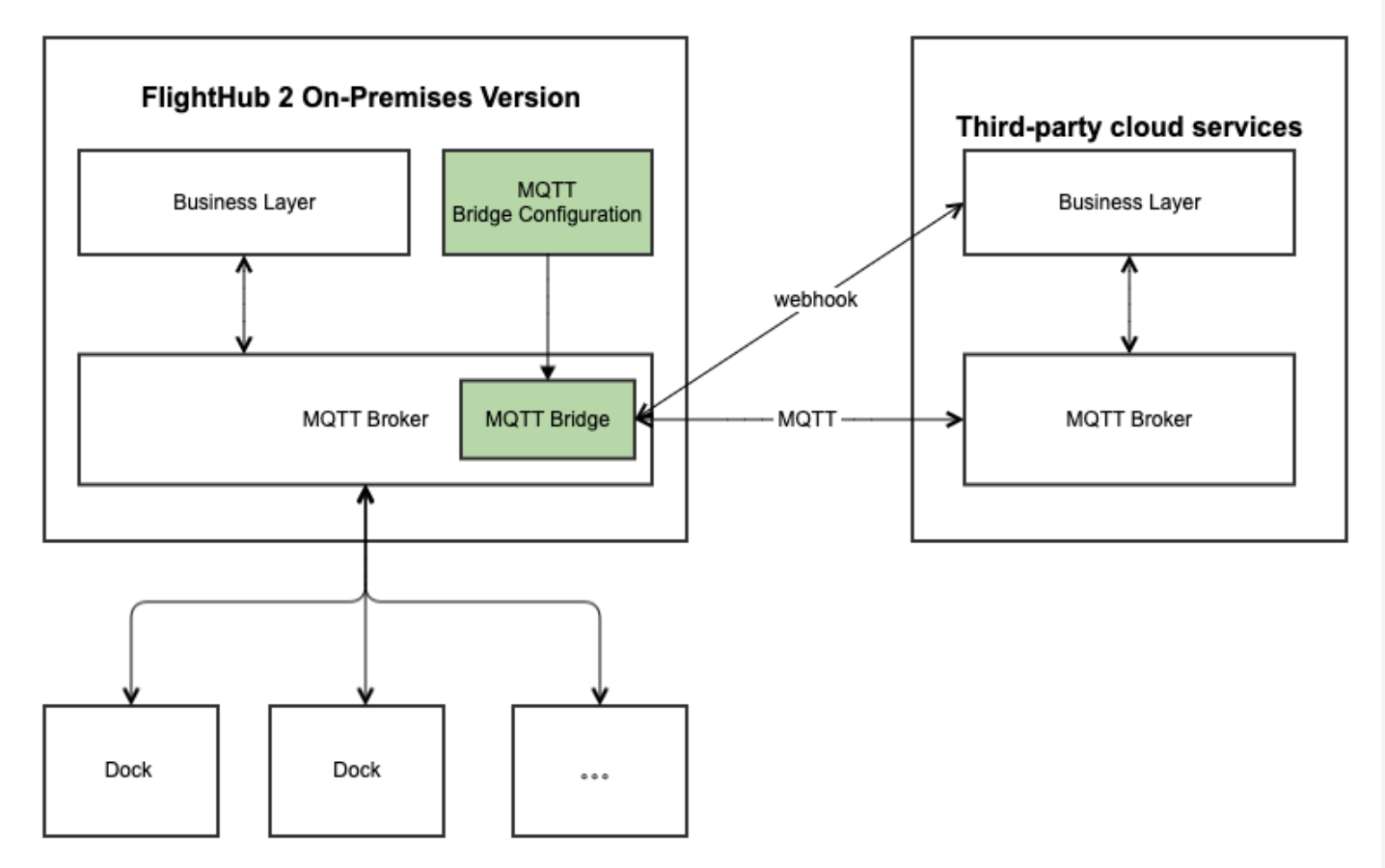
In the public version, FlightHub Sync can push telemetry in real time to a configured third-party MQTT broker. DJI's current setup asks for TCP, a host, port, username and password. That makes broker availability, credential rotation, network controls and monitoring part of the customer's design.
On-Premises MQTT Bridge
On-Premises uses MQTT Bridge to forward Dock MQTT information into the third-party environment. DJI's current bridge documentation identifies MQTT v4 and says EMQX is the broker it has tested; compatibility with another broker must be tested by the customer. The relevant networks, MQTT service and webhook path also have to be reachable through the customer's firewall design.
EventAPI: business events without constant polling
EventAPI is the active-notification path. Instead of a customer application repeatedly asking whether something changed, FlightHub pushes subscribed business events to the configured endpoint. DJI currently documents selectable event types, organization-wide or project-specific scope, HMAC-SHA256 signature validation, delivery from a fixed source IP, seven days of delivery logs and CSV export.
A work order, Teams message, Slack alert or GIS update is an example of what a customer's middleware can do after receiving the event. Those are not native FlightHub EventAPI actions. Production design should verify the HMAC signature, reject stale or malformed requests, make event processing idempotent, retain the original event and provide a retry/dead-letter strategy beyond DJI's visible audit window.
| Decision point | MQTT | EventAPI |
|---|---|---|
| Information pattern | Continuous state / telemetry | Selected business event |
| Delivery model | Streaming through a broker | Event-driven HTTP push |
| Typical use | Live fleet or asset dashboard | Workflow trigger or incident notification |
| Security focus | Broker authentication and network path | HMAC verification, source validation and replay-safe handling |
File Synchronization: more than media backup
FlightHub Sync can connect projects to AWS, Alibaba Cloud or self-hosted S3-protocol storage such as MinIO. The capability is broader than copying photographs: DJI's current matrix covers media files, routes, models, flight records and annotation information, with different direction and retention rules.
| Data type | FlightHub → third party | Third party → FlightHub | Auto-delete source in FlightHub |
|---|---|---|---|
| Media files | Yes | Yes | Available |
| Flight routes | Yes | Yes | Not available |
| Models | Yes | Yes | Available |
| Flight records | Yes | No | Available |
| Annotation information | Yes | Yes | Handled through OpenAPI |
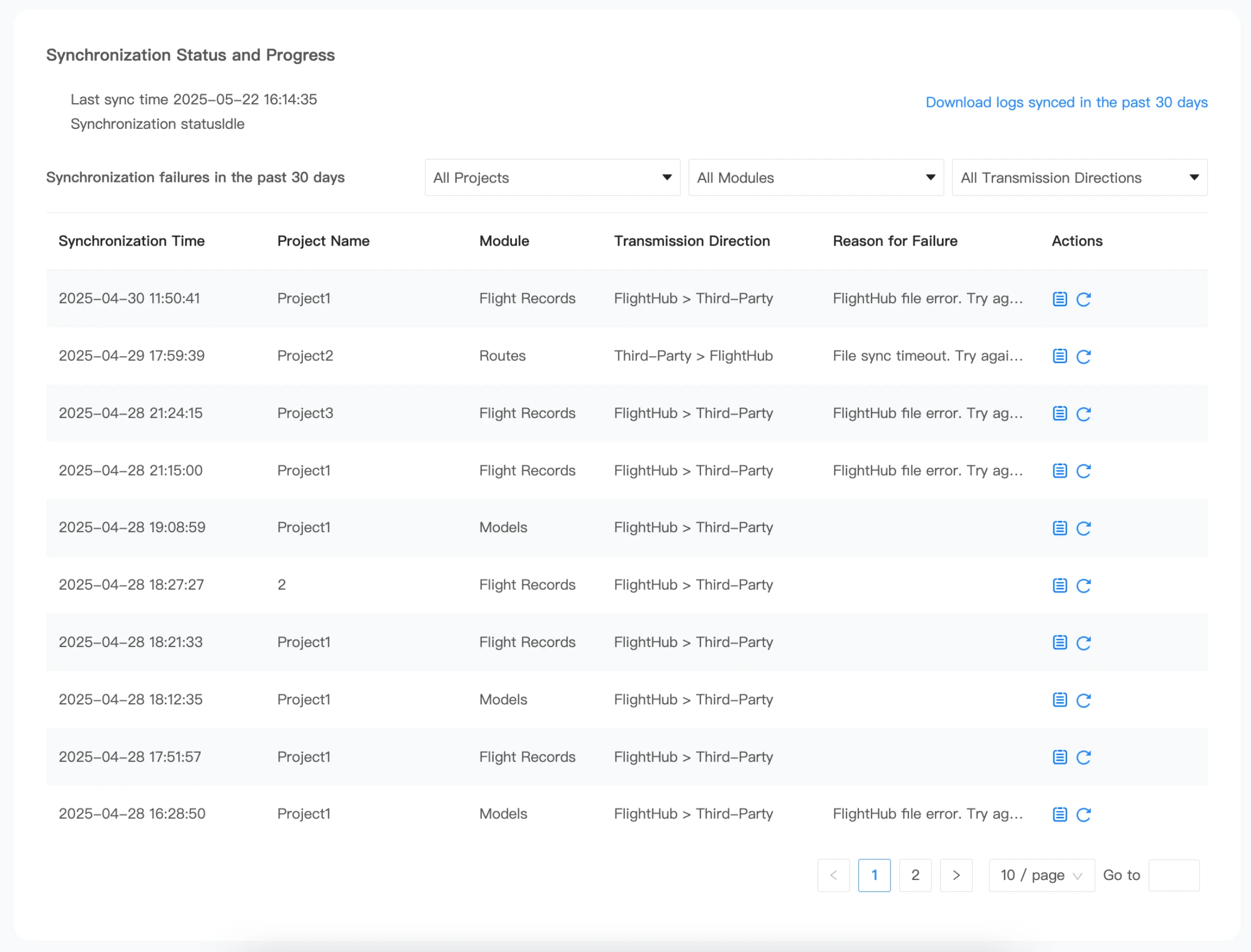
DJI notes that synchronized files are fully packaged, so the object stored on the third-party platform can be larger than the original in FlightHub. A project can belong to only one custom synchronization rule at a time, while an organization can hold up to 20 storage-bucket configurations. A storage configuration can be reused by multiple rules.
Auto-delete is an irreversible retention decision
When auto-delete is enabled, FlightHub waits for a 200 OK response from the third-party storage before deleting the source. That handshake is useful, but it is not proof that the file is recoverable, replicated or retained correctly. DJI warns that deletion can affect Virtual Cockpit alerts, flight logs and Analyzer features that depend on those files, and that the action cannot be undone.
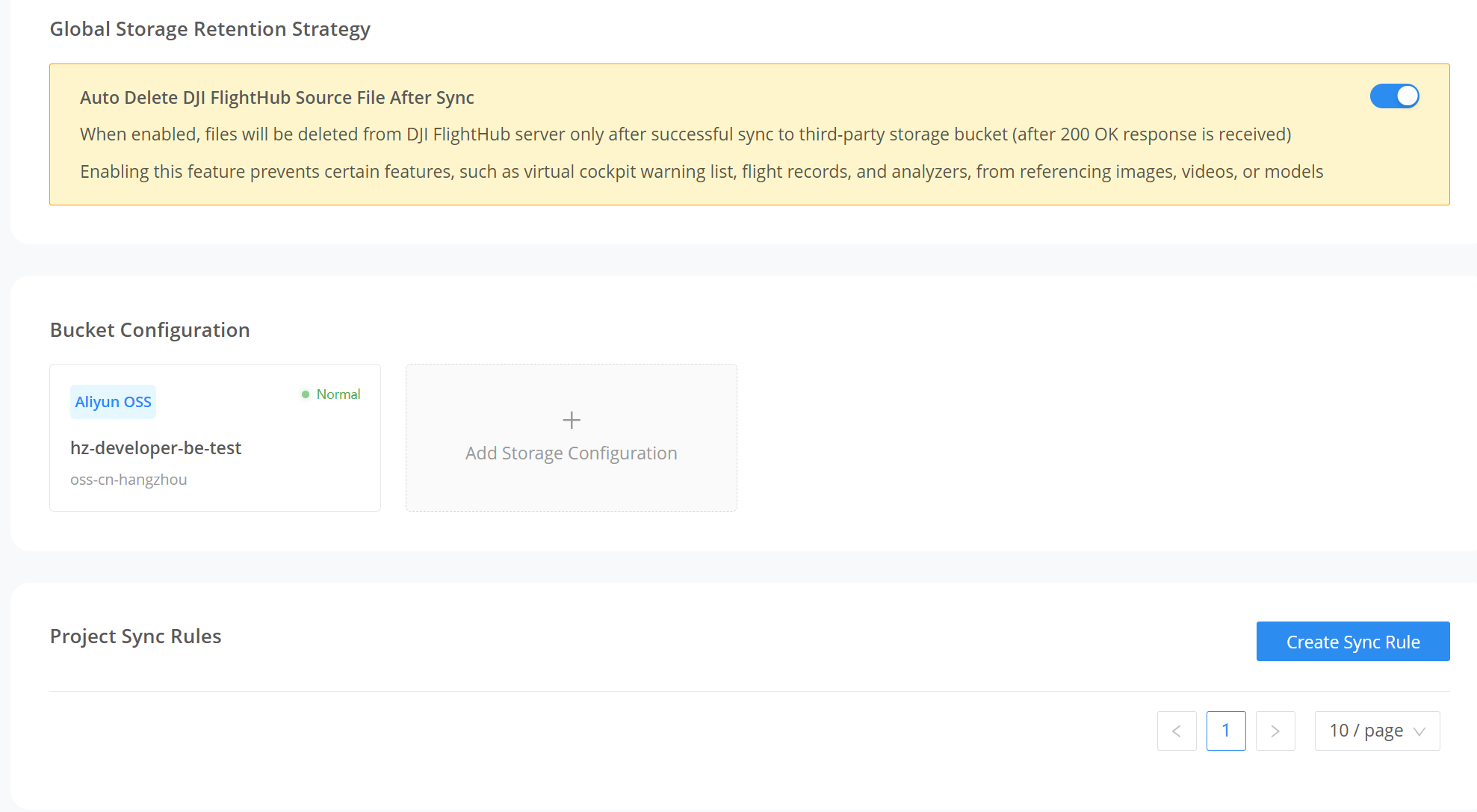
FlightHub exposes current synchronization status, failed files and error information, and allows download of the previous 30 days of sync history. Enterprise operations should export or ingest what they need for longer audit retention rather than treating a 30-day operational log as the complete compliance record.
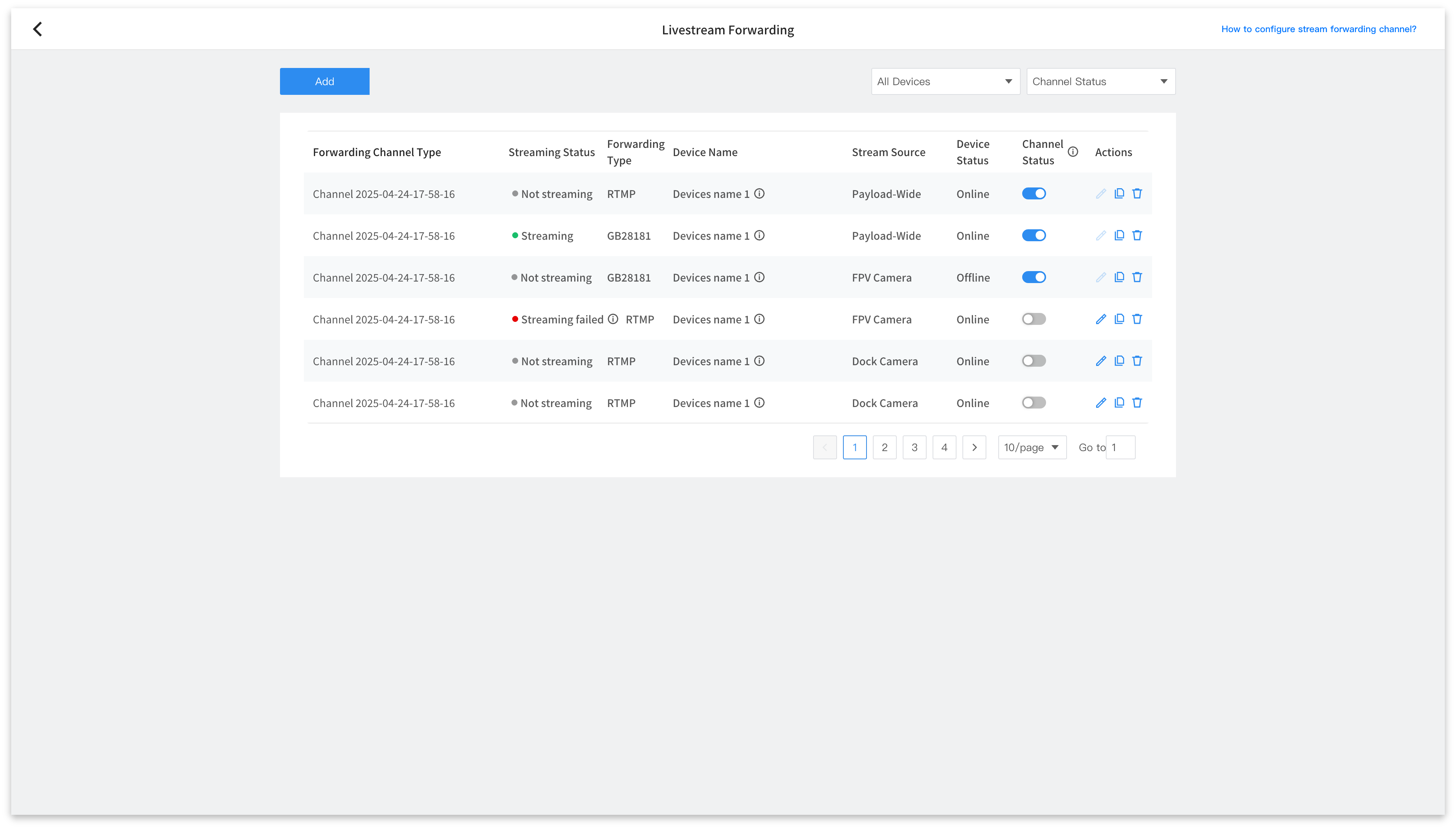
Livestream Forwarding: RTMP, RTSP and GB28181
Livestream Forwarding moves an aircraft, payload or Dock camera feed into another video environment. DJI lists RTMP and RTSP for both Public Cloud and On-Premises. GB28181 is an On-Premises option and is more relevant to specific surveillance architectures than to a typical Canadian deployment.
| Protocol | Public Cloud | On-Premises | Planning note |
|---|---|---|---|
| RTMP | Yes | Yes | Push-style channel to a configured server |
| RTSP | Yes | Yes | Pull clients affect public-cloud minute usage |
| GB28181 | No | Yes | Deployment-specific surveillance integration |
RTSP has an operational wrinkle: DJI says the address is not retained after streaming stops. A later restart requires a new address to be obtained and updated on the third-party platform. Integration runbooks should therefore avoid assuming a permanently reusable RTSP URL.
Plan livestream minutes before deployment
Forwarded video consumes the organization's FlightHub livestream minutes. Current DJI billing documentation says an RTMP forwarding channel is charged by actual streaming duration, while RTSP is charged by the number of pull clients multiplied by duration. For example, one RTSP stream pulled by five clients consumes five livestream minutes per minute. The legacy transcoder workflow also counts each created transcoder independently until it is deleted.
That means “one aircraft feed” is not a complete estimate. Model channels, duration, concurrent RTSP clients, human viewers and any separate AI or recording use. SpeedyDrone's FlightHub 2 multi-site operations guide covers the broader resource-planning context.
OpenAPI: active queries and business actions
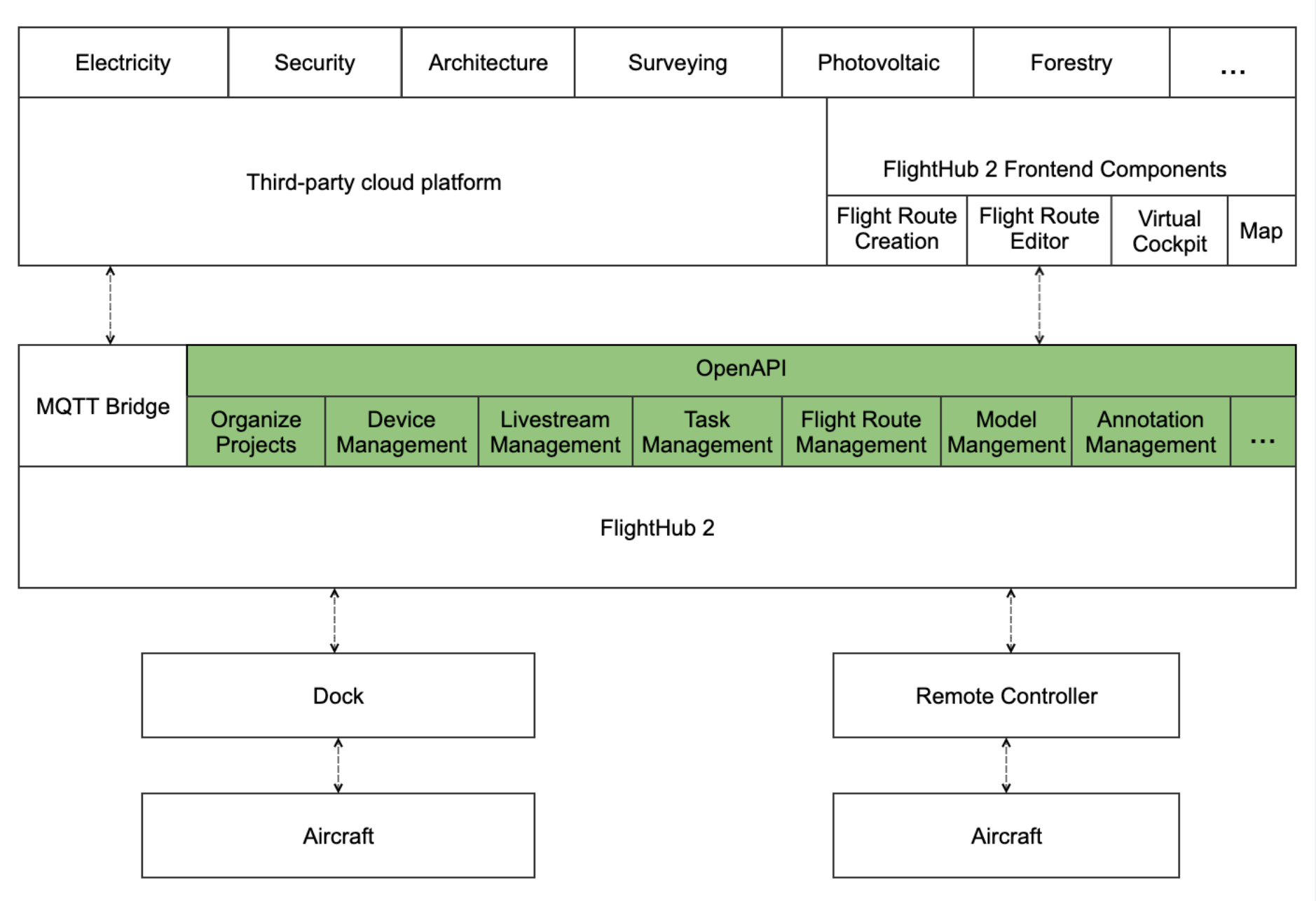
OpenAPI is the request-driven layer for a custom application that needs to retrieve or manage FlightHub resources. Public Cloud OpenAPI V2.0 covers organizations, projects and members, devices, flight tasks, livestreams, routes, reconstruction and related data. On-Premises V2.0 is deeper: DJI says it now exposes more than 300 interfaces, compared with 67 in V1.0, across devices, tasks, real-time control, livestreams, media, models, routes, map data and other modules.
The number of interfaces is not a reason to expose them directly to a browser. Put credentials and authorization logic behind a server-side integration layer, enforce least privilege, audit business actions and separate read-only monitoring from control paths. The exact operation list and permissions should be checked against the current interface documentation at implementation time.
OAuth, SSO and third-party airspace
In the current FlightHub Sync matrix, third-party OAuth is available for On-Premises and not for Public Cloud. DJI's wider feature comparison separately lists Enterprise SSO for Public Cloud. These labels belong to different deployment and identity flows; a requirement for corporate login should be validated against the exact public or on-premises edition instead of assuming “OAuth” and “SSO” are synonyms.
Third-party airspace management is listed for both deployments. DJI's current Sync documentation names SafeSky as the supported provider and describes an API-key connection that can show nearby aircraft movement, combine it with DJI AirSense data and issue collision-risk alerts. This is situational awareness. It is not Transport Canada authorization, air traffic control or proof of an approved detect-and-avoid solution.
Four practical integration patterns
Utility GIS
MQTT places Dock and aircraft state beside assets and weather; EventAPI opens an exception workflow; File Sync sends evidence to the organization's archive.
Security command centre
Livestream Forwarding feeds an existing VMS while EventAPI notifies the incident platform. FlightHub remains the drone-operations system, not a replacement VMS.
Construction data pipeline
Media and routes move to object storage for processing and retention. OpenAPI connects project status to the customer's reporting application.
Custom operations platform
A server-side service combines OpenAPI requests, MQTT state, signed EventAPI events and storage references behind the customer's own role model and interface.
Architecture mistakes to avoid
Where SpeedyDrone fits
FlightHub integration decisions are inseparable from the aircraft, Dock, network and operational workflow. SpeedyDrone can help define the deployment boundary, product stack and vendor questions before a customer commits to custom development. That may include DJI Dock 3, a Matrice 400 SP Plus Full Package, FlightHub licensing and the systems that will consume telemetry, events, files or video.

DJI Dock 3
Automated deployment hardware commonly used in connected FlightHub operations.
View DJI Dock 3 →
DJI Matrice 400
Enterprise aircraft package for complex missions and connected operations.
View Matrice 400 package →For mobile dispatch and field-side limits, use the DJI Enterprise App guide. For the wider FlightHub platform and resource model, start with the multi-site guide linked above.
FlightHub Sync FAQ
What is DJI FlightHub Sync?
It is FlightHub 2's integration layer for connecting public-cloud or on-premises deployments with third-party systems. Current capabilities include telemetry, events, file synchronization, livestream forwarding and third-party airspace information.
Is FlightHub Sync still in beta?
No. DJI states that FlightHub Sync Beta completed public beta and was upgraded to FlightHub Sync on September 1, 2026. Existing legacy implementations still need a migration review.
Does FlightHub Sync support MQTT?
Yes. Public Cloud can push device telemetry to a third-party MQTT broker. On-Premises uses MQTT Bridge to forward Dock MQTT information into the customer's environment.
What is the difference between MQTT and EventAPI?
MQTT is suited to continuous device state and telemetry. EventAPI sends configured business events when they occur. A live dashboard often uses MQTT; a work-order or alert workflow often starts with EventAPI.
Can FlightHub send media to our own cloud storage?
Yes. DJI currently supports AWS, Alibaba Cloud and self-hosted S3-protocol storage such as MinIO. Media, routes and models support both directions; flight records are outbound only, and annotation information uses OpenAPI.
Is it safe to enable automatic source deletion?
Only after a tested retention and restore design. DJI deletes eligible FlightHub source files after the third-party storage returns 200 OK, but deletion is irreversible and can affect FlightHub features that reference the files.
Can FlightHub forward video into a VMS?
FlightHub Sync supports RTMP and RTSP for public and on-premises deployments, while GB28181 is listed for On-Premises. Compatibility, latency, address handling and monitoring must be tested with the destination platform.
Does forwarded video consume livestream minutes?
Yes. RTMP is counted by forwarding-channel duration; RTSP public-cloud billing is based on pull clients multiplied by duration. Legacy transcoders also count independently until stopped.
Should a new integration use the old FlightHub Sync API?
DJI directs new users to current FlightHub Sync and EventAPI. Use current OpenAPI documentation for new development, and map every legacy endpoint before changing an existing implementation.
Plan the integration before writing code
Tell SpeedyDrone what must move—telemetry, events, files, video or business actions—and which systems must receive it. We can help frame the FlightHub, Dock, aircraft and implementation questions for your enterprise team.
Request an enterprise integration assessmentSource note: Product behavior was checked against DJI's current FlightHub Sync introduction, Public Cloud OpenAPI V2.0 guide and billing instructions on September 25, 2026. Interfaces, supported providers, billing and migration status can change. Recheck the current DJI documentation and your exact subscription/deployment before implementation.


